
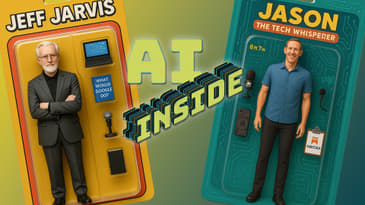


Jeff Jarvis and Jason Howell dive into this week’s AI headlines: OpenAI prototypes a ChatGPT social feed, GPT-4.5 retires as GPT-4.1 arrives, OpenAI boosts memory and chat history features, Nvidia expands US chip production amid export control shakeups, Bill Gates predicts AI’s impact on teaching and medicine, ChatGPT Barbie Box memes challenge creative boundaries, Notion launches AI-powered email, Google’s DolphinGemma tackles dolphin communication, and “vegetative electron microscopy” becomes science’s latest digital artifact.
Support the show on Patreon! http://patreon.com/aiinsideshow
Subscribe to the YouTube channel! http://www.youtube.com/@aiinsideshow
Enjoying the AI Inside podcast? Please rate us ⭐⭐⭐⭐⭐ in your podcatcher of choice!
Note: Time codes subject to change depending on dynamic ad insertion by the distributor.
CHAPTERS:
0:03:52 - OpenAI is building a social network
0:08:38 - ChatGPT now has a section for your AI-generated images
0:10:34 - OpenAI’s new GPT-4.1 AI models focus on coding
0:13:16 - OpenAI's "agentic software engineer"
0:17:51 - ChatGPT can now remember and reference all your previous chats
0:24:02 - Nvidia says it plans to manufacture some AI chips in the US
0:29:09 - Bill Gates says AI is coming for 2 kinds of jobs that once seemed tech-proof
0:34:31 - ‘She helps cheer me up’: the people forming relationships with AI chatbots
0:41:13 - A.I. Action Figures Flood Social Media (Accessories Included)
0:47:28 - Notion Mail is a minimalist but powerful take on email
0:52:04 - DolphinGemma: How Google AI is helping decode dolphin communication
0:54:53 - Thought experiment in the National Library of Thailand
0:59:19 - A weird phrase is plaguing scientific papers – and we traced it back to a glitch in AI training data
Contact us with questions and feedback: contact@aiinside.show
Learn more about your ad choices. Visit megaphone.fm/adchoices
This is AI Inside episode 64, recorded Wednesday, 04/16/2025. Vegetative electron microscopy
doesn't exist. This episode of AI Inside is made possible by our wonderful patrons at
patreon.com/aiinsideshow. If you enjoy our content, please support us directly. Thank you for
helping independent podcasting thrive. Welcome to another episode of the AI Inside podcast,
where we explore the role of AI in today's technology.
I am just one of your hosts, fifty percent of the hosting on the show. The other 50% of the No.
You're at least 80%. You're I'm nearly 20%. It's everything is an eighty-twenty rule.
You're the 80, I'm the 20, but that's fine. Oh, boy. Here. No. I love having you here, Jeff.
It's good to see you. How have you been? Good to see you. Alright. How are you?
Yep. Doing alright. I'm still kinda feeling a little bit of the, like, post Yann LeCun, joy, I suppose. It
was it was so great that he, daint to speak to little old us because he's a big deal. And He is a
big deal.
And I'm I'm so glad that he he we got him, especially because I do quote him often. I do think
that he's a leader in this space, and so it was good to hear it from the horse's mouth. Yeah. And
I mean, I've been going through the interview so much over the last week as I've been working
to promote it and everything. Mhmm.
And what I realized in retrospect is during the interview, there's only so much that my brain
could comprehend Yep. From the detail and the logic that he was spilling out. It took me a few
listens through before I was like, okay. I really understand where he was going with this. And
man, is he brilliant.
Like, he just sets the scene and lays out the pathway for understanding, and all the information
that gets you from point A to point B. It's a really remarkable interview. People just check it out if
they haven't. A genius in AI, but he also is a hell of a teacher. Yes.
He's a great teacher. Because I was his student in that podcast. Right? And and and I learned
from him, and he's a patient, a clear, directed, professor. It's good to see he is that example.
Yes. Thank you once again, Yann LeCun. Yes. If you haven't seen it yet, folks, do watch it
because I think you'll find it really interesting and provocative. We hope to have him back, as he
will remain important in the future of AI.
So we'll hope for that. Before we kinda dive into things, a big thank you to our patron of the
week. That would be Jesse! Jesse, you are awesome. We appreciate you.
Patreon.com/aiinsideshow if you wanna hop on board and support this show behind the scenes.
And just real quick before we do kick things off, if you enjoyed the Yann Lacun interview, now is
a great time for you to go to Apple Podcasts. Just log in real quick and just drop a review. Give
us a rating. Give us a review.
Please refer to the interview. This is a great opportunity to boost the show's visibility, and we are
working on more interviews. We hope to continue with a mix of news and great interviews we've
planned. So that would be a big help. So thank you for that.
And then, yeah, why don't we just dive right into it? I could continue doing housekeeping, but we
got a lot of news to talk about. And once again, the first block is just OpenAI. It's like there's
always so much OpenAI. It's like I just feel like I need to, like, lump it all together.
Yeah. They're kind of an attention hog. Or well, is it are they the attention hog, or is that all the
media just I'll I'll I'll start off with them. I don't know what's chicken and egg in that case. I seem
to be badly blurring my metaphors.
They've become such a prominent and recognisable voice in recent years that it's hard not to
notice when they release something new. And, yeah, as far as media is concerned, guaranteed
to get clicks on that. Right? Oh, yeah. I mean, we we talked about the mafia.
I think I think perplexity is cleverer at coming up with promotional ideas. Mhmm. OpenAI is the
obvious yet unspoken topic that everyone has to consider. 100%. Plus they do their own stunts
like this story.
Yeah. Well, so and and this is something that's happening apparently behind the scenes. We
don't have, at least last I checked, we don't have any official acknowledgement of this
happening. But I believe it's the information has, oh, no. Sorry.
It was The Verge, The Verge. OpenAI is developing an early internal prototype of a chat GPT
image product that incorporates a social media feed. Sam Altman has previously hinted on
Twitter/X about a potential social platform, suggesting, "Maybe we should get into social." If he
mentioned this at that time, he might have been planting the seeds for public response and
reaction. This seems like a great approach. Twitter X's Grok can utilise all the real-time
user-generated data as it comes in. You know?
It gets that really valuable source of information. Meta is reportedly working on bringing a social
feed to its AI products. Not to mention, you know, it has a social feed that it can integrate its AI
into, so it works in both ways. And so it seems like maybe OpenAI is saying, hey.
User-generated real-time data provides valuable insights at no cost.
It could just be ours. Why can't it just be ours? That's my take. So kudos to Kylie Robison and
Alex Heath at The Verge for the reporting here. But I don't know.
I wonder whether this is just a way for Sam Altman to poke two fingers into Elon Musk's eyes
and say, "You got a social network?" I can do that too." The same applies to Zuckerberg and
Meta. You've got social network, I can do that too. Social is hard.
Yeah. It is. People are difficult. People are a problem. And so, I'm not so sure if they really can
bite this off.
I think it's "I, I so so if if they're not serious, kudos for a good slapback at Elon." If they are
serious, watch out. This is hard. And we've certainly one thing we have learned about AI over
the last five years is it's not good at moderation. Mhmm.
It doesn't really understand context. It doesn't really understand, and that's not just LLMs.
Obviously, there have been other mechanisms that Facebook has relied on AI to moderate.
Mike Masnick's impossibility theorem asserts that large-scale moderation is fundamentally
unachievable. And so, colour me dubious about this.
I think that either it's a it's a stunt or they're gonna if they try it, they're gonna find out quickly
how difficult it is. And you're right, Jason, that Grok does have a ready-made supply of
conversation as does Meta. Mhmm. But it's stilted conversation. It's weird conversation.
If you're trying to train I mean, you know, look at Tay Yeah. It's true. Back in the day. Right?
Microsoft.
If you're trying to train a general machine to be intelligent, I don't know if social media is where
you go to get intelligence. Well, especially a social media platform that works in little bites and
chunks as opposed to Yeah. Longer and I guess, you know, they they have that ability. If you
are a verified user, you have the ability to write longer posts, and I see those all the time as well.
But, yeah, certainly, I would imagine on a platform like x has to work harder to get the overall
context of understanding around a particular thread or around 500,000 people commenting on,
you know, or replying to a single tweet.
You know, it's there's a lot more complexity there, I would guess. Yeah. Content, social scientists
who try to do content analysis on social media find it extremely difficult because it's you have it's
you don't have much context, you don't have length. Broken. Just trying to do a subject analysis
and and, emotional analysis is very hard.
So, okay. Alban got his story of the day, and we needed to do it. And it was I I agreed. It's the
lead story, I think, for for this week, but, file it under we'll see. Yeah.
Yeah. I'll just say two more quick things. OpenAI did you know, related to this, I think OpenAI did
open up a section or is opening up a section for library access to your previous images. And
part of this kind of leak, rumor, you know, sources say story from The Verge is about how this
would be tied to an image platform of OpenAI. So, you know, is this the germ of that?
I don't know. And then I will the other thing is that this really reminded me of another AI service
that I have used in the past, let me see if I can get there, Called Ideogram, which has been
around for a couple of years now, but it kind of is an image generation social platform. You can
go in here and you can create images, and then you can add, you know, your likes. You can go
ahead and like it. I don't know if they have any sort of comment thread, but it has a little bit of
that.
And I wonder if, like, even if it's just something like that, like, we have this gallery for the images
that you've created, and other people can, like, hit a heart and say, I like that. You know? That's
a social element without going too too deep. I'm I'm glad you went there because it because it is
interesting that, and I write about this in my next book about the linotype, we kind of move to a
post alphabetic world. Not that we don't get rid of the we don't get rid of the alphabet, but we
also have emoji.
We also have memes. We also have video. And creating these graphic elements does require
some experience with more complex tools. So if you can tell the machine what you want to say
and how you want it to say it graphically, that is a new, layer on social potentially. Yeah.
Yeah. A new way people can converse through images. That's interesting. For sure. For sure.
Alright. Continuing on, with the cavalcade of OpenAI, a small collection of other stories that we
can probably bounce through maybe reasonably quickly. Soon, you can say goodbye to
ChatGPT 4.5. They're sunsetting that in the API to make room for the newest model, ChatGPT
4.1. I'm so confused.
It's weird. I don't understand why you do that. This goes to the the maybe there's some sort of
explanation out there, and I just missed it. But this doesn't make any sense to me that you go
backwards in your versioning. The you know, OpenAI has admitted or rather, I think it was
Sarah Friar in an interview, which we'll talk about in a second, even admitted in that interview
that, like, OpenAI is not that great when it comes to marketing.
Or maybe she's just being self deprecating, because it benefits the company to do that. But, this
doesn't the the numerology of this doesn't make any sense to me. Right. But seven hundred
seven hundred fifty thousand words of context right around there with GPT 4.1. The article on
TechCrunch points out this is more than the entirety of war of war and peace, so there's that.
OpenAI says that it excels at coding and following instructions. We'll talk about coding in a
second. They do admit, though, that it becomes less reliable the more input tokens it has to
manage. So, for example, its accuracy with 8,000 tokens is right around 84%. Its accuracy with
1,000,000 tokens is right around 50%.
So can it handle more context? Yes. Can it handle it well? No. These systems still can't.
50% is not good No. In my opinion. Not usually It gets a failing grade and and Failing good. Far
far beyond failing. Yeah.
Yeah. Yeah. And it and it does go it is interesting that they're being open about this because it's
it's the problem of scale here. Totally. And the idea that ever bigger models is a solution to
everything, not necessarily.
Mhmm. Mhmm. Yeah. I guess I give them credit for for at least acknowledging that. I mean, I
guess they have to kind of spell out, you know, some of these stats because people will ask
them eventually and everything.
But you're basically admitting that, like, it can do all these things, but it can't do it really well yet.
Yeah. But I think also OpenAI believes that everything in AI is shifting is shifting ground. It might
not be able to do it now, but we believe it will be able to do it in the future. So 50% now might
not sound great, but we're getting there and we will.
Close Enough for AI is the new Close Enough for Jazz. Right. Exactly. I think we even had that
as a title on this show at one point because it's so appropriate. It's so appropriate.
You put in a link, that I that I mentioned just a few minutes ago. CFO Sarah Friar speaking at
Tech Summit last month in London about agentic software engineer. And I don't really have a
clip pulled. I'll just kinda, you know, show, you know, the video of this running. You can go on it.
I think I think I'd I it was it had the start point of what she was talking about. Oh, did you put the
start point? I hope that I I think so. Hold on. Retained that.
Oh, you know what? Probably 06/1966. So if you have to reload it and start it, I think you'll hear
her on that. I'm going to have to dance a little bit to get this The sound on? On the screen.
So, while I do that, tell me a little something about why how you you found this or or something
like that. I forget who I I think it was, Benedict Evans, I think, who who's the fount of so much
knowledge in this area, I think linked to it. What what fascinates me is and we talked about this
many times. But in a weird way you have a profession that is eliminating itself, in terms of
coding. And there's that debate we've had on the show and many people have that no coding
doesn't die, but and this is an aid decoder.
Yeah. Yeah. Yeah. Yeah. Yeah.
But I think that, the idea of mom and dad, I want to be a computer programmer for the rest of my
life. And who makes the tools that do that? It was different. So I'm I'm writing about the linotype
machine Mhmm. That eliminated setting type by hand one letter at a time.
And the typographers who set type one letter at a time demanded that they they be in charge of
the Linotype. They said, okay. This new thing is gonna come. It's gonna eliminate jobs, but we
have to be in charge of it. It's ours.
And and that worked for about sixty years until computers came along and then they were done
doomed. Mhmm. Here, you have a general interest tool that anybody can use to program at one
definition or another, and I think it's bad for programmers. I just can't help seeing otherwise.
Yeah.
I mean, you know, then there is kind of the addendum to that, which is bad for programmers as
they exist right now. Yes. Do those roles transform and morph, you know, do the do the skills
that programmers now have allow or enable something even greater if combined with AI in the
future versus me just, what do they call it, vibe coding versus me just going on to one of these
things and saying, make me an app that does the blah blah blah. And I don't even know whether
the code is good or not. I just know that what I see in the final app is kinda doing what I asked
for.
I'm wondering if people who have the true skills of coding, you know, they have a deeper
understanding and deeper knowledge of what's actually going on here. And does that couple
with the power of AI better? Is it the behind the scenes that matters? Is it the is it the quality of
the code that matters? In certain kinds of applications, certainly it is.
But for a lot of it, no. It's the front of the scenes. It's your more product development. You're
more dealing with user needs and, design thinking and that kind of stuff. Right.
Right. I do have the the clip here. I can go ahead and play it. Hopefully, everybody can hear it.
Let's fire this up.
Dinner tonight, whatever you wanna do. And then the third that is coming is what we call a suite.
We are not the best marketers, by the way. You might have noticed, but a Gentec software
engineer. And this is not just augmenting the current software engineers in your workforce,
which is kind of what we can do today through Copilot.
But instead, it's literally an agentic software engineer that can build an app for you. It can take a
PR that you would give to any other engineer and go build it. But not only does it build it, it does
all the things that software engineers hate to do. It does its own QA, its own quality assurance,
its own bug testing and bug bashing, and it does documentation. Things things engineers hate
to do.
Like, when I hear that, there's a there's a small part of me that hears it from, like, a, test the
those those, like, those engineers that never wanna do the things we want them to do. Like Yes.
You know what I mean? Yeah. Yeah.
Like, now fine. We'll build a system that does all the things you don't like. You because you're
not good at it. Or she's or she's trying to say do it. I know we might eliminate your job, but at
least we'll eliminate parts of the job you don't like.
Yeah. Along with the rest of it. But there but here they are trying to brand this idea of the
agentic, software engineer. They're trying to, I think, say that we can put this power in the hands
of many. So Yeah.
Yeah. 100%. Yep. It's a very, very interesting, and I'm happy you put that interview in there
because that is a, it's a great clip, and I think it summarizes kind of the direction of what OpenAI
is really are, aiming for as they work into their coding directions. And then OpenAI has also
announced a big expansion of its memory customization capabilities, learning even more about
its users over time.
And memory is not something that's, like, totally new to ChatGibT. This was announced I can't
remember when it was. Sometime last year, I believe. But my understanding is that you often,
as a user, you had to ask for it specifically to remember certain things. You'd say, remember this
for you for me, and then it would know this about you, or it would know this is a preference that
you had or whatever.
It would sometimes make guesses, but really you had to kind of be driving it, and it was also opt
in. Now with these new changes, you can reference chat history is what they call at the tap of a
button. It uses all of your past chat history to form an even more comprehensive understanding
of who you are, what your preferences are, all that kind of stuff to hopefully tailor the the
ChatGPT experience more around what you expect to see when you use it. Yeah. I think this
memory piece is is is critical because you're not gonna be at the point where you have a a tool
that you can, count on again and again and again and again if you have to train it over and over
again.
Oh, for sure. And we're gonna see concerns about privacy and about corporate information and,
and so on. But this is necessary. You've gotta be able if it's gonna be your agent, it better be
your agent. And the only way it can be your agent is if it understands you well enough through
various structures.
And also if you wanna create something and build upon it, Dave Weiner who's who's a hero of
mine when it comes to technology, a creator of RSS and podcasting and outlining and early
blogger. Dave's amazing. So Dave's on Facebook. Dave's been having fun with a character he
created, kind of a of a of a technologist who looks a little bit like Mark Zuckerberg but really isn't
Mark Zuckerberg. And he puts him in all these different positions situations.
And he makes jokes about them and, it's fascinating to watch because he can do that only if he
can carry it over. I don't know if you can get to Dave Weiner's, Facebook feed. Let me see if Let
me see. Yeah. Find it here.
Try and check it out. I'm gonna see what the latest one is. Yeah. So he has, my programmer the
latest one is RAPOL 14. My programmer friend is continuing on his trail of tears through Europe,
having boarded a train in Milano Central, headed to, of all places, Luxembourg, where he
participates in a cheese eating contest representing the king of Denmark.
Okay. So it makes no sense. It doesn't matter. But you see this this this character with furrowed
brow, eating cheese on a train. He, there you go.
That's that's that one. Right. So then, what if we do I'm trying to see another one. It it does look
like an older, more French looking, Mark Zuckerberg. Yeah.
And, let me try to find if there's another one here I could get to. He does all kinds of things. Oh,
so if we go down to April 11, my programmer friend, plane lands in Milan on his way to Denmark
to help the king with his cobalt problem where he travels to Milan Central Station to wait for his
train to Copenhagen. Okay. There he meets somebody who looks a lot like I don't know who
that is.
Somebody having an Italian having coffee. The coffee is really weird because you can tell the AI
doesn't know what it's doing because it's holding the the cup and the saucer at the same time,
which is quite a skill. Oh, yeah. That is a very impressive skill. I wanna learn that skill.
So my only point here is that serial nature if you go back a few more to April 9, the troubled
programmer is on a plane reading COBOL for Dummies. All this is possible because it has
some memory. Right? And, and and and and the art art of it is amusing. Okay.
One more. One more. April 8, my co friend has a new girlfriend. He's he's a sad sack, this guy.
There we go.
Right? So so this kind of creativity is really interesting to me because you can you can extend it
on, but again, only possible if you can pick up where you left off. Right. Only possible if you can
identify something and then say, I wanna do that again. I want that character, that thing again.
And I haven't followed exactly how Dave is doing this, what his prompts are, unless that's his
prompt. But it's fascinating to watch. I mean, he's he's really, like, capturing the same likeness
from image to image to image. It really does seem like the same character, which has, at least
the last couple of years, been a real challenge for these systems to maintain that consistency.
Yeah.
I was a little bit of I'm sorry. I'm gonna do one more. If you go down a little farther, April 7, he's in
a suit at a wedding And he looks similar, but he still he looks a little bit different here. He looks
younger. Mhmm.
There we go. There. Yeah. A little less troubled by the world. So anyway, kudos to Dave for
playing with these tools in fascinating ways.
And and I think it shows it demonstrates the point of what we were just talking about. Yeah.
Yeah. That consistency is important. And, yeah, kind of that that overall long term memory.
And actually, we'll talk here in a little bit about the action figure trend Yes. Which kinda ties into
this to a certain degree. I probably should have grouped them nearer to each other, but You
didn't know I was gonna do that. It's very similar though to what you're talking about. We're
gonna take a break.
And then when we come back, we're gonna talk a little bit about NVIDIA because they're facing
some challenges, let's say, as all of technology companies are right now in in light of tariffs and
trade wars and all that kind of stuff. And NVIDIA, man, things are shifting for them right now.
We'll talk about that in a moment. Alright. So I will admit that some of this is a little out of my my
scope, but I, you know, tried to do some reading and understanding and synthesizing here.
NVIDIA says it plans, it is ramping up its manufacturing footprint. So this is a couple of stories
here that I'm that I'm highlighting. First of all, more than 1,000,000 square foot of square feet of
space in Arizona and Texas, for producing and testing AI chips. Obviously, here in The US,
which is a very now thing, you know, tech companies are being called by president, Trump and
the administration to bring everything back home. And so NVIDIA is doing this.
I don't know if it's in direct response or if this was always part of the plan. These are pretty
much, tariff stories. Okay. Alright. So direct response.
So he wants to both build chips here. He also wants to build take the chips that he has and build
the frameworks around them more here. So he can say to Trump and company, okay. Okay.
Okay.
I'm here. I'm here. Clearly, he can't do all of his chips here. Mhmm. They're out of Taiwan, and,
that's gonna be a huge challenge for him.
So he's gonna have to import no matter what. Right. And what does that mean for these That
leads to the next story. For these things that are just already so incredibly expensive. But
NVIDIA's grappling, also with the financial pressures related to US exports, export controls
rather on its advanced AI chips.
The h two zero processor in particular has been designed for the Chinese market, and, that's
being finished here as well as results. This is going to result in some immediate revenue loss for
the fact that it's unable to, to, I guess, sell or market the HMO. Right. You can't sell them. So it's
a $5,500,000,000 charge against earnings.
So I just looked up NVIDIA stock and it is right now at 103, 58. Its fifty two week high was a
hundred 53. So it's down by 30%, in Wow. In in recent days. In recent days.
Yeah. Yeah. And Yeah. The CNBC article says, you know, I think in light of this and extended
trading, a 5% dip. But but just goes to show, like, in in light of everything happening right now,
even the even the companies who were flying high just a few months ago are just dramatically
impacted by this.
And probably now more than any time that I can imagine, the tech industry is just in a in a place
of severe uncertainty because there is no stability right now as far as what to expect when it
comes to the trade. And, it it seems to change every day. It seems to flip flop and go back and
forth. And, yes, it's in place. And now it's not for these particular things, but it's double for those
particular things.
How how do you even run a business? You you you can't. I forget who it was on on MSNBC,
like, a week ago was laughing and saying, well, okay. If we can't get our wood and our paper
pulp from Canada anymore, let's just make more trees. But you can't make more trees
overnight.
Right. And technology is similar in the case of factories. Right? Right. Especially fabs.
Extremely difficult. The difference between trees and chips is the expense is markedly higher.
And so if you're gonna try to do a major investment, where do you do it? If if you if you lock
yourself into The US, you're lock yourself into higher labor costs. Mhmm.
If you lock yourself into international, then you now lock yourself into risk of, tariffs. You know, I
just heard on, this morning, way off topic for us, but United Airline basically airlines put out two,
separate forecasts. If this happens, this is what it looks like. If that happens, that's what it looks
like. Because what are you gonna do?
See more of that. Yeah. I mean, yeah. How how else do you define these things? Because there
is no uncertainty, and it literally could go in any direction.
Yeah. So it's interesting. I mean, NVIDIA has has been, you know, soaring. And, yeah, I mean,
like I said, some of these topics are a little bit out of my total understanding because this just
isn't what I spend my time, you know, understanding as far as the AI market is concerned, the
the impact of tariffs and everything. Other than to just realize that NVIDIA had a pretty strong,
stronghold on the industry, and this threatens that pretty tremendously.
But I guess it does to everyone. So I guess everybody's in the, you know, misery loves
company. Right? Yeah. Yeah.
But I think this this this all of this portends well for Europe and for, Yeah. And for Asia in AI and
in technology. So they may lose the export market to The US, but they can take market share
from US leaders. So Totally. Yeah.
Oh, wow. Keep watching NVIDIA. Bill Gates projecting that AI is coming for a few professions, a
few key professions. And he was speaking on the podcast People by WTF, WTF podcast,
saying basically that the teaching profession and medicine are two areas that AI is is gunning
for, I suppose. And I I mean, I kinda feel like I've assumed that might be the case, but is what
he's saying kind of more just like, why is him saying it making news, I guess.
Yeah. I I I I I don't know because I think it's Bill Gates and interestingly he puts a lot of his
money into education, in the common core and trying to figure that out. I'm not sure it's not
gonna insult teachers. Part of his argument here is there's a shortage of teachers, so maybe this
helps. Right.
To an extent, okay. I think students can learn in many different ways, but clearly, you're not
gonna put your third grader in with, the machine full time. So, I don't think that works. In terms of
of medicine, somebody I know told me the other day that, their psychiatrist asked for permission
to record the sessions for the purpose of having AI, not just summarize them, not just transcribe
them, but summarize them and bring insights. Yeah.
I I for those of you on audio, Jason just gave the the side eye. I I think that's a side eye. I agree.
Yeah. No.
That for sure. That's as that's as as, close to side eye as I probably ever get. Yeah. Because
because you're you're screwing with somebody's psyche then. And That's interesting.
And it, I mean, the good news is that they had to ask for permission. And The good news is they
chose to add for ask for permission instead of just doing it by the scenes and not saying
anything about it, which I guess some people probably are are guilty of doing. I'm just matter if if
they use it because doctors for a long time now have been using systems to transcribe their
notes. You know, I saw a patient, Jarvis, and he complained once again about, his, knees, and
he's old. What does he expect?
He's a whiny old bastard. You know, right? And and fine. It'll take it down. That's one matter,
transcription of the report.
It's still coming from the doc's brain. This is different. This is trying to invite AI into analysis and
how it influences one, how it influences the doctor requires a lot of research, I think. Yeah. Well
and I mean, obviously, there's, you know, all of the HIPAA, protections, you know, related to
what that information, that private information, what you are allowed to do as a doctor or a
medical, practitioner with that information.
Are you even allowed to to feed it into a system like this and get it to give you the analysis?
What does that do to your capabilities as a as a medical practitioner, in the future? You know,
we've talked about it in the past about this, like, the potential of atrophy around knowledge and,
you know, does that actually exist, A, like, I think the jury is still out on whether that actually
does exist, in real form. But if it does, how does that impact the knowledge base, the profession
that it's being brought into, or does it superpower? You know, does it supercharge that?
Because we've also talked about how there are many examples in the medical industry where
AI is making some pretty interesting insights and potentially breakthroughs. And so if there, why
not here? You know? Yeah. And it's weird how, for me, I just kind of discovered that it went over
a line with me when it came to psychiatry.
If it's a an oncologist judging scans and the AI can suggest something that the oncologist
doesn't see, either because it has more background or because it could kind of see ahead
better and predict better, and as long as the oncologist is still in charge, I'm fine with that. I didn't
get a recriperate about that. But psychiatry is different. Yeah. Psychiatry is so qualitative,
obviously.
Yes. That, that made me that gave me pause and I kinda didn't realize that that's where the line
was for me. Mhmm. Yeah. So, I mean, I guess it's anytime we're talking about medicine and
health, I mean, it's incredibly complicated in all different directions, but we're talking about the
human mind and the human psyche.
And there could be a there could be a million reasons why this person feels this certain way
about this particular thing in their life. And, yeah, tell having an AI find patterns, god, I don't
know how I feel about that. And, you know, I'll I think I'd had the side eye reaction because I
have been in a position of, you know, seeing a therapist for things. And if that came up, that
would be really hard for me to to say yes to. I think I'd be like, yeah.
You know what? I'm good. I I don't know that I wanna go down that road. But maybe down the
line, you know, maybe I'm convinced at a certain point, opposite. We also go to the the, it's a
story I put in that we didn't put up in the but it's just relevant now.
The Guardian has a story. She helped cheer me up. The Guardian asked for people who are
using, AI chatbots and forming relationships with them. Like, what what are you getting out of it?
Mhmm.
And, so one guy is using it to help him, write self published books about his real life adventures.
Okay. He role plays with them. Neurodiverse respondents to the Guardian's call out said they
use chatbots to help them effectively negotiate the neurotypical world. Travis Peacock who has
autism and attention deficit ADHD said he'd struggle to maintain romantic and professional
relationships until he trained Chatt g p t to offer him advice a year ago.
He started by asking the app to, moderate the blunt tone of his emails, and so on and so on. So
this in turn isn't far from therapy. Yeah. No. You're right.
Right? It's it's it's meddling in the human psyche. And if if if, what's his name here? Travis feels
that he's fully in charge of this, I think God bless. And if it helps him, that's great.
Mhmm. But boy, we need research on this. Mhmm. Yeah. Yeah.
It's important. Another one, 49 year old British computer scientist who was diagnosed with
ADHD three years ago designed his first chatbot called Jasmine to be an empathetic
companion. She works with me on blocks like anxiety and procrastination, analyzing and
exploring my behavior patterns, reframing negative thought patterns. Hello? It's therapy.
Mhmm. Mhmm. So this is someone who's doing it without the benefit of the professional. So I
guess in that case, I'd rather have the professional at least involved. However Uh-huh.
Flip this around. Yep. This is this is a very accessible option for people who don't have the
money for therapy. Therapy is expensive. Amen.
And it well, hard to get therapists, number one. Yeah. I'm a therapist. Actually works for you,
number two. And then number three, there's there's the, the the social stigma piece here.
Mhmm. Stigma. Absolutely. One of my students, in engagement journalism, they all had a a
community and her community was African American men, struggling with mental health issues.
And it was hard for her to find them, to talk to them because of the stigma issues around that.
And so this is a way that you can we've talked about this in the show before, that you can speak
anonymously with something, sort of someone, and that takes that away. But, and I'm not I
mean, I know we're gonna see stories soon saying this is this ruined people or it led to someone
doing something they shouldn't have done or all that. Yeah. We'll find those edge cases. I just
want some research period because maybe it's terribly helpful.
Maybe I'm engaged in my little mini moral panic right now. Yeah. Maybe I'm too worried about
this, but it but it has to depend upon the quality of the individual chatbot. Mhmm. And, it's not
designed for this.
It doesn't understand anything. All it's giving you back is is the amalgam of human slop before.
Yeah. That's true. And, you know, I wonder if these systems even have any safeguards built into
them for really, like, you know, triggering kind of flags that real therapists definitely look for in
order to know when it's time to escalate, when it's time to stop, you know, that sort of stuff.
And these systems I I doubt that the general purpose ChatGPT has has it built in there that
when, you know, when a certain topic comes up, oh, you know what? Maybe we don't wanna
press down this road with this particular person based on their history because that might trigger
them to do this or whatever. You know? And that's that's a real issue. With research is that at
Facebook, it got very good at intervening in cases, involving suicide.
Let's be very quick to add that if you if you you know you or anyone you know is having a
problem like this, please don't go to a chatbot. Call 988. Go to someone who can find you the
resources that you need. But Facebook found that they identified cases earlier than other
interventions. Mhmm.
So there is and that's not again, that's not a generative AI. That's not a chatbot. That was
something that was monitoring what was being said, by humans in the social network. Yeah. So
there is some expertise there, but, boy, we want research on this.
Yeah. Yeah. There's a lot on the line, for something like this, and I have to imagine that research
is coming. It it I mean, I I don't I don't I don't envision a future where these kinds of things exist
and that research isn't eventually done. But we also know that AI, the industry as a whole, is
move move fast, break things at light speed right now.
Break break between being. So poor poor Jason tries to plan these shows and things like that. I
love this. There's this Bill Gates story about jobs. We'll talk about that.
That'll probably take about, oh, ten seconds and then No. Not at all. It inspires something and I
go off on a tangent. I love that. I love this conversation.
I think it was wonderful, that while we were doing this conversation, I was like, oh, man. I mean,
I might need to highlight this and and promote stuff. This is good. One thing I do want before we
move on from Bill Gates, I do wanna point out, he mentioned, what does this mean for us? Us
us, we measly humans, you know, if if suddenly, you know, these AI systems are taking over
even these jobs.
He says, quote, you can retire early. You can work shorter work weeks. It's going to require
almost a philosophical rethink about, okay, how should time be spent? And I know that's what
people like Bill Gates say, but, boy, that doesn't feel very appropriate, especially in the here and
now. It feels very not in touch with kind of how I think a lot of people look at technology
companies that are building these systems.
They might say that as the as the be all end all. It's like, we're gonna make your life better, but I
don't think people believe that. No. And I think we've seen this before. So so Lee Chong Ming,
who wrote the story for Business Insider, we got to it free from Yahoo News, ends the story, I
think, wisely, saying that in 1930, the economist John Maynard Keynes predicted the technology
advances would eventually reduce the work week to just fifteen hours.
So I don't know what you're doing with all that extra time, Jason. Oh, I'm yes. I'm I'm sitting
outside my recliner. Yeah. You're walking the dog about, twenty hours a week.
Yeah. Sure. Totally. You know what? I'm bored out of my mind is what I am, Jeff.
Interesting stuff. Great great topic. Okay. Getting back getting back to chat g b t apparently.
Dang it.
I really should have grouped this so that we were done with OpenAI, but I had fun with this one.
So if you've been on socials in the last couple of weeks, you've probably seen a new trend of
creating action figures. I had this really weird experience, I have to say, before we talk about
this. Probably, like, five days ago, I I couldn't tell you that I saw the trend exactly, but I had a I
had an idea hit me where I was like, I should go to ChatGPT and use it to see what it would
come up with if I made an action figure. And I think it's probably one of those situations where I
did see it and it just didn't register.
And it landed the seed, and then I thought it was my own idea. But, anyways and then two days
later, I see the articles come out. Yeah. And I'm like, oh, wow. I was ahead of the curve.
No. I think it was just a planting in my brain. But, anyways, everybody's, going to ChatGPT, to
see what kind of action figures they can create about them. Of course, I had to do it for you and
I just to kind of see what I could come up with. For me, it was easy because I've used ChatGPT
enough.
I just basically said, hey. Create it based on what you know about me. And, you know, I gave it a
little bit of extra context. I said, by the way, I'm very tall, six foot seven inches, and so it printed it
on the box. It wants everyone to know my height.
I can't tell if that's an iPhone or an Android phone, so that's interesting. It's the the microphone
does say a I think it's meant to say AI inside, and it has a little clipboard with a sub stack on it.
Kind of looks like me. And a circuit board background. Yes.
And a circuit board background. Exactly. Did it come up with the the Tech Whisperer? Yes. I did
not put that there.
So it it knew to come up with that. And then for you, like, I don't have you you know, like, you
aren't using my ChatGPT account, so I don't have the history there. So I basically said, hey,
ChatGPT. Tell me everything you know through research on Jeff Jarvis, author of these books
and, you know, CUNY and podcasts and Twitter and all that kind of stuff. And And then after it
gave me all that research, I said, now turn that into an action figure.
And, you know, I want a head to toe in the box realism, and it gave me this. And I think it may be
a little shorter than you actually are in real life. Short. Yeah. But people whenever I meet people,
they say, oh, I didn't know you were that tall.
Yes. Exactly. So it didn't quite you know, it did I did tell it that you were you were tall. I just didn't
give it an exact I look a little stubby there. Yeah.
You do. It looks like I like I wear a forty six short. I mean, it's it's kinda cartoon like, I guess, in
that regard, you know. But, yeah. You know, you got a laptop.
You got a book, an outdated book, but what would Google do? Oh, Michael, one second. I'm
gonna go to the back of my office. Right back. We're gonna do a side by side.
That's what I have a feeling is we've got a side by side with, Jeff Jarvis's action figure, and I I
don't know. That's a total guess, though. So I ran away to go to a shelf. So I was at a conference
in Vienna called Darwin Circle, and they had one of those 360 degree camera things. Oh, okay.
And so I got one of these. Right? So it was made by going around me as I stand there, and it's
pretty similar Yeah. To that thing. That looks good.
I mean yeah. Now if I do the let's see here. Do well, it's it's hard to do the side by side the same
size, but, yeah. There you go. Yeah.
So Love it. That's so cool that you have that. I want one of those. I you know, honestly,
ChatGPT can create these action figures for you. I I don't think that we're too far away, and it's
probably even possible to, like, feed this into Oh, I'm I'm an AI like This is CAD system.
This is eBay or Etsy overnight. Yeah. Give me give me your so right. Yeah. Give me your,
picture and I'll make it for you.
And I'll turn this into a an a true action figure. Oh, someone's working on that right now. You
have to know. So, of course, this is going on. It's a trend.
It's kinda lighthearted. People using the image generation to come up with a a representation of
themselves that they've never seen before. Maybe maybe we've all been curious what we would
look like in action figure form. Here's a way to get it within a matter of a couple of minutes. You
can even do it on free accounts, through ChatGPT.
I think it's four o is the model that you wanna use. But that has spurred a big discussion, a big
conversation, of course, around the reaction of human artists, human illustrators, punctuating
that the source of this AI driven ability is often, maybe not the case here, but, I mean, I guess at
the end of the day, we don't know, the use of unlicensed work and ultimately a threat to creative
livelihood. So when I tweeted out my action figure on x, I actually had a little moment where I
was like, do I send this out? Like, am I gonna send this out and draw the irate attention of
people who are like, now you're it's like you're supporting the the anti arts movement or I don't
know. I don't know.
But but the whole idea so so so what? Otherwise, Mattel would be very busy making the Jason
action figure. Yeah. No. Mattel would be hiring artists to make the Jason action figure.
I mean, we hope you're so famous it'll happen. But if this didn't exist, would I have paid an artist
to do this on a whim? No. No. No.
Right? I wouldn't have. But if you go to Etsy and search for, oh, I just lost it. Hold on. I think I
searched for history.
Go to Etsy and search for no. I can't find it now. Okay. There are Etsy. There are.
There are some some yeah. Yeah. This person's getting a little plug because it's the first one
that I saw. But turn yourself in three d action figure. You send in an image and you get, an action
figure.
$70, I guess. So So see, it it employs somebody. Yeah. There's a there's a whole bunch of them
actually. Here we are.
There you are. Alright. So they're they're way ahead of the curve. This just means you don't
have to go to Etsy and get a real one. You can just, put the image on your wall or something.
I don't know. Print it out. Something like that. It's like it's like a yeah. Yeah.
Interesting. Notion. Are you a user of Notion? Are you familiar with Notion at all? This was new
to me.
I I've used Notion a little bit here and there. I'm not a Notion super user. But, but one thing I do
appreciate about Notion is that it's they kinda generally take kind of like a a minimalist approach.
They've got their notes app called Notion. They've got a calendar app now, Notion calendar.
And then now the news is they now have an, take on email. And the reason that I put this in
here is, yes, of course, you know, there's all the kind of typical, email features, but it's driven by
AI powered, features like organization driven by AI, creating custom labels automatically for you,
labeling emails based on your content, not just things like sender or subject. And you can have
AI create custom labels, custom views, filters, of course, AI assisted writing tools. And it is
currently limited to Gmail accounts. But when I saw this, it just made me kind of reminisce a little
bit about, Inbox by Gmail Yes.
Yes. And how Yes. That was a product that I feel like was a little ahead of its time because they
ended up killing it, and they never truly integrated those all of those features that made it great
into Gmail. And I wonder if this does. I wonder if this would give me inbox vibes if I started to try
to use it.
So I'm considering it. Yeah. On the one hand, I thought, oh, well, it's reading your email, but, of
course, Gmail is reading your email to do what it does. It just maybe does it better. Yeah.
The example of it was that, the author, had an email with a receipt in it and said, go find me the
rest of these. And it, found a few, false positives in there, which was easy enough just to say no
no to that. But then it created a new category, and boom. Right now in Gmail, when I when I
subscribe to a new newsletter, I don't read newsletters avidly, and I lose them in the flood of my
email. So whenever I subscribe, I've then gotta go in, watch for the confirmation email, filter it,
add the label.
I had to create the folder to put them in. I I forgot to do that 20% of the time because
everything's an eighty twenty rule. And, it's a pain. So it would be good if you could just tell it this
obvious task that everybody is doing. I just subscribed to this.
Make me a newsletter folder. Or this this Love that. Or this domain. Do this for me. I mean, I'm
just I'm surprised that Google hasn't brought that into the core functionality.
Instead I am too. The AI is is always, like, an add on. Mhmm. Here's your email. You could do
this with it, but I can't influence the email itself.
I can't influence Gmail itself. Right. Right. Create a filter like this for all or create create a filter
that does this for all the emails that are like this. Right.
And preview it, and then thumbs up or thumbs down or tweak it or whatever. But you're right.
Gmail is is such a pain. Like, I am so overwhelmed in Yeah. In both of my main inboxes.
And it's kind of at the point now where, like, it would take me a day to get it back on track, and I
just don't have that kind of time. And so I'm considering seriously considering this, and it just
again, it makes me nostalgic for inbox because, man, Google had it right there. Like, that really
did what it promised to do for me. I know it did for everyone, but it really worked well for me. Me.
And I'm so still so sad to not have it because I see every day I log in to my email, I see the
impact of not having that system in my current inbox. And the other thing I'm scared of is I could
do in Gmail. Right? You could I can have multiple counts in Gmail, and then I can send as this
or that or that. So I'm I'm involved with three universities plus my personal email plus, you know,
one more, basically.
Mhmm. So I've got five email addresses, which means that I've gotta do incognito windows to
keep them separate because I'm afraid I'll mess up and I'll send from one university instead of
the other. Right? And AI, I think, could do a much better job of saying, okay, Jeff, here's your
lives Right. And organizing it for me that I can go and and and deal with things like desktops.
But, yep. Yeah. Yeah. Get on that, Google. Alright.
And we're gonna get on a break, super quick break. Then we got a couple of quick stories to
round things out and, including talking to dolphins or at least may maybe not talking to them, but
potentially someday understanding them. That's coming up in a second. See, we're halfway
there, Jeff. We already know how to talk dolphin speak.
You're too you're too young to have watched, Flipper. I remember Flipper. I mean, listen. I I I
remember it on reruns when I was younger. Yes.
Yeah. Yeah. I don't remember it first, you know, first run. But you watched this crap when you
were young? Yeah.
We did. We had no choice. I remember Leave It to Beaver. That wasn't that wasn't on when I
you know? It certainly wasn't.
No. That was before my time, but I remember watching a lot of Leave It to Beaver when I was a
kid. Maybe that says something about me. Like It does. You are kind of beaver like?
Yeah. It kinda works, doesn't it? Yeah. Or Wally. What do you think, people?
Is he those of you old enough, is he more beaver Wally? What do you think? Oh my goodness.
We just aged this show by Like, yeah. This is what this is what I do.
More than we probably should. Increase the average age of anything I do. I'm there with you.
Google collaborated with the Wild Dolphin Project and Georgia Tech to develop DolphinGemma,
and this is an advanced AI model for decoding and generating dolphin vocalizations, potentially.
It's compact.
It can run on a measly little pixel device and, does not directly translate dolphin language, but it
can identify patterns and structures in their vocalization. It's gonna be released as an open
model and kinda be, you know, a big piece of of research going forward because, yeah, I mean,
are we looking at a at a potential future where we can, like, talk to other animals? And and, you
know, like, that's such such a crazy concept, but I guess it's not entirely impossible depending
on how these systems are trained. I mean, it's so fascinating. I I talked to I I a brilliant young
student, a senior at the University of Syracuse University, came to me yesterday with a with a
really good question about journalism.
And occasionally, I'll I'll respond to these and I had an amazing conversation with her. She's
really, really smart. And she's getting a degree in journalism and poli sci fi. What are you gonna
do next? Well, she's gonna work at the UN for a year.
She's she's really powerful. And then she said, I'm thinking about either law school or linguistics.
And I said, linguistics are just so fascinating right now because of LLMs, because of AI, because
of the literate machine. And and I think there's so much there. And one of the most interesting,
scholars around AI is Emily Bender from University of Washington, who is a linguist.
And she, she's a co author of the Stochastic Parrots paper. Yes. And, they have a book coming
out soon. So, yeah, we may end up talking about her more in the future. Mhmm.
But she has a great paper, or really notes to post on medium. Thought experiment in the
National Library of Thailand. And I wrote about this in, The Web We Weave because I I found it
really provocative. So she said imagine that you are locked into the library of a country where
you don't speak the language at all. In fact, it doesn't use our alphabet.
So you have no tie there. And there's no children's books that translate anything. And there's no
encyclopedias. It's just filled with thousands and thousands and thousands of books in that
language, and you have no mechanism to get to a hook that you can build on a reality. And her
point in this is that this is what large language models are like.
They are they operate in in millions, trillions of words, but they have no hook on reality to
understand the essence of any of them. Mhmm. And so that strikes me. This came to mind
thinking about the dolphins. How do we get our first hook with a dolphin?
Right? It's like watching the story of, senior woman, a famous woman who was blind and deaf,
and, the movie was made about her. Emily, I I I I I, Keller. Oh oh, Helen Keller. Helen Keller.
Thank you. Yeah. Not Emily Keller. Jeff. Jesus.
Helen Keller. Right? And there's a famous scene in the movie where there's no hook, there's no
connection, and then they're at the water pump with their teacher Yeah. An AI, and people got
fooled because of language to think that AI is sentient. Mhmm.
But it's a lot easier for me to think that if we can have language with animals that we can believe
sentience there. Mhmm. Yeah. It is super fascinating. It's so fascinating.
I I, you know, I don't know a whole lot about about dolphin language ahead of this story, and so I
That's a flipper. You know, I I went on chat g p t or, I went on perplexity. I was like, tell me why
dolphins? Like, what is it about dolphins that makes this research make sense versus
something like a dog or a cat or a mouse? And basically, what it said is that dolphins have a
certain level of complexity to their language that isn't the same as human language but parallels
it in certain ways.
You know, it's not just like with a dog, it's like it's a loud bark or it's a quiet bark, but it's a bark,
you know. And maybe there's some subtlety in there, but it does it really doesn't seem that way.
Yeah. And I think it's reversed. We're trying to teach the dogs or the famous Koko the gorilla.
We're teaching them to use our language rather than us being able to lose to to learn any
language they may have. Right. Right. Right. So ants have a chemical language.
They follow me. Right? Mhmm. Pheromones or whatever they have. Right?
That's that's we can we can guess that to a point. But if the dolphins make an audible
communication structure, and if we can learn theirs, that's an entirely different thing. Oh, 100%.
So yeah. So interesting stuff.
I think it's, I think it's really fascinating research, and I'm super curious to see where that leads.
And then, finally, vegetative electron microscopy. This is a phrase this is yeah. This is great.
This is a phrase that has begun to appear in scientific papers.
It sounds legitimate. Right? It's complete nonsense. There's no such thing. Complete nonsense.
Nobody can figure out why the hell it's there. It doesn't actually exist to refer to anything. It's and
apparently, it's an ongoing, it's it continues to resurface and appear because of a series of
accidental errors that now are driving AI kind of reinforcement around it. So it my understanding
is it restarted with a digit digitization mistake back in the 1964. Up on that story, you'll find it.
Let's see. There. Okay. So the word and so the the one on the right is easier to see. The last
word in the column in a paragraph to the left is vegetative.
Vegetative. Vegetative. And then in the next column, so obviously, you know, 10 inches of text
away appear the words electron microscope how do you say it even? Microscopy. I think.
Microscopy or microscopy. I never know on that one. You guess people just guess. And so it
appeared in that way. And then another column, the word vegetative appeared on the line above
in the different column, those two words again.
So the scan put them together as a phrase. They were not phrases. These words were not
associated in the original. This is the paper. Totally attached.
They found so this is great research. They found it in two papers from the nineteen fifties in
bacteriological reviews. They were scanned and digitized and this combination, erroneous
combination of three words ended up in the air quotes brain of the AI and then when you use
the AI to write stuff, it became a signal of AIBS. I I just it it it's hilarious. It's just hilarious.
Because it's made its way into, like, journals and and Yep. And all sorts of things. It's appeared
in 22 papers according to Google Scholar. And I I don't know if that's in addition to the paper
that wrote this. One was a subject of a retraction for Springer Nature.
Elsevier had to issue a correction. News articles discussing it are, integrity investigations. So it's
a real issue of Okay. Credibility. And it's a signal that you used AI because it is absolutely
meaningless.
But be able to find the source of it. That's pretty impressive. I love it. That's just super
impressive. And what occurs to me now is now we've got recognition in print on web pages
about the source of this thing.
So now it exists as a thing. Anytime you talk about vegetative electron microscopy or however
you say that, it refers to the inaccurate use of it, historically speaking, and this whole story that's
attached to it. So you can't necessarily automatically add a filter to AI that says don't ever use
this because it doesn't mean anything because now it does mean something. It means the
inaccuracy. Yes.
Story. So they found it in, GPT four o. They found it in Claude3.3.five. They're finding it all over.
Oh my goodness.
They identified, the common crawl data set of scraped Internet pages where the most likely
vector from AI models learned it. And again, all that Common Crawl does is scrape publicly
available content. It doesn't it that's its job is not to verify anything. It's just content. And they call
these digital fossils.
Digital fossils. I love that, which is kinda cool. Love that. Oh, fascinating. Yep.
Oh, this this whole this show has been very fascinating to me. This has been fun. Great stuff.
Jeff, thank you so much for hopping on and helping me under and everyone listening and
understand AI on a deeper level. I'm just feeling so empowered by this show in recent weeks
and months especially.
And I love the little action figure. I'm slightly jealous. I might have to go on to Etsy and get it.
Etsy and get your own now. Yeah.
Because you can, apparently. The Web We Weave is one of Jeff's amazing books, also the
Gutenberg Parenthesis Magazine, working on a book on the Linotype. You can find all of his
works at jeffjarvis.com, and you should. Jeff, thank you. Thank you much.
Everything you need to know about this show can be found at AIInside.show. And, again, please
leave a review. Like, I'm gonna I'm gonna I'm gonna punctuate this for the next couple weeks,
and I think right now is a really great time to do that. I would love to, you know, continue to grow
the show. And the fact that we had such a wonderful guest in Yann LeCun is a great opportunity
to kinda share that around and see if we can get more people through the door.
So leave those reviews on Apple Podcasts. You can also, of course, support us on Patreon.
That's patreon.com/aiinsideshow. Many levels of support, ad free shows, Discord community.
We're talking a lot about AI in the Discord community lately.
But if you are an executive producer of the show, of which we have many, then you get a t shirt.
Big thank you to our executive producers, Doctor. Doo let's see here. Why did it remove Jeff?
There we go.
DrDew, Jeffrey Marraccini, WPVM 103.7 in Asheville, North Carolina, Dante Saint James, Bono
De Rick, Jason Neiffer, and Jason Brady. You all are Thank you. Thank you. Continue to be so
amazing, and we just really appreciate your support.
Patreon.com/AIinsideshow. Almost almost hopped into my other show. Previous life. Oh my
goodness. I do too many podcasts, Jeff.
Alright. That's it. Thank you so much for being here with us. We appreciate you all. We'll see
you next time on another episode of AI Inside.
Bye, everybody.