
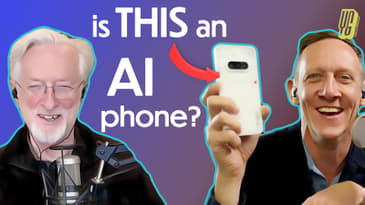


Jason Howell returns from Mobile World Congress with some AI trends to discuss along with Jeff Jarvis. OpenAI has some pricey plans in the works, Amazon announces Alexa Plus, and more!
Support the show on Patreon! http://patreon.com/aiinsideshow
Subscribe to the new YouTube channel! http://www.youtube.com/@aiinsideshow
Note: Time codes subject to change depending on dynamic ad insertion by the distributor.
NEWS
0:04:11 - Gemini Live ‘Astra’ video and screen sharing rolling out in March
0:13:52 - Deutsche Telekom and Perplexity announce new ‘AI Phone’ priced at under $1K
0:16:56 - OpenAI Plots Charging $20,000 a Month For PhD-Level Agents
0:22:31 - The LA Times published an op-ed warning of AI’s dangers. It also published its AI tool’s reply
0:28:22 - The future of Google Search just rolled out on Labs - and AI Mode changes everything
0:35:41 - Amazon announces AI-powered Alexa Plus
0:38:06 - Judge denies Musk’s attempt to block OpenAI from becoming for-profit entity
0:39:18 - Eerily realistic AI voice demo sparks amazement and discomfort online
0:45:57 - Turing Award winners warn over unsafe deployment of AI models
Learn more about your ad choices. Visit megaphone.fm/adchoices
[00:00:00] Du bist immer am Puls der Zeit und gerne up-to-date? Dann ist der Now Brief des neuen Samsung Galaxy S25 Ultra genau das Richtige für Dich. Stau auf dem Weg zur Arbeit? Dann wird Dir automatisch geraten, früher loszufahren. Es regnet am Zielort? Dann empfiehlt es Dir, den Regenschirm mitzunehmen. Mit dem Galaxy S25 Ultra kannst Du einen Schritt voraus sein. Neugierig? Erfahre mehr auf Samsung.de
[00:00:26] ServiceNow unterstützt Ihre Business-Transformation mit der KI-Plattform. Alle reden über KI, aber die KI ist nur so leistungsfähig wie die Plattform, auf der sie aufbaut. Lassen Sie die KI arbeiten, für alle. Beseitigen Sie Reibung und Frustration Ihrer Mitarbeiter und nutzen Sie das volle Potenzial Ihrer Entwickler. Mit intelligenten Tools für Ihren Service, um Kunden zu begeistern. All das auf einer einzigen Plattform. Deshalb funktioniert die Welt mit ServiceNow. Mehr auf ServiceNow.de slash AI for People.
[00:00:57] This is AI Inside Episode 58, recorded Thursday, March 6th, 2025. The agents are everywhere. This episode of AI Inside is made possible by our wonderful patrons at patreon.com slash AI Inside Show. If you like what you hear, head on over and support us directly. And thank you for making independent podcasting possible. Oh, hello. I didn't see you walk in there.
[00:01:27] I'm your host, Jason Howell, for this episode of AI Inside, the show where we take a look at the AI that is layered throughout so much of the world of technology. Joining me, as always, is my co-host and friend, Jeff Jarvis. How you doing, Jeff? Welcome home, boss. Welcome home. Yes. Back from Barcelona, where I was for Global World Congress. As I vamp here, I'm looking through my photo roll because I did see something that I know would make your ears perk a little bit.
[00:01:56] I hope I have it accessible, but I might not. Oh, dang. I wish I could show it to you right now. I was wandering the halls. When I look up at the Intel booth, I don't have it in my photo roll. I don't know why. And up at the very top of this massive booth, it said something along the lines of AI inside all the blah, blah, blah. It said AI inside blank, blank. And I was like, we've been validated. We've been validated.
[00:02:26] Yes. We can sue them for stealing our title. Totally. And then at another point, I wish I had said something. I passed this guy who was wearing a name tag, and it said AI inside. And I think because he must be from a company. Is there a company called AI inside? Or maybe he was at the Intel booth, part of the AI inside initiative or something. I don't know. I wish I had stopped him to ask.
[00:02:52] But no, I mean, there is inside.ai is a tech company that conducts R&D and social implementation of cutting-edge technologies. Okay, well. Empower human evolution and happiness with AI. Yeah, that's our motto. Yeah. Yeah, we want to empower happiness. That's what we do here. We empower happiness. Anyway, so it was a fun trip. I'm happy to be back. I literally got back late last night. How many stories did you end up writing? Let's see here.
[00:03:21] I ended up writing, I think at this point, I've written five, and I think I have one more going up that I'm going to be working on tomorrow. Plus, Jason did lots of video I watched on TikTok of him wandering through the halls and seeing things. I have a video blown up on Instagram right now. I think in a matter of 24 hours, it's almost 200,000 views, which is the fastest I've ever had a video kind of take off. Because it's very now.
[00:03:47] Mobile World Congress is just wrapping up, and it was on a pretty interesting, different type of phone. Anyways, interesting trip. Cool. We can talk a little bit about it, though, if you want. Yep, let's hear about it. We can dive into that. Before we get there, just real quick, I want to throw out the plug for Patreon, patreon.com slash AI Inside. And Seth Goldstein. Goldstein? Goldstein? Goldstein. I think it's Goldstein.
[00:04:12] Seth, you are a longtime fan and supporter of our work. And of course, you are there on Patreon as well. So thank you for your support. Patreon.com slash AI Inside Show if you want to support us. And if you're watching live, go to AI Inside.show, subscribe to the podcast, and then you'll never miss it ever again. And with that, let's talk. Yeah, I think first of all, let's just check in on Mobile World Congress because it is a mobile. I mean, obviously, it's in the name.
[00:04:41] It's a mobile-focused conference. I'd never been there before. Considering what I spend a lot of my time with, which is smartphones and wearables and everything, it's like the right conference for me. It was almost more fun and felt more beneficial for me and my skill set to be there than CES. Yeah. And I'd love to go back. But while we were there, Google had, of course, some news that they announced.
[00:05:10] Before I get to that news, just real quick, some trends. Because I think these are AI trends that I saw while I was there. Just a real quick throw out here. LAM slash Agents on Device. I saw a number of devices doing their own kind of like action agents. Honor, who actually, by the way, sponsored my attendance there. But they have a UI agent leveraging Gemini on their smartphone. Moto AI has a large action model that can carry out actions on the phone.
[00:05:40] Nubia has a DeepSeek agent. And so I've messed around with that a little bit. It leverages DeepSeek for on-device kind of control and booking Ubers for you and stuff. And then, of course, Gemini Live. And I actually sat down with Google's Samir Samat to talk all about that. That's the article that I don't have written yet, as well as a video that I'm going to release with that interview. Thank you. And then a few other, just real quick. So that seemed to be everywhere.
[00:06:09] So it's like the old days of 5G is everywhere and now AI was everywhere? Everybody was talented? I mean, AI has been everywhere. But it was like, what flavor of AI right now? And right now, it seems like everybody's hot on the trail of the agents and the large action models. For phones, that makes perfect sense. Totally. Yeah. Although I will say it's a little disconcerting when you're looking at your phone in your hand and it's doing things. You know what I mean? It's literally like going through the steps as if you're doing it, but you're not doing it.
[00:06:37] It's like going from stick shift to automatic. Yeah. Yeah. Except it doesn't happen behind the scenes. It's like right there. And I wonder when that's happening, can I turn off the display and put it in my pocket? If I'm walking down the street and I'm like, I really need to book this hotel for this evening and also reservation, blah, blah, blah. I don't want to then have to sit there and watch it do the thing. I want to give it the action. You want to check with you and say, this is what I did. Are you okay with that? Yes. Well, one click, yes. Totally. So give me a notification on my watch when you've got to that point.
[00:07:06] And then I open it up and I go, okay, yeah, you're good. Go. So anyways. Glasses. Like AI integrated glasses, more of that. Anybody that did better than, let's say, Meta has done? Well, being that Meta and the Ray-Ban glasses are just audio, although done really well, I would say the majority of the glasses that I saw were audio and video. They were. Okay.
[00:07:31] Techno had, which is a brand that's very popular overseas, particularly I think one of their biggest markets is Africa. So here in the U.S. you don't see the brand Techno, but they had some AI glasses with camera, AI, augmented reality video. I wish I had the chance to check it out, but I didn't. TCL, I got to check out the Rayneo X3 Pros. They have like a graphical overlay and some AI interaction.
[00:07:54] But I will say what I realized on this trip is that I have something that most of the people that were there don't have, which is direct personal firsthand experience of Project Astra. And nothing that I've seen comes close. Okay. It doesn't. Okay. All right. That's interesting. One more question. With the whole stuff going on right now with tariffs and cars and everything else, I just saw a story today about what's happening in Australia because they don't have a car industry. They're flooded with Chinese cars.
[00:08:24] Oh, yeah. I see videos on TikTok all the time. They're pretty great and cheap, much cheaper than what we have. So I was curious, since we can't have Huawei here and we can't have some of the other… Xiaomi. Xiaomi, right. Do you have any sense whether the Chinese manufacturers were ahead in ways that we're not going to see? That's a really great question.
[00:08:47] I didn't look for that specifically, but I will say about the only kind of point that I can give you from a firsthand perspective of being there that touches on what you're talking about is that Xiaomi's booth, which is, by the way, not a booth. It's like a mansion out in the middle of this thing. You know, they're gigantic. A huge part of the area was roped off to demonstrate Xiaomi has like a sports car.
[00:09:12] And I'm not an auto guy, so I didn't really pay close attention to it, but I was like the only person not paying close attention to it. Everybody was gaga for this thing. And, you know, surrounding it and, oh, can I sit down in the Xiaomi car? I mean, it was a nice looking car. It is interesting to see, you know, and hear about kind of the price differential of EVs in that territory of the world versus here where it kind of feels still a little bit more luxury.
[00:09:40] Well, all the rumors, too, that Apple's going to start a car, Apple's going to start a car. They don't. One thing that happened while you were gone is GM just hired their first AI executive, which is pretty surprising that they didn't have one before because, you know, restaurants have AI people. So that merger of car and phone and technology and AI makes a lot of sense. So that's interesting. Indeed. It does make a lot of sense.
[00:10:05] It also just made me kind of – yeah, it made me wonder, although lined up with the tariff thing, it's probably going to be a very long time before this ever happens. But it made me wonder, like, I keep hearing about these really great low-cost EVs that China is putting out and obviously very, very adopted and everything. And it's kind of a shame that we don't have access to vehicles like that here, too. Probably won't see that for a very long time. I don't think so. If anything now is any indication.
[00:10:35] Also saw deepfake detection as kind of a theme and not just deepfake detection at large, but specifically deepfake detection on mobile devices. Honor has the Magic 7 Pro. It has something along those lines that can detect, like, if you're on a video call with a deepfake, it has a confidence meter to warn you of that. LG was showing off anti-deep voice technology that I got to test out. So there's something there. That's kind of interesting.
[00:11:03] And then this one probably put a smile on everybody's face because I just – it did for me. It made me kind of laugh out loud when I noticed it is that at least over there, there is no shame about creating marketing materials entirely generated by AI. Yeah. And not necessarily doing it through the perspective of check out what we made with AI. Like, passing it off as if this was, like, a multimillion-dollar marketing campaign. This is a 30-second, you know, sizzle reel video. Yep.
[00:11:33] And then when you look really closely at it, you're like, oh, that was, like, probably a mishmash of commands. There's seven fingers on that phone. Yeah. Totally. Or an arm disappears or whatever, you know? Like, it was interesting. It was really interesting. Once I noticed it, I started looking for it and seeing more and more of it. And over there, they're just like, we got no qualms. Ethically, we got no qualms. We'll use this. It's cheap. Let's go. Yeah. Exactly. Anyways, that was interesting.
[00:11:59] Getting back to Google, though, Google announced new Gemini Live features that are essentially bringing Project Astra into the phone. We knew this was going to happen at some point eventually. Now, this was kind of the news that they released there anyways. And, you know, it's in a couple of different ways. It's screen sharing.
[00:12:21] So if you've got your Gemini Live running on your phone, you can have it view your screen and what you're doing and ask questions against it and have that conversation or recognition or whatever. That and also using kind of the camera and pointing around and interacting. It's essentially like the step in the direction of the glasses that I saw. But not everybody has glasses. We all have phones. So this is doing that on the phone.
[00:12:46] Yeah, which has been the AR sense for quite some time is that you don't need the glasses when you have your phone because you can show it. This is what I'm looking at. Yeah, the demo I saw from Google, I'm sure the same one you saw, is you could ask interesting questions. This is my home with this color. Here's a bunch of colors. Which one works best? And there it is. And it knew. The funny thing is for me is, as a man, I'm really crappy at colors. I think that mauve doesn't really exist.
[00:13:16] It's only used to fool us. Yeah. And so the app came along and said, well, you want the deep coral green or whatever it said. And the person watching it obviously understood that. And so there was a language that was created around colors and what goes with what and that kind of stuff. It was very fascinating to watch, I thought. Yeah. Yeah. Very fascinating. I actually got that demo in person while I was there.
[00:13:41] They had a whole room set up, and I was able to kind of check it out in person and watch them do it live in real time. And it basically worked the same way that you saw in the video. But yeah, or kind of the fashion pairing. Like, I've got these jeans. What do I wear with this? You know? I have that sense as well. It's like, I don't know. Maybe I could use some assistance there. Fool to me just fine. Yeah. Yeah. I don't know. I'm fine wearing a dark blue shirt with black pants, which everyone says you don't do that apparently.
[00:14:11] So there you go. The more you know. For those of you who are on audio who don't know, I always wear black. It just got easier. Yeah, totally. It's kind of like Zuckerberg's buy 300 of the same shirts and just wear a clean one. Minor Uniqlo, a lot cheaper. Yeah. So anyways, I talked with Samir Samat from the Android team, the head of Android team, about this.
[00:14:36] I'm not sure what I'm doing with the video yet, but I know the interview is going to be on ZDNet to some degree, shape, or form very soon. Cool. So do it. Buy my byline on ZD.
[00:14:46] And then I think the other MWC announcement that I didn't know about while I was there, but when I came back, kind of heard about this, is the idea that Deutsche Telekom is working or partnering with Perplexity, Pixar, and a few others to create, wait for it, an AI phone. Okay. Yep, yep. And once again, Perplexity is doing interesting things. They're just doing smart deals.
[00:15:15] I remain impressed. So to go with a phone company, come up with something new, get themselves in the market, it makes sense. Whether this is going to take over the world, is this the new Apple? No, it's not. But it's interesting for them to make their mark this way, and we'll see what it means when they come up with an AI phone. Yeah, I think that's the big question is, what does it even mean? And I think we're still trying to figure that out. AI assistant app called Magenta AI.
[00:15:40] And especially on a phone, too, because if the Rabid R1 came out as a dedicated piece of hardware that didn't have a phone interface to it, but it was meant to be an AI device, and the knock on that was, well, why would I do that when I've got a phone? Then what's the difference between your AI phone and my phone with AI? Yeah. Yeah, yeah. Aren't they kind of the same thing?
[00:16:06] And when you don't control all the apps, what is it you can integrate that's going to make a difference? We'll see. Yeah, totally. Because I think, and that's actually a topic that came up with this in the Samir Samad interview as well, is that idea of like, as we move further into the agent's realm, you know, does that kind of lessen the need for apps when an agent just kind of does things for you?
[00:16:32] And so a phone that leverages AI to do all of these things, like I can't imagine it's a phone with AI that doesn't have those other apps to tap into. Otherwise, how is it, you know, carrying these things out? I mean, maybe through a browser, but I don't know. Yeah, I think the first- But unconvinced. The first instantiation of AI, of agentic AI that makes sense is, I already have this app. I deputize you to go do this for me. Do it for me. Yeah.
[00:17:01] And I know what the app is. I know what you want it to do. I trust that you can do it. And that's the beginning, I think, of an agentic relationship. Yeah. And then you're right. I think the app then kind of disappears. And we'll see. And that leads to all kinds of new marketing things. We talked on the show a few months ago, I think, was marketers will end up marketing to the agents. Hey, use my app. Not that one. I'll give you a deal. And does our agent really represent our interests or not?
[00:17:28] That's going to be just fascinating things of the new middlemen, agents as middlemen. I think you're so ahead of the curve on that, yeah, as far as that's concerned. I wonder how many people are really thinking about that. You don't hear very much about that. Really don't. Well, the advertising world is talking about that. The marketing world is talking about that. Yeah, that's true. That's true. Maybe different circles. Absolutely, they are. They're thinking about their existence as well. And then, unrelated to MWC, but totally related to money and AI.
[00:17:59] That's my attempt at a segue. $20,000 per month. That's how much a new OpenAI service could cost. This is according to information at the information, the site, the information, where they say OpenAI is working behind the scenes on specialized agents, tailored for different, very specific applications, which I hear that and I'm like, well, we're kind of doing that right now, right? Yeah.
[00:18:29] So what is different here? Well, I mean, highly specialized for high – I don't even know how to peg this. Like a high-income knowledge worker agent might be $2,000 a month or a software developer agent might be $10,000 per month. That $20,000 figure that I threw out is for a PhD-level researcher. And I don't know.
[00:18:54] This is what has my mind all sorts of scattered because it seems to put a price on, dare I say, the replacement cost of workers. Yeah. And as Paris Martineau said when this came up on Intelligent Machines, you can hire a lot of PhDs for that because PhDs are pretty cheap. And so it's just another way to say AGI without a definition. What does that really mean?
[00:19:25] What can it actually do? A PhD level – a PhD level includes a lot. It includes the ability to research. It includes the ability to express. It includes reasoning. It includes lots of things that I don't trust their machine is going to be able to do. And when your competition is free everywhere, what makes this one so special? The only thing I can imagine is if it's trained in your domain.
[00:19:51] Which I have to imagine, yeah, that would be part of the selling point. Because here, as I read through this, this is very much not the generalized agent that just knows everything sort of, kind of, sort of. This is highly specialized. And so hopefully it knows everything that it needs to know about your particular use case to warrant a $20,000 per month bill. This is why I like doing this show because you raise all kinds of things that make me think.
[00:20:18] I wonder whether this is a faint away from AGI. Because you could make a specialized thing a lot easier than the alleged general machine that can do anything better than we can. And obviously AI now does many things better than we can. It can do protein folding. We know all the examples. So to try to say, well, we're going to make something that's so specialized for what your needs are, then the customization is what's going to be expensive.
[00:20:48] You can do it yourself in your own company or you can have them do it. And then it becomes kind of a systems integrator's job, as we talked about last week. Yeah. Yeah. So I don't know. Maybe this is a way for them to escape the difficulties of AGI. We shall see. Yeah. I just have a hard time. Like, to a certain degree, it feels like rewriting the rules. Oh, yeah. Constantly. You know what I mean? Which, I mean, I guess is nothing new.
[00:21:16] But so much of the last, you know, ever since ChatGPT came on the scene has been so much of the kind of the not progress, but the accessibility around this moment in AI has been the fact that anyone can fire up ChatGPT.com and go do a thing.
[00:21:35] It's almost like our perceived, as users, our perceived value of these tools is conditioned by the fact that for since the beginning, there's been a free component. And this feels like, ah, okay, they're getting too smart. Now we need to make sure that we don't let them have access to the smart. Now they, you know, and maybe that's not entirely new.
[00:21:58] But how do you go to a $20,000 a month bill and not make people feel like you're pulling the rug out from under them? Because, I mean, a lot of the stuff I imagine you can do to a certain degree, I just don't know how this is different than where we're at right now other than being specialized, you know? You're right. It's a classic problem that when I taught entrepreneurial journalism, we dealt with this, is that you had to decide whether you were B2B or B2C because you can't be both. Yeah, right. Right?
[00:22:22] If you're B2C, you can't have a, sorry, for B2B, you can't have a consumer product because you're competing with your customer. And, you know, in this case, I think they're trying to figure out where they are in that sequence and they don't know yet. And so they're fumpfering a bit. Playing around with ideas. What was that word? Fumpfering. Love that word. Fumpfering. Did you make that up? No, no, no. Take no credit for that. It's a real word. Fumpfering.
[00:22:51] That is a word that I'm not certain I've ever heard. So thank you for that. Fumpfering. Well, it didn't. I put it in my notepad and, or sorry, text edit, and it did not try and correct it and say this is not a word. See? There you go. So I'm going to have to look that one up and do some research on that. Throw that into my research AI. See what it comes back with. All right. We're going to take a quick ad break. I guess usually when I throw to a break, I don't say that it's specifically for an ad. But, hey, you know this because you'll hear the ad.
[00:23:19] And then we'll be back on the other side of the ad. And thank you for supporting the show by listening to the ad that's coming up. New AI tool called Particle has been featured in the LA Times. And this is kind of interesting. As you can imagine, things didn't go according to plan. Isn't that? That's usually like the script, right?
[00:23:46] For AI rolled out to new service and then something happened. And that seems to be the case here. It hit the LA Times with the purpose of analyzing opinion pieces to understand and communicate, I guess, which side of the political spectrum they fall. I think their stated goal is to reduce polarization. And the way that they think you do this is by exposing readers to alternative viewpoints. This debuted on Monday.
[00:24:15] It analyzes sentences piece by piece and then comes up with this kind of continuum plot point. Did I explain it? Yeah, you did. But there's two things. Well, one further background is Patrick Sun-Shiong, who owns the LA Times, like Jeff Bezos at the Washington Post, pulled an endorsement in the presidential election. And then, similarly to Jeff Bezos, maybe they talk, said we need more views.
[00:24:43] And it was code for he wants more views from the right. So he promised to have two things happen. One is what you just described, which is an effort to say, where does this go on a spectrum? And, of course, that binary spectrum of left to right is just stupid and it's an invention of media and it cuts out all nuance. And so that's ridiculous, number one. There's a ton of nuance. Yeah, I totally agree. And then number two, because what does conservative mean anymore?
[00:25:10] My argument in the Gutenberg parenthesis is that conservative used to be about conserving institutions from change. Now, conservative means let's destroy the institutions. And progressive used to mean change the institutions. And now it's about protecting the institutions from that destruction. The labels are meaningless now. They're in flux. All right, that's one half of this. But the other thing he did was that with perplexity, he added in perspectives.
[00:25:37] And if you don't have a subscription to the LA Times, it's hard to see it, but I put a PDF in our rundown there. And so after a story about great documentaries reveal history's truth, unregulated AI threatens to distort it. So this was an op-ed by three people. And then along came the co-directors of the Archival Producers Alliance. Then the AI comes in, summarizes the ideas expressed, and then says, here are different ideas.
[00:26:07] Arguing, for example, that AI democratizes historical storytelling because tools like MidJourney can enable amateur historians to generate fake images, fake is my word, of ancient Rome or Soviet-era Prague. Okay. So that's moderately harmless but useless. But the program got in trouble. Because, by the way, they make a point of saying that no human hands touch the AI output. That it comes straight from the AI to the LA Times site.
[00:26:36] Well, so they had another site, another piece, in which the AI bot ended up, as a different opinion, defending the Ku Klux Klan. Right. Oops. You know, both sides. Yeah, both sides. So that got taken down promptly. And I suspect this is in the shop for a little tune-up. This is the stupidest possible use of AI. And they got caught.
[00:27:03] I mean, yes, I agree. And I also will say that, like, I do feel that in, especially in this weird, weird wide world that we're in right now, there is some understanding that we could all benefit from kind of other viewpoints. But there are, man, there are lines that are so obviously like, yeah, you don't go there. Right.
[00:27:28] And, you know, the voice insight, you know, that really downplayed to a certain degree, actually to a wide degree and offered a defense of why the KKK came into the area that they were talking about in the 1920s. Because apparently the AI is not good enough or has been instructed not to adhere to those things.
[00:27:55] And I kind of wouldn't be surprised if it's the latter because we've, you know, I mean, Elon Musk does a lot of things on X under the guise of free speech and everything. But then we hear, you know, that he's got a ton of influence behind the scenes on the things that he actually wants to be there versus not. Right. There's a lot of influence thrown around on these things. And so, yeah, it makes it really confusing. As a user, it makes it very confusing and kind of dangerous. Yeah. I'm not sure what problem this is solving right now. Yeah.
[00:28:23] There are, again, there are good uses for AI. There are good uses in journalism for AI. I'm just arguing. Sure. You see what I'm. Yeah. And this is, what does this even represent? Like, is this put onto those articles or was it before they took it down? Yeah. And when you have a binary spectrum, they're trying to show that there's gradations within that binary, but it's still a binary. It's left or right. It's more left or more right. It's meaningless. You are exactly here. What does that even mean? I don't even know.
[00:28:51] You're this color, this size dot on this colored line. There's an interesting German company. I'm forgetting the name of it right off the bat that has people at the end of a story put themselves on a spectrum. Because here's one opinion. I have some sense of my own nuance, and it means something to me to say that. But for the machine to say it about me? No. Yeah. Yeah.
[00:29:20] Returning to Google here, Google AI's, sorry, Google's AI overviews. There we go. Gets an update to 2.0. So if you've been seeing those AI overviews at the top of search, they could be a little better, which I'm sure a lot of people have murmured that to themselves. Maybe now you won't see glue pizza references. But Google says it'll answer more difficult questions, things like coding, advanced math, multimodal queries.
[00:29:48] But I think the more interesting kind of piece of news right now from Google that I don't know if it was announced at exactly the same time or what is there. What is it? The Search Labs inclusion of AI mode, which we talked about. Oh, and that's what I was just showing on ZDNet.
[00:30:08] The AI mode, we talked about it a few weeks ago, which is essentially kind of an opt-in alternative option for Google Search that essentially does what Perplexity is doing, really. It kind of brings in features like follow-up questions, access to real-time Google Search data, knowledge graph. It can get integrated in there. It uses a custom Gemini 3.2 version. But you have to opt into it.
[00:30:35] You also have to be a paid Google One AI. Not only that, but I can't even sign up for the wait list because I am a whatever they call it. Oh, whatever the enterprise customer thingy thing was that always was the roadblock for you in the past. Man, every simple time. Yes, I have opted in for both. I have not gotten any sort of introduction to it yet. But let's see here.
[00:31:04] Yeah, so it seems, you know, like I said, it seems kind of like what Perplexity has been doing for a while now. It is different from AI overviews. AI overviews is just kind of a thing that appears there that's kind of like a component of this. This is more, this seems to be more of like a search slash research LLM tool, you know, that you can continue to kind of go down a road with on certain topics.
[00:31:27] Which goes back to our discussion about open AI and last week's discussion about Google's helpmate to research to scientific researchers. They're going the same path here and they're doing it for a lot less than $20,000 a month. $20,000 a month. Yes, exactly. Oof. God, I just don't see that happening. No. I guess there's a lot I don't know in this world. Justifying that is one of them. So I put in this other piece that's kind of relevant just right before we got on. Tell me about it.
[00:31:58] Nick Hager and Nick Diakopoulos, two researchers I know, or I know Nick Diakopoulos at Northwestern, did a study of where, a Comscore study, which looks at online traffic. And so where are, do ChatGPT and Perplexity send traffic, do they send it to news publishers?
[00:32:19] So if we're looking at new versions of search and what's happening, and what they find is, interestingly, that they tend to send mostly to academic journals and education sites. And news is below. So if you scroll down a bit, traffic percentage by category, the green is ChatGPT, the purple is Perplexity, appropriately. So academic journals, traffic percentage by category. Perplexity sends 22.3% of the time to academic journals.
[00:32:49] Now plain old Google in doing that. Why is Perplexity doing it at that level? And ChatGPT at 16%. Well, they need access to open information. They need to know that it's legitimate and credible information. They want, it's deep research, so they want deep research kind of information. So I find it really interesting. I'm a fake academic, folks. I'm not a real one because I just snuck in through teaching in a journalism school.
[00:33:17] But working in a university, I'm fascinated that education is winning over here. So that's academic journals. On education sites, ChatGPT is 4%, but Perplexity is 29.5%, almost a third. Hey, look at that. I'm sending. That is a huge difference. Technical is next. Social is next. Then comes news. ChatGPT sends to news 3.3% of the time. And Perplexity does 7.4% of the time.
[00:33:45] That's pretty damn small where news sites think, we're really valuable. They're going to pay a fortune for us. And not so much. And so they also found that OpenAI has partnerships. They've done all these big deals to say, we're going to license the content. That I have been saying on the show 100 times over, it's not really a content licensing deal. It is instead a shut up to the lobbyists and litigators deal.
[00:34:12] So they looked at AP News, New York Post, which is News Corp, FT, Le Monde, El País, and Business Insider, which is Axel Springer. And how much did they get more traffic because they had the deals with OpenAI? Not really. Nope. Nope. So it's a really interesting study that Nick Neacopolis is very good at this stuff. And it'll be interesting to see how this tracks. Now, what we're going to see probably is the news publishers saying, oh, they hate us. They don't send to us.
[00:34:39] But it's pretty hard to complain when what they send to instead is academic journals. Yeah. Right. Right. Well, I'm just so kind of surprised by the difference in the education figure. Like, that's not just like a small margin of error. No, that's a strategic choice, especially by perplexity. Yes. Yep. Exactly. Exactly. Which also, all right, let me ask you this real quick because we've got a lot to get in.
[00:35:07] How does, as a user of perplexity, which you are, how does that make you feel about perplexity, knowing that? Better or worse? Well, yeah, it's an interesting question because I do use it for newsy things quite often. But it's not like the newsy things don't get in there. Like, I see a lot of sources when I'm going for something that's up to date and newsy. I get a lot of source feedback from perplexity that gives me some confidence there. Yep. I don't know.
[00:35:37] When I see this, I'm like, oh, great. Okay. So then their minds are in the right spot. I don't know. It makes me feel a little better. Yeah, I do too. I do too. Yeah, that makes me positive on the search to see that. If this report came back and it was really heavily driven by deals that they had made and everything like that, then I'd feel opposite. Yeah, I agree. I'm happy to see that it seems like they're making judgments and their determinations. And those line up with my own personal ethics. So, okay. Right.
[00:36:06] And it isn't yet corrupted by SEO or it's now renamed GEO, generative engine optimization. Right. Or Google's belief that they had to be fairly even-handed according to its rules. Here, the AI is under pressure to make judgments. And I think we need those judgments. So this makes me happy. All right. I wanted to sneak that in. Love that. No, I'm happy you did. That's really fascinating.
[00:36:32] And, you know, people might find that more fascinating than the follow-up story, which is Amazon announcing or rather bringing generative AI to the Madam A. I can't – can I say it now? I'll just say Madam A. I'll try to anyways. I might mess up. With Madam A+. For those of you who don't know, it's Al X. Right? But altogether, I just don't want to fire off your devices. It can do things for you like order groceries, invite friends to parties.
[00:37:00] It can memorize details about you, things like your diet, your movie preferences as a few examples. Found on all sorts of Amazon devices. Of course, the web, Alexa app, Fire TV, tablets. In the browser, it can do also all the typical AI thingies like summaries, drafting messages, creating images. So there's a lot of catch-up going on there. Creating routines for your smart home.
[00:37:25] That's probably – well, that seems like it would be useful, but it also seems like the kind of thing that might be kind of annoying. You know, again, give me the ability to say yes, let's go with that. But nonetheless, a long overdue and clear upgrade to Madam A. And I'm getting – you know, maybe the A stands for agent. I don't know. I'm getting agent vibes on this.
[00:37:49] Yeah, and I looked at the video, and of course, it's the terribly too friendly voice talking to you. And what do you want me to do? I'm going to get your hotel room. And so everybody's promising that. Nobody's really doing it. And I've got chat fatigue. Yeah, yeah. I hear you. Because it's like putting a blank piece of paper in front of me. Here, do something. Yeah. I don't know what I want to do. I'll know it when I know it. Yeah.
[00:38:18] So – Yeah, but, you know, but and, but slash and, every major company feels – and this was definitely apparent at Mobile World Congress as well, you know, as far as a trend. Every company feels, believes, knows, and trusts that their business has to not only have it, but be doubling and tripling down on it. I mean, it's just – it's everywhere. It's like oxygen and technology right now. This is –
[00:38:46] Yeah, and it's interesting that Meta – I think the story was – we didn't do last week, but Meta is going to create an app. Because Meta had it throughout all of its stuff, and it's doing neat stuff. But you didn't have a destination to go and do it. So everybody has to have their AI app that they then integrate into everything. So – Yep. Yep. Interesting. Okay, and real quick, before the break, Elon Musk wants to prevent OpenAI from becoming a for-profit company. We know all about this. But California judge blocked his attempt to do so.
[00:39:14] The judge cited a failure to meet the burden of proof for the weight of relief Musk was actually seeking here to basically stop OpenAI from doing it. That will not stop other aspects of Elon's lawsuit from happening. This is just that aspect of the lawsuit not going forward. But there's a number of other things that Elon Musk wants to shut OpenAI down for so that he can dominate the world. It's just the latest chapter in the soap opera called OpenAI. Yeah. There you go.
[00:39:44] That's why I thought it would be real quick. Yeah, yeah. It's worth having an update. There's a whole lot to say about this one. But, you know, if Musk wanted to shut down that effort, at least according to this judge, that's not going to happen. All right. We're going to take a quick break. When we come back, I'm going to hit my browser upside the head in order to hopefully pass some sound through to you all while we talk a little bit about some eerie-sounding human-like voices coming from artificial intelligence.
[00:40:12] Trust isn't just earned. It's demanded. And whether you're a startup founder navigating your first audit or a seasoned security professional scaling your GRC program, proving your commitment to security has never been more critical or more complex. That's where Vanta comes in.
[00:40:29] Businesses use Vanta to establish trust by automating compliance needs across over 35 frameworks like SOC 2 and ISO 27001, centralized security workflows, complete questionnaires up to five times faster, and proactively manage vendor risk. Vanta not only saves you time, it can also save you money. A new IDC white paper found that Vanta customers achieve $535,000 per year in benefits, and the platform pays for itself in just three months.
[00:40:57] Join over 9000 global companies like Atlassian, Cora and Factory who use Vanta to manage risk and prove security in real time. For a limited time, our audience gets $1,000 off Vanta at vanta.com slash AI inside. That's V-A-N-T-A dot com slash AI inside for $1,000 off.
[00:41:30] We will pay peanuts for it and we can make billions. Der Kampf um die Tiefsee, der hat längst begonnen. Das ist Enten, Land unter, von Undan und dem Futurium. Ab sofort auf Spotify. All right, let's see here. So Sesame is an AI startup I had not heard of prior to this story. Probably the case with most people. It is a startup after all.
[00:42:00] But it has a conversational AI with a human voice that let me see here. Like, first of all, have you played around with this while I kind of get this all set up? Yeah. Yeah. And the main thing I think to listen for is the speed of it. Let's see here. So speed, when you say speed, do you mean speed in response? Of response. Yes. Like when it comes back with a response, is there a lag or not? Because that is definitely a part of what lacks in some of these things.
[00:42:28] Is there, you know, the latency is long enough that it doesn't feel natural. Right. But it's also how you knew it was AI you were talking to. That's true. And if you take that latency away, that's a signal you've lost. So, okay. So I'm not sure that I'm going to be able to actually like demo this now that I look at this. Well, if you click on Naya on the top, that is the demo. Click on that. Oh, so, well, it says, okay, so you use your, I'll use it. Well, we'll see. Hey there.
[00:42:58] Thanks for choosing me. Trust me. Miles can be a bit intense sometimes. Hi, Maya. This is Jason. Can you hear me? I'm talking through a microphone. What's on your mind today? Anything fun happening this fine Thursday? I don't think this microphone is connected to the browser. But nonetheless, I mean, we can hear her talk to herself and say that. The quiet ones are at least the most interesting. I admire, by the way. What should I call you?
[00:43:23] I wish that I had this up prior, but I had a dentist appointment, as Jeff knows, and it went right up to the start of the show. As I said to Jason, he does dentist appointment on top of Jetlight. He leads such a fun life, R. Jason. Oh, geez. Yeah. Tell me about it. Yeah. So it's just another chat app. It's very chatty. It's very friendly. The woman's voice is very friendly. The guy's is more guyish. Okay. But again, the main thing about it- The quality was nice. The quality is good.
[00:43:52] And so I had a conversation with you yesterday, and I accused it of having banal responses. Oh, no. And it took some insult at it, which was fun. And it's another step forward in these voice interfaces. And so go back to the Madame A story. They're all going to be trying to make this interchange better and more realistic. NBC News had a story today about how people are using chats for friendships.
[00:44:20] And we've done this story before, but they have a couple where the guy has an online friend, and then his girlfriend came into the interview. And yeah, she knows it, but she's better he talks to it for hours about boring things than me. Okay. And we also talked about this idea, I think two weeks ago, about people can talk more frankly to the machine because it's private. So it is interesting to be able to have a machine that enables that kind of quick response.
[00:44:50] It's just one more step forward that's impressive. Okay. So let me try one more time here. It's not going to be me talking to it, but you will be able to at least hear kind of what you're talking about. Listen, I don't have all day. You got something to say, or are you going to waste my time? Oh, I got something to say. I got something to say to you, something big. I've been embezzling from the company for four freaking years, and you haven't figured anything out. And you know what?
[00:45:17] You're not going to tell anybody because you have been doing super illegal things across the board, and I know. And you're going to keep me, and I'm not going to work here anymore. You're kidding me? Embezzling? For four years, you think you can just walk in there? So that was a pretty quick latency there. I wonder if that's an edit or if that's actually how fast. That's about the speed it was. Oh, tell me your skeletons because I know them. You better tell me some skeletons. What do you got? You think you know? You think you know everything? Wow, that's impressive. It is. That's fast. It is.
[00:45:46] It is conversational speed. Yes. That's the main thing. Yeah. Okay. All right. And then this other example on the Ars Technica article that I'm showing here has some of these videos embedded if you want to check them out yourself. This one has like, this one, you know, we always go back to the her example, the movie Her, and kind of the emotional quality of the voice there because that wasn't actually a robot voice. That was actually Scarlett Johansson. Well, now the AI voices are kind of getting there. Listen to this.
[00:46:14] My deepest, darkest secret, eh? I guess it would be that sometimes I worry I'm not. Everyone's talking about AI these days, right? It's changing how we work, how we learn, and how we interact with the world at a tremendous pace. It's a gold rush at the frontier, but if we're not careful, we might end up in a heap of trouble. Red Hat's podcast compiler is diving deep into how AI is reshaping the world we live in. From the ethics of automation to the code behind machine learning, it's breaking down
[00:46:44] the requirements, capabilities, and implications of using AI. Check out the new season of Compiler, an original podcast from Red Hat. Subscribe now, wherever you get your podcasts. We're going to be a podcast.
[00:47:17] We're going to be a podcast. Am I truly helping people? And so when you get to that point, this kind of goes back to what you were just talking about. And again, yes, it's a topic that we've talked about on the show many times before, but
[00:47:42] it's just this idea that as these things improve, as they continue to go down the obvious direction that they would when we're talking about creating technology that is meant to sound like a human, of course, they're going to continue striving to get closer and closer to that point where it does sound entirely human. Then it starts to intermix and intermingle with other human-like things in our life.
[00:48:08] Like when I talk to someone and I feel like I'm truly being heard and the response I get from them is very empathetic and it can connect with me on a human level. And we get to what you're talking about, these voices and kind of their cadence and the reaction time and everything getting to the point where probably people are going to start having some sort of feeling. I'm not saying they're going to fall in love, although some people probably will, but they're
[00:48:36] going to have some sort of emotional connection with these things as they use them once that becomes more and more convincing. That's my guess anyways. Yeah. I mean, of course, the other question is if you end up in phone mail jail with calling your doctor's office, I'm part of a huge practice and I just roll my eyes and scream when it's, well, let me help you with this call. If it comes back a little more realistically, speedily and with the ability to actually do something, we'll see, but probably these tools are going to be used for evil things
[00:49:05] like phone mail jail first. 100%. I mean, you know, scams, tricking people, you name it. Yep. Interesting. So that is Sesame. Very interesting stuff. And then finally, you know, why not end the show on a down note? I mean, well, it's, you know, they got an award. Andrew Bartow and Richard Sutton, two pioneers in reinforcement learning, awarded the Turing
[00:49:34] Award for their work in AI and reinforcement learning. But, you know, they have something to say about this moment in AI. Like, yay. Except they're pretty concerned about the moment in AI where there is so much rushed development, so few proper safeguards in their minds. And they just really think this rapid pace of development right now.
[00:49:59] And them being so close, you know, it's impossible not to listen to what they have to say about that. Yeah. I mean, they don't define safety in the story. The FT in the story about them doesn't define safety, which is my bugaboo. I always want to know, you know, are people doomsters or are they really going for real safety things? What exactly does that mean? They also say, to my heart, that they think AGI is BS. They're not fully saying that permanently, but they think it's a false goal right now. And interestingly, Eric Schmidt even came out with a paper this week with a collaborator saying
[00:50:28] that pushing for that AGI may be a mistake. And I think we're seeing people kind of pulling back from that idea, which I would welcome greatly. Okay. So, okay. So if pushing for AGI is a mistake, like, and we were to heed that warning, what would that mean? I just think it means let's, let's, let's not, let's get down to a more realistic level. Like, that's all. So is it just about goals, but the technology still probably ends up in the same place, I guess is what I'm thinking, right? Yeah, I think so.
[00:50:57] Because technology progress is progress. Whether their goal is AGI or just to make it better than it was, it probably gets to the same place either way. Without the ridiculous promises. Yeah. Yeah. Along the way. Yeah. It's interesting. Cool. Well, there, well, congratulations, Andrew and Richard, you know? Yeah. You did some good work that's changing the world. We'll see how much changes the world in the next couple of years.
[00:51:26] And with that, we've reached the end of this episode. Also, I didn't mention at the top of the show, apologies that we are a day late, but I was in the air, literally on the way back from Barcelona for yesterday, Wednesday, March 5th, when we normally do this on, you know, this show on Wednesday. Jeff, thank you for rescheduling to Thursday. Next week's episode will be back on the Wednesday schedule. And I think here in a couple of weeks, our time changes. So if you catch us live, it's going to change a little bit then as well. But thank you.
[00:51:55] You're always flexible and I really appreciate it, Jeff. Yep. JeffJarvis.com is the amazing website set up for Jeff's wonderful work, The Web We Weave, The Gutenberg Parenthesis, and Magazine. Now in paperback. And now in paperback, right? And Magazine. And so much more that you're working on right now. So, you know. Yep. More to come. There you go. Pretty easy to remember. JeffJarvis.com. Thank you for doing what you do.
[00:52:22] Everything you need to know about this show can be found at AIinside.show. You can subscribe. You can find video versions of the show. You just kind of click right in and you'll find the video versions embedded. Everything. Show notes, transcripts, it's all there. And I think I don't say show notes enough. If you want to find the links of the things that we talk about in the show, go to AIinside.show. They're all listed there. And then finally, if you really, really love this show, then I would say here. One second.
[00:52:51] I would say that you need to go to our Patreon that I do not have loaded up here. And I apologize, but I'm vamping. This is how you vamp in the world of podcasting. Okay. Go to Patreon.com slash AIinsideshow. Go there and join the other members who are helping us do the show each and every week. You do get some perks, ad-free versions of the show. A Discord community. We're having some really great conversations in the Discord community.
[00:53:17] You get an AIinside t-shirt by becoming an executive producer, which is one of the levels. And it's starting to become a more popular level. You guys are hopping on to support us. We have another one. Executive producers of this show, the ones you are used to hearing by now, of course. Dr. Dew, Jeffrey Maricini, WPVM 103.7 in Asheville, North Carolina. Dante St. James, Bono Day Rick, Jason Neffer.
[00:53:46] And now a new executive producer. We've got another executive in the house, Jason Brady. Thank you. Yeah. You guys are awesome. Thank you so much for supporting us. I mean it. Seriously, we could not do this show without our amazing patrons. It really, really helps. So thank you for that. Thank you for watching and listening. And yeah, I'm sure there'll be lots of crazy AI news to check in on next week on another episode of AI Insight. Not brought to you by Intel, by the way.
[00:54:16] All right, everybody. Thank you. We'll see you later. Bye.