
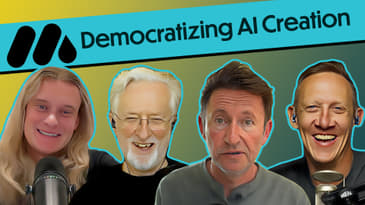




Jason Howell and Jeff Jarvis talk with the creators of MindStudio.ai, a no-code AI development platform where enterprises and individuals can build custom AI solutions tailored to their needs.
Please support this podcast on Patreon! http://www.patreon.com/aiinsideshow
INTERVIEW TOPICS
- Introducing guests Dmitry Shapiro (CEO) and Sean Thielen (CTO) of MindStudio, their backgrounds and how they met
- The pivotal moment of ChatGPT's release and their vision for MindStudio as a model-agnostic, low-code/no-code platform for building AI applications
- Overview of MindStudio's features: creating multi-step AI workflows, comparing models, calling APIs, uploading data, publishing apps for human or programmatic use
- MindStudio's business model, pricing tiers, and monetization opportunities by selling created AI applications
- Examples of how enterprises use MindStudio for automation (resume screening, sales, customer support), building custom AI assistants, and replacing old software with tailored AI applications
- Addressing individual users, artists, and creators using MindStudio for creative projects, productivity, and efficiency
- Handling model updates, switching between models, and MindStudio's model-agnostic approach
- The value of empowering non-technical users to build AI solutions close to their work, avoiding one-size-fits-all tools
[00:00:00] This is AI Inside episode 23 for Wednesday, June 26 2024, democratizing AI creation with Mind Studio.
[00:00:11] This episode of AI Inside is made possible by our wonderful patrons at patreon.com slash AI Inside show. If you like what you hear, head on over and support us directly. And thank you for making independent podcasting possible.
[00:00:30] Hello everybody and welcome to AI Inside, the show where we take a look at the AI hiding inside everything in the world of technology. Boy, oh boy. Each week we, you know, sometimes we talk about the news and illustrate just how deeply embedded AI is becoming into technology. And sometimes we talk to people who are making the products, the services, the AI, the everything that is relying on that AI. And that's the case today. I'm Jason Howell.
[00:00:59] Joined as always by my co-host Jeff Jarvis. Good to see you, Jeff. Good to see you, boss. Yeah, great to have you back here. This is just to kind of set the stage here. This is the last pre record episode. So this episode was recorded in advance before my return from vacation next week. So if you've been missing the live kind of experience, you're going to get it starting next week. I have that to look forward to. Which is also to say that podcasters don't take vacations. They just apparently record.
[00:01:29] Apparently not. I know, Jeff, you try to use offer offered it as a suggestion like, well, we don't have to do them. But I'm like, no, the podcaster in me was like, I can't. I just can't do that. I can't bring myself to do that. We before we get started, I just want to give a big thank you to people who support us directly on Patreon. That's patreon.com slash AI inside show.
[00:01:53] Ardith McCullough and one of our newest patrons, Mike Hallett, both support us on a regular basis. And we truly cannot do this show without your support. So thank you. And anyone else who wants to wants to get in there and get some of the extras and all that. I'm actually wearing my AI inside.
[00:02:10] Whoa, I know I didn't show this to you, Jeff. You get it if you are of a certain tier and you stick with us for three months. Patreon has this thing built into the service. And so I was like, hey, can I take a look at the quality of that? And it's really good quality. So there you go.
[00:02:25] All right, marketing stuff out of the way. Let's get to the fun stuff. I want to bring on to the stage with us two folks from the company Mind Studio. First of all, Dimitri Shapiro, who is the CEO of Mind Studio. Dimitri, it's a great privilege to meet you today. Thank you.
[00:02:45] Thanks so much for having us on the show.
[00:02:48] Absolutely. Yeah, and we're bringing you on the show partially or primarily because Jeff was at an event and met Sean Thielen, who is the CTO of Mind Studio and saw a saw a little walkthrough of the product and the company that you guys are running. So, Sean, thank you for being here.
[00:03:08] Yeah, thanks for having us.
[00:03:10] Yeah, it's great because we get the wide view and then Sean, you were telling me in email, you're doing a lot of the coding. So a lot of like in the weeds code stuff so we can really go wherever we want here. We can cover all bases.
[00:03:24] Yeah, just for a second's background before we actually hear about it. I was at the BDMI, which is the Bertelsmann Investment Group at an event they hold regularly on new AI apps and mainly aimed at media people. And so they have a couple dozen folks there and Sean presented Mindscape and I said, Whoa, this is amazing.
[00:03:42] I'm a big fan of Mind Studio and an amazing opportunity for media people who are dumb like me to be able to make some AI. And that was by all means the view of people in the room. And then I was at another event not long thereafter, a news product unconference at my former school.
[00:04:05] And a couple of folks there said, Oh God, yeah, I use it all the time and believe in it. That's great. So I called Jason and said, Let's have them on. Let's do it. You guys should describe what what it is because I'll do a terrible job of it. But it's an impressive toolset.
[00:04:20] Yeah, yeah, I guess as we're getting started here, I know we were talking before kind of firing off the interview, Dimitri, you worked at Google for a number of years. Like tell us a little bit about how you both how your backgrounds kind of converged and ended up with you can co founding and creating Mind Studio.
[00:04:40] Yeah. So Sean and I met 11 years ago now on a website called hacker news, which is like the Y Combinator message board. And I was working at Google at the time on the main campus and Sean was still in college and he was building some apps in a spare time and sort of was looking to sort of meet someone who'd built some apps and done it before.
[00:05:09] And so I reached out, we became good friends. And then actually, when Sean graduated college, he moved into my garage in my garage for a year and a half. It was a four car garage. So nice. Oh, okay. So it's luxury.
[00:05:24] But it had a couch. I had a real bed.
[00:05:26] Yeah, there were worse garages to be in. Larry and Sergey had it harder. But I was still working at Google. And then in summer of 2016, I left Google and Sean and I started this company so almost like eight years ago. And by the way, before you know, I was at Google for four years running product.
[00:05:54] On a bunch of services, you know, a bunch of machine learning teams were sort of like crunching all this data. Google has about people primarily. This was days of Google Plus trying sort of our Oh, we miss it. Oh, those days. Oh, we miss it.
[00:06:10] Which is interesting, actually, if I can interrupt real quick. In the Google Plus days, Google was searching for every way to integrate all of its services and things and efforts into the Google Plus world. And now we find ourselves in the in the time of this moment of AI, where I'm sure you paid attention to Google's Google I O a couple of weeks ago.
[00:06:33] And I mean, it was just white noise AI top to bottom. It's like Google's playing the same game here with AI, we got to get it into everything and get everything into it.
[00:06:43] Yeah, this this, this is the way that Google sort of operates and some of these scenarios like, you know, Facebook was an existential threat. As far as Google was concerned in 2016. And therefore, like they had to like, get social into like the backbone of social into all of Google services. That's why I was called Google Plus and not Google, you know, social. And now obviously AI is very similar. Hopefully, Google will be more successful with sort of bubbling AI up to the top.
[00:07:12] Obviously, all of Google is machine learn powered anyway, is just now you know, generative AI is coming to the forefront. Anyway, before Google, I was CTO of my space music if anybody remembers my space. And before that I built two other venture backed companies one was called VO networks, VOH was a major competitor to YouTube.
[00:07:32] I raised $70 million there got into a fight with Universal Music Group, won the lawsuit, they sued us for copyright infringement, won the lawsuit one two appeals but they sued our investors individually not just the company ended up basically choking us out. And a famous case we served as the precedent to the Viacom versus YouTube case that you to one before that I built a venture backed cybersecurity company called iconic systems raised $34 million.
[00:08:02] And then in the mid 90s 95 to 99 I built the web team and Fujitsu. So I just turned 55 a couple of days ago and and Sean just turned 30 a couple of days ago. And so we've got 25 years and two days between us. So I'm an old nerd, old nerd. He is now reaching early middle aged nerd and so we're together we're nerds.
[00:08:27] We're I mean honestly, the four of us here on this on this show we are all nerds together. I'm only a nerd. We're honorary nerds. Are you are you guys are total nerds? What are you talking about?
[00:08:39] I mean we talk about this stuff every single week and we love to do it. So I guess that that qualifies us as nerds. So so it sounds like Dimitri that you've had your hands in a lot of different avenues in the world of technology and then the last eight years, mine studio becomes
[00:08:58] a thing that both you and Sean unite on and it really obviously is heavily focused on AI and AI. I mean eight years ago versus what we you know, I'll put it in air quotes because AI can mean a million different things depending on who you're talking to.
[00:09:12] But eight years ago, it felt like a different moment than it does right now. And I mean you've been doing this this mine studio kind of development that whole time how is how is your efforts with mine studio changed in the beginning very quickly?
[00:09:28] Versus where you find yourself now where it were people seem to be maybe a little more aware or a little more open to how this can really impact their business.
[00:09:37] I'm sorry, let me let me clarify Sean and I started the company almost eight years ago. But the company did something else. We built another platform called Koji which we recently sold to a company called Linktree.
[00:09:50] And it was almost two years ago now basically, you know a month after the release of chat GPT in November of like two years ago almost that we started building mine studio just to clarify.
[00:10:04] So we've been working together full time at this company for eight years with working on mine studio for you know one and three quarter years I guess.
[00:10:10] Yeah, okay. Well then that just illustrates even even more so that the many different directions that you've gone in the realm of technology. That's a that's that's just fascinating to me.
[00:10:20] So what was it about this moment in AI that brought you two together to say hey we should do this together?
[00:10:25] Yeah. So when I joined Google in May of 2012, I got thrown into product managing these these machine learning teams as I was mentioning that was that were sort of trying to understand the world.
[00:10:42] And even before that you know when we were doing video again the YouTube competitor we actually had recommendations that were machine learned recommendations before YouTube even had recommendations.
[00:10:52] So I've sort of been paying attention to the AI space for a very long time although not involved in it you know other than to Google you know via Google and then you know recently in the last two years.
[00:11:04] And it was clear that the release of of you know chat GPT and sort of everything else that followed was a pivotal moment.
[00:11:14] And again Sean and I very quickly understood that even though you know a bunch of people at the time said well is this sort of another fad we just gone through this like Web 3 stuff and is AI sort of generative AI just another fad.
[00:11:25] It was clear to us that the answer is of course not this thing is extraordinarily powerful will transform the world.
[00:11:31] But also very clear that to think of AI as being sort of this chat bot that you chat with and that's how you sort of leverage the power wield the power of these you know rapidly evolving models that this was just silly right.
[00:11:42] Computing for example didn't take off until we moved from DOS to Windows. Nobody ever learned Google search operators right then enterprise. And so believing that the right way that people are going to leverage this was to train employees to do things that are not just a simple thing.
[00:11:59] And everybody was going to sit there and type commands to AI models that this was just silly.
[00:12:04] And really what needed to happen was there needs to be sort of a layer up abstraction of all of these you know models and sort of that somebody needs to create the application layer of AI. And so that's where we started to think about AI.
[00:12:18] So to be able to allow you know individuals or enterprises to sort of leverage all of the power of all of these different models that are now coming out. And but be able to build sort of real applications using that not just chat bots.
[00:12:34] You can certainly build chat bots as well. But that's not just a simple thing. So that's sort of was one thing that became clear to us is that it needs to be an application layer.
[00:12:43] The other thing that became clear very quickly was that even though at that time it looked like open AI was going to run away with it and sort of be a little bit more
[00:13:02] The other thing that became clear very quickly was that even though at that time it looked like open AI was going to run away with it and sort of be the dominant provider in all of this.
[00:13:12] We knew that there would be other players and that sort of model agnosticism was going to have to be it was going to be really important.
[00:13:20] Really before anybody that we at least know was sort of talking like that we started building mind studio to be model agnostic and so today we support any model you can imagine. And that's really, really important.
[00:13:34] And another thing that again we sort of realized actually from our work prior to this and Koji was that you know we needed to make it much easier for sort of non technical people to be able to build AI applications that you know developers sort of the lack of developers is always a bottleneck.
[00:13:53] And AI sort of ushers in you know this new age of sort of low code no code the sort of idea of low code no code platforms that allowed what are generally known as citizen developers to build application that's been around for decades.
[00:14:08] But because of generative AI there can be sort of this new generation of local no code platforms that can be sort of dramatically faster to build in much more accessible and obviously be able to build much more powerful applications that just a couple of years ago would have seemed as like science fiction.
[00:14:28] Anyway we had a vision really quickly and were able to you know get up to speed really quickly it was great timing as we were selling off Koji.
[00:14:35] And you know here we are now there's over 50,000 of these AI applications that have been built you know and deployed in all kinds of places you know giant enterprises government agencies SMBs across every industry I think so.
[00:14:49] So let me let me come in for just a second so I think that our audience has a good idea of what this does and and and to be sure and Sean you should definitely correct me if I'm wrong here.
[00:14:58] But having seen Sean's demonstration to us dumb news folks and then played with a little bit. So my understanding of what I want to can do is that without coding.
[00:15:12] One can create an application atop any LLM that's available and can even compare which LLM you want to do for the same application. There's there's a couple of samples in there the demo that I've watched is created a application to create blog posts.
[00:15:37] And there are steps in that input and output data that you can add into it. And then there are some adjustments you can make in how each model operates comparing the models and then bingo.
[00:15:50] You can publish to the world an application built atop an LLM and even if you pay the business fee which isn't that great charge for it and potentially make money by creating an application and business layer atop any LLM did I get that wrong.
[00:16:09] Yeah that was that was spot on. Yeah so you can use any model or many applications now use multiple models or many models as you can create these multi step workflows.
[00:16:21] And in those workflows you can do lots of things you can ask users if this is for a user and for people to use you can ask them for you know get input output so you can create screens just like you would in a regular application that you're creating.
[00:16:35] You can call large language models from open AI and drop it Google meta Mistral sort of any you want. We've got a bunch of enterprises now that want to use their own private clouds or on premise models.
[00:16:50] You can do that as well. You can call any third party APIs via custom functions. You can upload reams and reams of data from your enterprise and we automatically turn it into vector embeddings and you can query a vector database during these steps of this workflow.
[00:17:08] So you can create like very sophisticated multi step workflows and then publish those as sort of applications to be used by humans meaning they've got input output screens or you can publish them as headless applications.
[00:17:22] So they expose API endpoints and they can be called programmatically by other applications.
[00:17:29] For example many enterprises use things like Zapier or make dot com to create triggers that you know look for whenever there's an email for example it comes into your inbox take that and now call a mind studio created AI that does the processing of that and then does something and then can call other processes if you want.
[00:17:49] So really easy to learn. Again tens of thousands of people building these things now many of them completely non technical have never written a line of code in their life.
[00:18:00] You watch some YouTube tutorials and you know certainly within an hour you know half an hour to an hour you feel proficient and then you know in a day perhaps you start to feel like a master.
[00:18:15] And then you sort of start to look at the world and again mostly how people use this how enterprises use this is again once they understand what they can do with mind studio they can look at their operations.
[00:18:27] You know sales marketing HR whatever finance and start to realize that like there are things that they're doing now using humans that they can just automate like they can create automations using mind studio to completely take humans out of the equations humans no longer need to do this part of the work.
[00:18:47] That's amazing that's incredible ROI extraordinarily powerful faster better quality etc. Then once you've automated everything that can be automated you start to look at things that can be partially automated maybe the human still needs to be involved but a lot of it could be automated and so AI can sort of do a bunch of heavy lifting of that with human involved and she can quickly create those kinds of things once you've done that you start to say okay great now for things that humans really need to do.
[00:19:15] Do they have the right applications to be able to do that like meaning are these old sass products we've been using from last generation or those still the best applications for them to use or might they benefit from a completely new set of business applications that fit them like a glove for each job function in enterprise that's needed and you can very quickly again as an enterprise yourself without developers.
[00:19:40] Create these custom business applications for all of these different job functions you have and replace old sass solutions in things become much more efficient and more productive and all of that and then sort of finally you can for things that are ad hoc where people still need to periodically sort of like chat with a with a let's say a chat GPT or some other language model great you the enterprise can replace that with enterprise grade enterprise
[00:20:10] managed conversational eyes that they can give their employees that are aware of the enterprises sensibilities and constraints and can enforce all of those that are aware of the job function of the human for whom they are serving versus another human who they are serving have access to enterprise data in all of this is managed by the enterprise and so they've got you know granular user management and logging archiving compliance.
[00:20:38] AI business intelligence comprehensive solution for AI digital transformation of any type of an organization from tiny you know one person shops to to giant enterprises. So let me ask I'm gonna ask this of you Sean. What strikes me here. You're a CTO, you do code, but you are.
[00:21:04] Are you eliminating a lot of roles and jobs in companies by what you do Jensen Wong of Nvidia said not long ago that university should should stop training computer scientists.
[00:21:16] Obviously your level you're needed but it strikes me a lot of the applications that I see as as Demetri just explained are things that you would have had a technology department creating but now it strikes me that almost managers and product people.
[00:21:31] Can create these applications without coders and coding is that true and do you feel guilty about that. Well I have an English degree. Revenge of liberal arts I'm delighted to hear it.
[00:21:50] Maybe biased and kind of answering that a bit but no I think actually you know the way I see a lot of this and if you look at kind of the history of Demetri's in my work together this thread kind of emerges of like how can you bring these new amazing tools closer to the people who are doing the work and the people who are you know solving the problems on the ground like rather than kind of alienating.
[00:22:14] The people who are doing the work and just kind of sitting around waiting for someone to develop some solution that will hopefully make their lives better you know how do we make sure that these tools are available to everyone in a way that they can actually you know use and take advantage of and feel kind of agency and power over.
[00:22:31] Like if I go back to kind of when we first started that was kind of the era of you know you read a new op-ed every day about like is chat GPT going to take over the world and like what's going to happen here and as a developer as someone who knew how to use these APIs I felt like you know a total mismatch in kind of what I was seeing in terms of people's reaction versus what I felt empowered to build because I could actually wrangle these things and use them to do interesting things and solve problems and express myself in different ways.
[00:23:01] And I think that's kind of the way that we're building new ways and all of that so like yeah I think kind of implicit in everything we're building is how can we re-center the power to be more proximate to the people who are doing the work and solving the problems.
[00:23:17] So I'm not sure if that quite answers the question. It seems like a Vizicalik moment. That is to say my late father who was a sales manager at selling resistors and wing nuts and wire nuts in the electrical electronic industry right.
[00:23:34] And so he had projections for his sales staff come the spreadsheet it opened the world to him differently that he could do projections and what ifs and the tool was brought down to his level.
[00:23:47] And he didn't need any technical expertise and as he got older he had less and less technical expertise and that's why I was there my son was there for him.
[00:23:57] But it really I think that speaks loudly to me that you're bringing these tools to the level where it's useful so you can be a manager of any sort and say gee I wonder whether I could do this and you can use this tool with not much effort to create that.
[00:24:15] And I think when you reframe the relationship that you have with these kind of almost mythologized technologies such that you see them as tools over which you have agency.
[00:24:25] I think we can have a lot more productive conversations just broadly as a society about their effects and places we should get involved and what we should do about it rather than having to ask the question every single conversation of like should it be allowed to fly drones.
[00:24:39] I'm like I don't know I want to talk about this information.
[00:24:42] But yeah I think like what you're saying speaks to kind of my creative impulse in all of this which is like as someone who knows how to write code and build software like I so often look at the work that people you know that we work with her doing or the things my friends are doing and I'm like oh I could just write you a little script that would free up like six hours of your day that you're not spend like banging your head against your computer getting this done.
[00:25:08] And I think when you can bring that feeling to more people being able to take advantage of kind of this new way of interacting with technology. Like I think it helps us think about our work in completely new ways.
[00:25:21] Yeah yeah what comes to mind for me is the the automatic kind of go to response to kind of the scenario that you were spelling out there in the beginning Sean is oh wait a minute so you mean we don't need coders anymore because this thing can do it for us.
[00:25:38] And the really the reframe there is no it's not that we don't need coders is that we now have these these incredibly powerful tools that enable coders to be even better than they were without them or enable people in the position to think that they you know that they have an idea but they have no idea how to execute on it.
[00:25:57] And now suddenly they have the ability to do that. They've got a tool set that's accessible to them that widens open you know opens up their capabilities and allows them to do even more with less effort with less time.
[00:26:09] That's kind of the beauty of what I hear you guys talking about with my I think the beauty and I think I'll give you the provocative answer in there which is that I think that is also the scary thing of like I think we are on the cusp of having to reevaluate kind of what work is and why we do things
[00:26:26] and I say this you know as the slightly embittered English major who's some of the most creative and like wonderful people I know who are like beautiful poets and authors are have been stuck doing copywriting and like writing ad copy and things like that.
[00:26:41] And it's like maybe we should you know rethink the way we value some of the work that we've been doing and maybe it's going to be messy and weird and uncomfortable but if we can you know make it through to the other side of it I think it's going to be beautiful.
[00:26:56] All right, we do have more coming up but we do need to take a super quick break. So, you know, I think it's a great question.
[00:27:04] Yeah, I agree how how this is as you've talked about it's very much an enterprise value of companies being able to do things, but for the artists who want to use these tools for others who want to use it for others purposes like education.
[00:27:20] Is it getting easier and easier to the point that it's almost B2C in retail. Yeah, look, it's already being used by you know thousands of just individuals, including artists and creators and physicians and all kinds of folks that are using it.
[00:27:38] So when we say that the word, the term enterprise, we use it quite loosely meaning like any kind of an endeavor, where you're trying to get something done and that's something might be.
[00:27:49] You want sort of more creativity you want a creative partner to be able to to help you do whatever it is you're doing as an artist. Well, you can now in a sense build that creative partner.
[00:28:01] And with chat GPT people argue is a creative partner and I agree it is a creative partner. But with mind studio, you can build a creative partner that's radically more specialized for you than chat GPT is because chat GPT is just generic off the shelf.
[00:28:16] Amazing thing, but you want more specificity and so you can build that and again behind the scenes. You can actually still use GPT, you know the models from open AI or from any other model provider or again many model providers simultaneously.
[00:28:31] But you get customized in this case, you know creative partner or again most endeavors care about getting something done. So let's say it's productivity and efficiency. And so again, that could be an individual that's just working and trying to get the stuff done.
[00:28:47] Individuals have workflows for whatever it is they do, whatever their endeavor is. Well with mind studio, any individual can now look at their workflow and say this stuff I've been doing manually that I'd hate to do.
[00:28:59] I constantly check my emails looking for things or I've got some e-commerce form where people fill it out and you know ask for my services and I got to go like parse that form a couple of times a day and do it.
[00:29:10] You can just automate all that stuff. And so like you can take things off your plate that you don't want to do or make yourself sort of radically more productive by having that done much faster.
[00:29:19] And so there are applications for any individual that wants to sort of get assistance in their life for whatever endeavor they choose to do whether that's a business or creative endeavor.
[00:29:37] And I think I would add to that just on the point about like multiple models and being able to extend them. It is really interesting to be able to compare the output from different models from different vendors for the same query.
[00:29:51] And I think especially for the AI enthusiasts of which we all are, it is cool to see a new headline and be like Google has some new thing that is better at passing the LSAT than the last thing.
[00:30:04] How can I actually feel that and get an intuitive sense of what's going on? And I think being able to explore those sorts of things qualitatively actually leads to a much better and more empowered user experience at the end of the day.
[00:30:18] Let me ask about the business model here for you and for the user. So there's a starter kit that is free. There's a pro kit which is $49 and then enterprise pricing varies.
[00:30:30] So I pay that to you to be able to do this. But then obviously below that, I pay usage based prices to the model companies, to open AI or complexity or whoever it is.
[00:30:44] Do I pay that for how many tokens there are on you? And on the site you list the cost per tokens. Do I pay that through you? Do I have to have separate accounts with these model providers? How does that work as I'm trying to build here?
[00:31:03] Yeah, great question. Yeah. So we've got these multiple tiers on the free tier. You can, you know, you've got a bunch of features and you've got your own personal workspace and you can create AIs and use these different models.
[00:31:17] And we give you $5 credit on each account for these usage costs for calling the models. And then beyond that, you have to put in your credit card and you pay metered billing.
[00:31:32] We also have a teams tier which we call pro, which is if you're working as a team and you want collaborative workspaces and you want to build these headless AIs to be able to use in automation things, you can pay $49 per month per seat.
[00:31:49] It's basically an enterprise tier as well, sort of like a junior enterprise. Yeah, so the metered pricing is run through us. And so you don't have to have your own accounts on all of these model providers.
[00:32:00] You simply create a Mind Studio account and then we meter them and pass those costs on to you. So right there, when everyone is trying to charge you 20 bucks a month at a minimum, you have the all you can eat buffet, though you do pay as you go.
[00:32:17] But you don't have to pay the subscription rates to each of these companies. Totally. Well, and then for your business model, you're making the 49 bucks or whatever. Do you get a slice of the fee to the model makers?
[00:32:34] We do. Yeah, so we take a cut of that and then the primary fee we get is the per seat per month on the pro tier.
[00:32:44] So as a business, do you see doing more of these $49 pro accounts or more of the enterprise larger accounts that you become the application layer within companies?
[00:32:59] Yeah, so we're actually about to launch not this coming week, but the week after an additional tier that we're calling individual pro, which is going to get a bunch of new capabilities. And then there's the teams and enterprise.
[00:33:15] Yeah, we are focused on the enterprise again, even though there's thousands of of consumer things that are being built with Mind Studio.
[00:33:24] Our sort of focuses on enterprise inside enterprises, primarily what these enterprises are doing is that thing that I mentioned earlier, which is digital transformation, finding efficiencies through automation and assistance and all of that. And there is a bunch of integrations to other systems that they tend to do.
[00:33:45] And so our primary approach, their sort of custom deals with larger enterprises for these per seat plus metered. One more dumb question. Jason, get back in. But just on terms of the business.
[00:34:01] So let's say that I the video demo you have is a really good clear demo of how to make a blog post writer. God help us bloggers get loaded with all this stuff, but we'll leave that for another day as an old blogger.
[00:34:16] And let's say I use Claude or GPT on the back end there. Is there a cost to success for me? Creating the application in that if it gets really popular, suddenly I'm getting all kinds of token fees from my users using it a lot.
[00:34:36] Question one question two, it seems to be that's what that's where the opportunity comes in that I can charge my users and profit from it the same way you do. Is that kind of where this goes? Yeah, yeah, yeah.
[00:34:48] So if you're an enterprise and you're using it internally, obviously you open it up simply to your internal users and you pay the meter costs. You can absolutely and many people have done this create AIs with Mind Studio and then make them publicly available.
[00:35:04] So just any user on the Internet can show up and use it. These are just web applications. That's how they're published. So they've got a URL where you could wrap them in a native wrapper and publish them to the app stores as well.
[00:35:14] People have done that. And there you could absolutely get a lot of people using your application and because they're using your application, because it's calling models that you're being billed for inference for usage of the models.
[00:35:28] Now at that time you should absolutely either pay it because that's what you do or put up a paywall, which many people have done and charge your users for accessing your AI. And then behind the scenes you're paying obviously usage costs for it to run.
[00:35:46] Yeah, there are there are, you know, multimillion dollar a year businesses that have already been built on Mind Studio in this way where people have built AIs using Mind Studio, put them behind paywalls and then charge access to the AIs that they've built via the paywall.
[00:36:05] Could you give an example? Yes. Academic Insight Lab dot org are Kimberly and Jessica. They are academic consultants, both PhDs before Mind Studio. They sold their time advising faculty and staff at universities on building PhD postdoc programs and then discovered Mind Studio
[00:36:31] and have now built over 80 AI applications using Mind Studio and then charge access to these 80 applications to faculty and staff individually at universities and also have enterprise deals with universities where they sell at that scale.
[00:36:53] When someone when someone builds something like this, is there any, you know, because new models are being released on a regular basis and, you know, changes changes just inevitable.
[00:37:04] Is there any situation in which changes hit some of these systems or these these models that are driving some of these solutions that people are releasing where they change? And holy cow, what once worked no longer works the same way. How is that addressed?
[00:37:21] Not typically. These models tend to go up and down periodically in sort of their availability. Right. So there's like a lot of fail whales for the old timers.
[00:37:34] And by the way, this is why Mind Studio, by the way, is like really powerful because you could very easily just switch to another model provider. Swapping. And again, they all generally behave very similarly.
[00:37:46] There are some new ones that one model might be faster, cheaper and better at something versus another. But like you can fail over to other models and still stay up and maintain your business.
[00:37:56] We make that easy to do. And there are new models coming out all the time. And so you might want to upgrade your application to be able to use newer models. We make that trivially easy also just pick a new model.
[00:38:06] Eventually, we will allow you to opt in that we automatically can do that for you programmatically and intelligently. You know, in real time, choose the right model. And if they fail, cut over. If one becomes better for your use case, automatically switch to it today.
[00:38:24] You kind of have to monitor yourself and make those choices. But we make it trivially easy to then upgrade. I think one of the things that we actually see kind of often in user journeys is basically people will show up and they'll be like,
[00:38:37] I need GPT-4.0 or I need Claude 3, whatever. I need the biggest and baddest model to do every single thing. And then as they continue building and experimenting and exploring, they often find that the cheaper, faster, oftentimes open source models are more than good enough for their use cases.
[00:38:55] So it's interesting to watch the way that people pick models and kind of learn how to engage with models, depending on the task they're performing. Wow. That's really cool stuff. I love it. Besides, I love the business. Sorry.
[00:39:08] Well, I was just going to say I love I love where we're at right now. Where these these capabilities where actually as we're doing this interview, I'm like, you know, you picked a really great name for all of this because it really is about creativity in my mind,
[00:39:24] about how we've got the things in our business or the things that we want to pull off. How can we utilize the tools that exist in order to do this? And this everything that's happening in the development of AI and all these different directions,
[00:39:38] having some way to kind of like harness the power of all of them individually, bring them together and create something that didn't exist before that can make your life just a little bit easier.
[00:39:49] Like I know working for myself, I'm always looking for ways to kind of make my life a little bit easier. So it's nice to be able to to build a tool and then potentially let others use that too and make their lives easier.
[00:40:03] Yeah. Yeah. It's exactly as Jeff was suggesting that happened to his dad. It is that kind of a moment where when we got spreadsheets, the world changed. And that was sort of the first thing that we were all able to do to create applications.
[00:40:18] A spreadsheet allows you to create applications, right? By how you format the spreadsheet. It's not just for like entering manually things into cells. It's an ability to create formulas and the ability to link cells together and like all of that.
[00:40:34] That was sort of the first enablement of business users to be able to create information technology. This is yet another phase of that, but obviously in many more dimensions and much more powerful.
[00:40:47] And I think on the spreadsheet example, use cases are also interesting too of like, you know, when was the last time anyone used a spreadsheet to do accounting? You know, I'm using spreadsheets to just organize things, share plans, all of that, like make lists, stuff like that.
[00:41:04] So I think when you give these tools to more people, the ways they use them kind of actually blossom in exciting and interesting new ways. So that leads to my last question, not necessarily Jason's, is besides creating a major business,
[00:41:20] just what neat applications have you seen created out of the tool you've created? And are there any surprises in how people are using this? Well, there's over 50,000 of these AIs that are now deployed. So it's hard to pick.
[00:41:38] So start with the first one and tell us a little bit about every single one. I'll give you a bunch of random examples. And arguably like they're all surprising because they're sort of all new. And so we're constantly seeing a stream of like interesting things.
[00:41:56] And again, inside of organizations and again for the purpose of automation and creating custom business applications and these specialized assistants. By the way, we have a matrix on our website that's sort of segmented by job function, right? Sales, marketing, HR, etc.
[00:42:15] So across all of these different job functions in these organizations, we tend to see patterns of things that people create. And then within these patterns, obviously sort of countless derivatives. One pattern is the pattern of being able to take things like,
[00:42:36] you know, there's a big government agency that gets thousands of resumes sent per month and used to have people that sat there and like looked at this inbox and like scanned these resumes. And then some were a no-go at all. Some needed some more information.
[00:42:53] So they'd like have to reach out to the person, get more information and you know, whatever classified them and then routed them to the right thing and some system have to put them in manually into some kind of a tracking system.
[00:43:04] Well, that no longer happens with any humans doing it. An HR manager in this organization found Mind Studio and built automations that take that and automate that process now. So people are freed up doing this work that they hated doing anyway and doing it there.
[00:43:22] Also, the same kind of pattern exists across many enterprises that are using Mind Studio from sort of a sales intake capability. Most companies now have forms on the web that customers fill out or prospects fill out asking for more information. Or wanting to talk to a salesperson, whatever.
[00:43:44] And again, all of that can now be automated where the AI is watching the form intake and whenever it gets triggered, it uses intelligence and does the workflow that's been defined by people who again, the same people that used to do the job have now built automations
[00:44:02] that just get rid of them having to do that job so they can move on and do other things. So like this taking a bunch of information of people trying to reach out or people trying to reach you in some way or another
[00:44:12] or people have it looking at their email inboxes. Again, the same pattern of like people are trying to reach you, figure out if you want to talk to them, what to do with them
[00:44:21] and then sort of process the first part so you can just get to the nitty gritty of it. And that's a big unlock because the amount of time we waste scanning through emails and doing all that is silly.
[00:44:33] In a sense, if you had a personal assistant, a human personal assistant, that would be one of the first things you would ask them to do is just watch my inbox so I don't have to watch my inbox
[00:44:42] and then clean it and just give me the things that I need to pay attention to. Wow, everyone can build that now. So we see that often. Then again, sticking with sales, obviously sales is arguably the most important function in any company, right?
[00:44:57] You need to bring in revenue. Okay, great. Well, sales is a multi-step thing that happens over some period of time and better salespeople, salespeople that are more capable do a better job than salespeople that are not as capable. That's just a fact. So sales does matter.
[00:45:17] Sales skills matters. And by the way, human salespeople tend to do better than just a website because human salespeople can pay attention and ask questions and have a conversation and all of that. But the problem is, of course, is that's resource intensive from a human resource standpoint.
[00:45:35] So people are building assistance that help the salespeople be radically more productive. One example of that is everybody's now recording and transcribing their conversations. You see these assistants show up like Firefly, Inauter, et cetera. And most of the time this goes into some bucket
[00:45:53] and nobody really pays attention to it. Now you can have an AI watching that bucket and whenever a conversation is happening between salesperson and prospect, the AI is sitting there listening and asking the question of, is this person ready to buy?
[00:46:10] What questions are they asking that they need answers to as follow up? What questions are they not asking, which might be even a bigger sign of what they don't understand? People are shy. Everybody wants to look smart. So they're afraid to ask dumb questions.
[00:46:26] And in sales, that's a catastrophe because if they don't ask dumb questions, they don't understand the value of your product and you don't make the sale. And so AI is really good at being able to sort of read between the lines
[00:46:37] and then help the salesperson then automatically create the sales collaterals for the salesperson, personalize for each prospect, have them sent out and sort of help project manage in a sense the entire workflow. By the way, there are countless other examples,
[00:46:52] but those are some interesting ones that are extraordinarily powerful and have great ROI. I think I would add to that, in all of those examples, I think you can see very clearly the value of having them be created by the person who is close to the work.
[00:47:11] The one size fits all solution that is going to magically improve your sales process might be kind of cool for a little bit, but it's going to pale in comparison to the thing that's been purpose designed with all of your company history and hooking into your CMS
[00:47:27] and all of that and just connecting all the dots in kind of this personalized way. So empowering these, in this case, sales leaders or HR managers or people like that to be the ones to actually build out the applications
[00:47:40] because they're the ones who best know how to use them. And I think this also helps us when we think about hallucinations and what if this thing makes mistakes? Well, if the person who is using it is also the person who built it,
[00:47:55] they're going to be much closer to the process and be more involved and understand what it's good at, what it's not good at, and how to use it effectively rather than just relying on it as some kind of magic
[00:48:05] one size fits all tool that just, you know, they press a button and disappear. Yeah. Yeah, that makes a lot of sense. Really cool stuff. Really appreciate both of you coming on to tell us all about Mind Studio.
[00:48:18] Mind Studio.ai is where folks can go to kind of get a good sense of what they might want to build using the power of all of these different AI models and everything that's integrated into it. And should definitely get started. But Dimitri Shapiro and Sean Thielen,
[00:48:37] I really appreciate you taking some time to tell us a little bit about this, the kind of no-code world that we're firmly implanted in and what that's opening up for people down the line.
[00:48:47] I think that's really at the end of the day what's really exciting to me about all this stuff is what do we see when we are relieved of the burden of some of the stuff that could easily be handed off.
[00:48:57] And it seems like Mind Studio is a great tool to address that. So thank you both. Thank you so much for having us on the show. Yeah, thanks for having us. Yeah, really great to meet you and we wish you the best of luck
[00:49:08] and we'll talk with you soon. Be well. All right. And Jeff, that is it. We've reached the end of this episode of AI Inside. I'm sure you want people to go to GutenbergParenthesis.com, is that right? Yep. And welcome back from your vacation. Yeah, right.
[00:49:26] This is the moment of my vacation where I'm starting to look at the calendar and go, oh, real life begins next week. Yes, I will be back next week and so will our live stream schedule. I will be very jet lagged, so I'm apologizing in advance.
[00:49:41] But we do normally record live every Wednesday at 11 a.m. Pacific, 2 p.m. Eastern on the TechSploiter YouTube channel. That's YouTube.com slash at TechSploiter. We publish the show later to the podcast feeds after we do it live. So look for that next week.
[00:49:58] You can also support us directly on Patreon, Patreon.com slash AI Inside show. We offer ad free shows, early access to videos, Discord community, regular hangouts with me and sometimes Jeff and sometimes the rest of the community.
[00:50:13] And we offer the ability to be an executive producer of this show that right now, Dr. Do, Jeffrey Maraccini and our newest executive producer WPVM 103.7 in Asheville, North Carolina. There you go. Thank you for your support.
[00:50:30] We could not do this show without all of you helping us behind the scenes. Everything you need to know, found at AI Inside dot show. Thank you again and we'll see you next time on another episode of AI Inside. Bye everybody.