
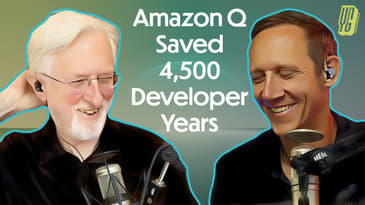


Jason Howell and Jeff Jarvis explore OpenAI's Orion and Strawberry advancements, the impact of AI on the music creation process, how AI saved Amazon an estimated 4,500 developer years of work in application upgrades, and more.
Please support our work on Patreon: http://www.patreon.com/aiinsideshow
NEWS
OpenAI Shows ‘Strawberry’ AI to the Feds and Uses It to Develop ‘Orion’
Hello, you’re here because you said AI image editing was just like Photoshop
Gannett is shuttering site accused of publishing AI product reviews
Chinese and US scientists create AI model to help develop new drugs
This robot from Disney Research can imitate human facial movements
Why musicians are smart to embrace AITop 100 GenAI consumer apps
Jassey: Ave time to upgrade application plummeted from 50 developer-days to hours
Perplexity AI plans to start running ads in fourth quarter as AI-assisted search gains popularity
[00:00:01] This is AI Inside Episode 32, recorded Wednesday August 28th, 2024.
[00:00:07] Amazon Saves 4,500 Developer Years with AI.
[00:00:12] This episode of AI Inside is made possible by our wonderful patrons at patreon.com.com.au.
[00:00:17] If you like what you hear, head on over and support us directly and thank you for making
[00:00:22] independent podcasting possible.
[00:00:29] Hey, what's going on everybody?
[00:00:31] Welcome to another episode of AI Inside, the show where we take a look at the AI that
[00:00:36] is layered like a wonderful azana through all sorts of technology that we use on a regular
[00:00:41] basis or might use in the future when we've got household humanoid robots wandering about.
[00:00:49] That's just a little bit of a glimpse into what we might be talking about today.
[00:00:52] I'm Jason Howell, one of the hosts, joined as always by my co-host Jeff Jarvis.
[00:00:57] How you doing Jeff?
[00:00:58] Hey boss, good to see you.
[00:00:59] Hey, good to see you too.
[00:01:00] Welcome for another episode.
[00:01:03] We've got a definitely a great show with some excellent news to talk about before we get started.
[00:01:09] Huge thank you to those of you who support us on patreon.patreon.com.
[00:01:13] Slash AI Inside show like this week's featured patron, my sister, Kim Blazer.
[00:01:21] Kim, you're supporting me from day one.
[00:01:24] Me and Jeff.
[00:01:25] Thank you sis.
[00:01:25] It's awesome.
[00:01:26] Thank you, Kimmy.
[00:01:27] So good to have you on board.
[00:01:29] Anyone can get on board.
[00:01:30] You don't have to be my sister in order to support us.
[00:01:33] Patreon.com slash AI Inside show.
[00:01:36] Also, if you are watching us live because week after week we continue to get more and
[00:01:41] more live viewers of the show when we're recording it, please subscribe to the podcast
[00:01:46] so you don't miss future episodes that can easily be done at AI inside dot show.
[00:01:51] All the information you need is there waiting for you.
[00:01:55] All right.
[00:01:55] So let's get right into it.
[00:01:57] Starting with strawberries and what I'm talking about is the information who reported on its
[00:02:04] sources saying that open AI is targeting a fall release for its rumored strawberry AI.
[00:02:11] This at one time was called Q star and they ended up reportedly changing the name of this.
[00:02:17] This is the model that is reported to be capable of solving complex math and programming
[00:02:24] problems much better than what we've seen out of current models.
[00:02:29] Also, though part of the report is that open AI is working on another model or AI model called
[00:02:37] Orion, which would actually utilize strawberries high quality training data to surpass GPT
[00:02:46] fours abilities.
[00:02:48] So essentially, strawberry creating that high quality data that's then fed into Orion as its
[00:02:57] dataset.
[00:02:58] It's learning of model essentially, which is interesting.
[00:03:03] I'm super curious about this idea because on its surface, we've talked about it before,
[00:03:09] but on its surface the idea of taking AI generated output and using that as a dataset for
[00:03:15] an AI system just sounds it sounds wrong.
[00:03:20] But I don't know, some people have pointed out that it's not actually it might seem like
[00:03:25] it would be wrong, but it just seems like it would be deluded information.
[00:03:29] But I don't know what are your thoughts on that?
[00:03:31] Two things.
[00:03:31] I think the first is that is the strawberry supposedly capable of reasoning and when I
[00:03:35] wrote about all these topics is it forces us to define reasoning.
[00:03:40] Yeah, what is that?
[00:03:41] What is reasoning?
[00:03:41] What does it mean to say that it can reason something if you give it a problem?
[00:03:45] The issue for AI remains that it has no touch to reality.
[00:03:49] It has no experience.
[00:03:51] It has no way to experience things.
[00:03:53] So can it come up with its own human like algorithms of figuring out the world
[00:04:00] reasoning things through knowing what the impact of something is?
[00:04:04] How does it test hypotheses against reality?
[00:04:08] So that's one.
[00:04:09] The second is this is this synthetic data thing.
[00:04:12] Yes.
[00:04:13] I remain still cautious as can be about that.
[00:04:19] I've mentioned oftentimes my friend, Matthew Christian,
[00:04:21] about wrote a piece in the Atlantic about the text Pocalypse about feeding upon your own
[00:04:26] entrails until you end up with a gray goo.
[00:04:28] Sorry for that.
[00:04:29] Right.
[00:04:31] And the New York Times, I think it was had a story this week
[00:04:36] about the illustration they gave is they gave it a bunch of handwritten numbers
[00:04:40] and then had it learn from the output of that over and over and over again until
[00:04:44] everything just starts to look the same.
[00:04:49] And I don't understand the logic of artificial data, synthetic data.
[00:05:00] Yeah.
[00:05:01] I have a hard time with that too.
[00:05:02] In the sense that if you were saying this machine is trying to just train the machine
[00:05:08] better, that might make more sense to me.
[00:05:10] And it's doing some routine to do that.
[00:05:12] But once again, it has no tie to human reality.
[00:05:17] And so it's making up something on making up something.
[00:05:20] And I just I'm dubious.
[00:05:21] It's going to work very well.
[00:05:22] I know there are experts who say I'm full of crap.
[00:05:24] And I don't know enough about the science and the computing to get to the bottom of it.
[00:05:31] But I'm dubious.
[00:05:32] So we'll see where the strawberry in fact wows us.
[00:05:34] I'm sure it'll have some great parlor tricks.
[00:05:38] And maybe it'll be very useful in new ways.
[00:05:41] But I will say again, it ain't artificial intelligence.
[00:05:45] It's not general intelligence.
[00:05:47] It's not AGI.
[00:05:48] The better what?
[00:05:49] I'm not going to believe it.
[00:05:50] Yeah.
[00:05:51] Well, that is a good question.
[00:05:53] Like I'm not sure that I've seen AGI called out in relation to this.
[00:05:58] But we know that folks like Sam Altman and who are creating models like this,
[00:06:04] they really want you to believe that that is the past.
[00:06:07] That's the past.
[00:06:08] That's the only thing they're all just around the corner.
[00:06:10] When I was a little kid, my parents would say the Christmas was around the corner.
[00:06:14] And I really wanted to walk around the corner for your other.
[00:06:16] That's where Christmas is, right?
[00:06:18] It's to me, AGI is just like that.
[00:06:20] It's perpetually around the corner.
[00:06:23] It's perpetually just out of arms.
[00:06:25] We're there on Third Street.
[00:06:27] It's flying cars.
[00:06:29] Right.
[00:06:30] Right.
[00:06:30] Flying cars.
[00:06:31] We're going to have it in 10 years.
[00:06:32] I guarantee it.
[00:06:33] And then that it's always 10 years later when it's going to actually happen.
[00:06:37] That and fusion.
[00:06:39] Yes.
[00:06:40] Yes, that right.
[00:06:41] That too.
[00:06:41] In the case of Strawberry, it is a fall release possible according to the report
[00:06:49] done as part of chat GPT, but a smaller version of the model could actually still get pushed
[00:06:57] to 2025.
[00:06:59] So it could be pushed even further.
[00:07:01] All that's to say that there is no obvious launch date for any of this.
[00:07:07] We could see it sooner rather than later or later or never.
[00:07:11] Right.
[00:07:11] What was interesting too about the story is that OpenAI showed it to the feds.
[00:07:17] That's right.
[00:07:18] That's very important.
[00:07:19] Constant effort.
[00:07:21] They're doing a very smart job of doing PR, otherwise known as lobbying,
[00:07:25] with the government.
[00:07:26] I'm saying, oh, we're the ones you should listen to.
[00:07:28] We are the smart ones.
[00:07:29] Yes, we want regulation, but we should help write that regulation.
[00:07:31] And we're going to show you this amazing tool we've done before we show anybody else.
[00:07:35] And they're playing to governmental ego, which is kind of fascinating.
[00:07:41] Yep.
[00:07:41] Yep.
[00:07:43] Yeah, so very, very interesting.
[00:07:45] And that by the way, what you're talking about is showing it to the national security officials
[00:07:50] aligns with their, they had announced a collaboration earlier this morning.
[00:07:56] This month with the US AI Safety Institute.
[00:07:58] So this is kind of part of that as well, kind of like proof in the pudding sort of thing.
[00:08:04] Right.
[00:08:05] I knew the second I saw the headline of this article that we had to talk about it.
[00:08:11] The Verge article by Sarah Zhang about the Pixel 9 magic editor.
[00:08:15] Of course, last week on the show, I showed off the Pixel 9 and some of the features.
[00:08:20] And of course, one of those AI features is the magic editor, which is
[00:08:25] kind of a part of Google photos.
[00:08:28] So the photos experience, you can go in there and find a photo in your photo reel
[00:08:32] and go to edit it.
[00:08:33] And then you hit the magic editor button, which is of course denoted by like, you know,
[00:08:37] graphical stars and colors and everything.
[00:08:41] It's an animation.
[00:08:42] Yes, it's totally magic.
[00:08:43] It's enticing you to go there.
[00:08:45] And then when you do that, you can take a portion of your photo that, you know,
[00:08:49] your real photo and reimagine it.
[00:08:51] You can say put daffodils here.
[00:08:53] Or in the case of Sarah's article, you know, remove the person from the Tiananmen Square photo.
[00:09:00] Or and I don't know if that was just used as like an example of what could have happened.
[00:09:04] That might not have actually been used with reimagine.
[00:09:08] But Sarah did show, you know, some images like here's a photo of a stream.
[00:09:12] And then through the use of the reimagine tool able to edit in a very easily.
[00:09:18] And I think that's a big part of her point here at the click of a button
[00:09:23] edit in a crashed helicopter that looks, you know, reasonably convincing or a woman,
[00:09:28] you know, sitting on a carpet in her apartment, let's say, and then edited with magic editor
[00:09:35] able to include, you know, a syringe filled with the red liquid, a bottle of wine,
[00:09:41] something that resembles like lines of cocaine or some sort of powdery drug on the on the
[00:09:46] carpet. And I think her point is that is that these kinds of tools are the bar is lowered so far
[00:09:57] that as she puts it in the headline, no one's ready for this, that the assumption that photos
[00:10:03] equal reality has been challenged before. But this is the biggest challenge that we've seen
[00:10:09] yet because the masses now have access to this capability with very little effort needed in
[00:10:17] order to do it. And I think I know where your where your mind is at on this, but I'm curious to hear
[00:10:23] your thoughts. Yeah, and I get the argument. It's the argument made in the next story you
[00:10:28] put up too, which is also from the verge that the difference here is kind of a follow-up.
[00:10:34] It's the scale and speed. And so they stole a famous Mike Maznick headline about section 230
[00:10:40] and adjusted it here. Hello, you're here because you said AI image editing was just like Photoshop.
[00:10:47] So it's going to go in and say how you're wrong. That's a bad faith argument because
[00:10:50] it can do so much more and so much faster, which is the argument about so much about the
[00:10:54] Internet. Okay, stipulated it can do more and faster. But let's remember that photography
[00:10:59] is less than two centuries old. And even in old fashioned dark room photography,
[00:11:06] I've mentioned before there's the famous incident of a photographer thinking that Abraham Lincoln
[00:11:11] didn't look distinguished and presidential enough. So he put one of the famous portraits
[00:11:16] of Lincoln is his head on Calhoun's body, Calhoun being a slave owner irony of ironies
[00:11:22] and a horrible human being. And this came up with last year's Association of Internet
[00:11:27] Researchers Conference I went to, we were talking about all of this in deep fakes and
[00:11:30] everything else. And one of the researchers said, I quote this in my next book, the Web We Leave,
[00:11:35] we forgot that we already figured out that we can't know truth. And in any of this,
[00:11:41] it's just simply true that we have to judge the medium, judge the source,
[00:11:48] judge the veracity based on motive of what people are giving us. And there are tools,
[00:11:53] some better, some faster than others. But there are plenty of tools that let you create
[00:11:57] anything you want. That's fiction, that's film, that's anything. So I put up on the rundown. I
[00:12:04] don't know if you can get to it because it's a machine. A story from 1990, which had the exact
[00:12:11] same fears, of course about Photoshop and saying in there that, oh my God, look at the things
[00:12:17] that could be done with photos. And I remember being at the New York Daily News in about 1991,
[00:12:24] where I wowed them showing them what could be done with photo manipulation. And they hadn't
[00:12:29] seen this before. They hadn't really seen Photoshop and stuff. And I showed them what was happening
[00:12:34] with it. And there's always this little stage of shock you go through. I didn't think we
[00:12:41] could do that. Oh my Lord, what's the implications? Well, the implication is always that you
[00:12:45] got to judge for yourself. And yes, there's now a factor, a new factor you've got to judge.
[00:12:50] But I'm not terribly concerned. Now the other thing about AI is right now you can tell it in a flash
[00:12:55] because it looks so fakey. But it's made up from not just what's manipulated through
[00:13:00] the iPhone. But if you look at the stuff that AI makes up on its own, you can tell immediately
[00:13:07] it has that strange sheen about it. Yeah. Yeah. This came up last night on
[00:13:13] Android Faithful, we were talking about this. And the example of the Taylor Swift thing that
[00:13:21] we talked about a couple of weeks ago, the AI-generated image of Taylor Swift supporting
[00:13:25] Donald Trump and like, see, this is what happens when more people have access to these tools.
[00:13:32] And I was like, yeah, but what happened when that was shared? Immediately people called BS.
[00:13:38] Right. It's not like suddenly everybody was won over because this thing existed.
[00:13:45] It was immediately called out and widely spread that this thing was fake. And yeah,
[00:13:51] I mean at the end of the day, but my feeling when I read through that is like,
[00:13:55] Sarah, I'm a fan of the work that you do and everything, but it just,
[00:13:59] it feels very reactive like, oh, wait a minute, the technology is now too good.
[00:14:03] And we've got to do something and I don't know that she's necessarily calling for
[00:14:09] slowing down development or just raising awareness potentially about this stuff.
[00:14:16] But I mean, the challenge, the trick is the same as it ever was. It's,
[00:14:22] as we've talked about many times, it's the people, not the tools,
[00:14:25] just because the tool is suddenly better than it was before doesn't immediately make it
[00:14:29] a bad tool. Like it's people can and have done this for centuries.
[00:14:36] And I'll do it again. I'll plug the book again. And the web we weave coming out this October,
[00:14:40] web 20 is the discount code for 20% off if you find it on basic books. Okay.
[00:14:46] I go through a story which I won't dwell on right now that I call it's called Fama.
[00:14:51] It's the ability, the system that people used before they had print, which was social.
[00:14:56] You knew the innkeeper, talked to the people who came through town and the innkeeper
[00:15:01] cared about her reputation and you tended to trust the innkeeper. But that salesperson over
[00:15:05] there, you know that he's full of crap to make stuff up. That is to say that it's in the
[00:15:10] ear of the beholder that it's our responsibility man to decide. And no, I don't think this
[00:15:15] leads to all kinds of new classes in media literacy and tech literacy and all that.
[00:15:19] It just means that we've got to understand the human motivations of why someone might
[00:15:23] make up something like that and make us suspicious enough to ask. And especially
[00:15:27] anything you see that is too good to be true, stop. Just stop and ask what could be behind
[00:15:34] this. It could be a great joke. It could be a great insult. It could be a conspiracy.
[00:15:39] You don't know. And you need to look into it more. What you're looking into is not the
[00:15:42] technology. You're looking into how people manipulated it in whatever tool for their purposes.
[00:15:49] Yeah. So I'm not scared. I'm not scared. Yeah, it doesn't concern me either, but certainly a lot
[00:15:56] of people reacted to that. Yeah. And I think a lot of people do feel that way about it. And I think
[00:16:02] really at the end of the day, it comes down to the uncertainty tied to a new technology that is
[00:16:08] still kind of misunderstood, I suppose, or kind of making itself understood slowly.
[00:16:15] And actually, this is a topic that I'm sure we're going to have plenty of opportunity
[00:16:20] to talk with Sarah about when she connects here in a little bit.
[00:16:25] Is it Gannett or Gannett? I never know how to say Gannett. Gannett shuttering its reviewed
[00:16:34] product review website. This is going to happen on November 1st, 2024, according to sources
[00:16:41] at the Verge. The content on the review site had been scrutinized for the authenticity of its content.
[00:16:49] And this all stemmed from an October 2023 investigation by its own unionized staff
[00:16:56] who was questioning the writing styles and the reviews, could not verify the authors,
[00:17:01] you know, went looking on LinkedIn and other places online and could not verify that they
[00:17:05] actually existed, basically accusing the site of using AI to generate reviews content, which
[00:17:11] Gannett then attributed to a third-party marketing company, AdVon Commerce,
[00:17:19] who later denied using AI to write the articles, but people internally there said, oh yeah, AI has
[00:17:25] been used to write some of their content anyway. So it's shutting down. What do you think about
[00:17:29] this? That was using AI for sports stories too, not really generative AI, but a different
[00:17:33] structure. I think this is bad in a couple ways. One is that they use this stuff,
[00:17:39] and two is when the employees were whistleblowing on it, they ended up losing their jobs.
[00:17:45] And so kind of everybody lost there. They shouldn't have used it in the first place. If you're going
[00:17:50] to have a review site, I expect human reviewers to put their opinions on the line to say, I used
[00:17:55] this product service, watch this, whatever, right? But if the truth is, I talked to the,
[00:18:01] there's an executive at another one of these awful companies I talked to some time ago
[00:18:05] who said, you don't understand, Jeff, we're in a war about reviews. And so he justified using AI
[00:18:11] to make up reviews, which is to say that reviews online now pretty much have no credibility whatsoever,
[00:18:17] but it's not just reviews. It's a microcosm of what's happening to the web. People say Google
[00:18:22] is getting worse. Maybe it is in some ways, but I think the real problem is the web is
[00:18:26] getting worse. The web is getting ruined by this onslaught of junk. And it's not just
[00:18:32] synthetic data ruining AI. Synthetic data is ruining the web. And so, yeah, Gannett, I think
[00:18:40] ruined its credibility in reviews and probably had to get rid of this. The fact that the employees
[00:18:45] were the ones who blew the whistle and they lost their jobs is the wrong responsibility here.
[00:18:50] They should have gotten new jobs, God damn it. But yeah, a lot of the crap that we're
[00:18:56] seeing on the internet now is AI generated and it's ruining it for all of us.
[00:19:00] Yeah. I mean, reviews is just one of many different types of content that can suffer at the face of
[00:19:07] this sort of thing. But it is a very, like it is a type of content that I'm personally very
[00:19:12] familiar with because I review products and as my own kind of ethical approach on this,
[00:19:19] I won't write something unless I truly feel it deserves to be written or spoken about
[00:19:25] a product based on my particular use. And if I'm looking for reviews content from someone else,
[00:19:30] I want to know that that's derived from some sort of personal experience.
[00:19:34] Something real and tangible and not an AI that just goes out and scours and finds the general
[00:19:41] sentiment about a certain thing and then turns that into the declarative statement.
[00:19:49] Especially if you also have an affiliate link to buy. Oh, you know, those companies that are
[00:19:56] trying to make this stuff up are going to make up reasons to get people to buy this stuff and so
[00:20:00] credibility goes nowhere as a result. I used to be a reviewer myself of TV
[00:20:06] and I vowed that I would never use the fast forward button. I'd watch every damn minute
[00:20:09] of some of these horrible long miniseries. You don't know how I suffered. But yeah,
[00:20:14] a reviewer has a responsibility to the audience to say I'm spending my time so you can spend yours
[00:20:20] better. Right? Yes. I watched this entire series, so you don't have to. AD was the worst thing I had
[00:20:29] to watch a 14 hour miniseries. I watched every damn minute of it. AD. I vaguely remember that one.
[00:20:36] Vaguely remember hearing about that. I don't know that I actually watched it. You were
[00:20:43] remember it like I do remember it existing. So I've added like thorn birds. Did you have to review?
[00:20:50] Oh, yes. Oh, yeah. Yeah, that was a big deal at the time too. My parents are way into that one.
[00:20:55] Anyways, scientists from China and the United States have developed a pretty groundbreaking
[00:21:02] AI model called Act Found which can predict drug bioactivity. It could make drug development
[00:21:09] faster, more cost effective. The model was actually trained on a pretty extensive data set,
[00:21:16] including over 35,000 assays, 1.6 million experimentally measured bioactivities,
[00:21:26] a widely used chemical database or sorry, training data was sourced from widely used
[00:21:34] chemical databases. So many databases, I guess the one big challenge is the fact that different assays
[00:21:41] have differing units, different values, ranges, measurement metrics and all that making them
[00:21:49] incompatible, let's say between each other. And so that's a challenge for the AI. But
[00:21:54] I thought this was an interesting story. I'm always very curious to see how AI can transform
[00:22:00] things like exactly this from a super kind of a supercharged perspective of what we could do before
[00:22:08] and then taking the power of AI and its analytical capabilities and applying it to something really
[00:22:15] important. Yeah, this is where it really does matter. I was reading up on AI being able to
[00:22:20] predict where tumors appeared earlier than the human eye could catch them. I think
[00:22:28] gave an address to a pharma company in Switzerland. Very nice trip, good chocolate.
[00:22:35] And the language that I never realized about pharma is what they talked about is what they
[00:22:40] trade in is molecules. They're always in the hunt for a molecule and then the use of it.
[00:22:49] And that makes it a little simpler to get your head around that there's a finite set of, well,
[00:22:58] there's a test that exists against it. And one thing about the pharma industry is that they go
[00:23:03] through obviously a tremendous amount of failure. They try a hypothesis, it doesn't work, they do
[00:23:08] something else. And one of the problems for the industry has been that they didn't share their
[00:23:13] failures because it would seem like, well, let the other guy go through the same stuff we went
[00:23:17] through. When it gets to AI and training sets, I hope that it motivates pharma to share
[00:23:23] that data more openly so that these systems can be smarter and that everybody's going to
[00:23:28] be better off as a result. And I'll be curious just kind of ethically where that goes in that industry.
[00:23:35] Yeah, indeed. Indeed. I'm very curious to see how that how that proliferates and influences
[00:23:41] development of those things. And then finally, robotics which is kind of AI,
[00:23:52] robotics and AI really seem to travel in the same kind of direction. And I think in the future,
[00:23:57] this is going to become more and more the case. But Mark Gurman at Bloomberg wrote about Apple's
[00:24:03] exploration of robotics as its next pursuit quote beyond the iPhone. And so, which brings back
[00:24:13] memories of the auto, their self-driving car initiative that basically went away according to
[00:24:21] sources. Here it's looking at a ways to bring robots into the home. And Mark Gurman points out that
[00:24:30] essentially the car, the driving car project was a giant rolling robot at its core. And so,
[00:24:38] some internally are saying that by shuttering that department, they're able to redirect more staff
[00:24:46] at being positioned towards this goal with a much higher focus. But it's still going to be
[00:24:52] a long time before we see any of this stuff happening. They have a tabletop device codename
[00:24:58] J595 that has an iPad type display cameras and a base with a robotic actuator as a product that
[00:25:07] Gurman says should arrive in 2026 or 2027. But who the heck knows? I mean,
[00:25:13] it's Harvey Rob Collins as shuffle in the comments. What kind of robot would actually make an app?
[00:25:18] When I hear this notion of a tabletop robot, I can't envision what that does. Shuffle some
[00:25:25] cards for me. I mean, probably my paucity of imagination to figure out what that might be.
[00:25:30] But that's the latest description. We'll just have to see. It's a solution looking for a problem
[00:25:37] and maybe they'll find it. Yeah, maybe, maybe. And then let's see here. As far as things that
[00:25:45] the robot could actually do according to the article, it could be a device that comes to
[00:25:54] you when you're preoccupied and you need to do something with a device or whatever. So, okay.
[00:26:00] That's kind of hard to figure out. Operator, check on something in the house while you're gone.
[00:26:06] Do household chores. That would be a good one. Would love to see a robot do some household chores.
[00:26:12] I just don't see Apple being in the vacuuming business though. Totally.
[00:26:18] Policy maybe, but not vacuuming. And if you thought Apple Vision Pro was expensive right
[00:26:23] out of the gate, just imagine how some robot that cleans your home, how pricey that's going
[00:26:29] to be. And then finally, real quick, and then we're going to take a break. I just,
[00:26:33] I came across this video from Disney Research. It's an old video. It's actually from 2020,
[00:26:40] but the whole approach of this is robotic that is meant to imitate the facial movements
[00:26:47] of a human in the eyes and then also kind of like these subtle head nods and things like that.
[00:26:53] So, you could have that on your desktop freaking you out.
[00:26:57] Yes. You know, put a skin bag over it and it'll be fine. It'll be fine.
[00:27:04] Anyways, interesting to look at nonetheless. All right, we're going to take a break and when
[00:27:08] we come back, we should have a fun conversation coming right up.
[00:27:14] All right, Jeff. Today is a day of winging it because we had some plans for this episode.
[00:27:21] Plans changed sometimes on you at a moment. Technology.
[00:27:25] And so, yeah, sometimes, you know, technology even it's not just AI that's imperfect. It's all
[00:27:30] types of technology. So we've got a bunch of stories here. You are more familiar with some
[00:27:35] of these stories than I am. So we're going to kind of like reverse the roles a little bit
[00:27:39] and you get to set up some of this stuff and let me know. And then I can, you know,
[00:27:43] kind of jump in and let you know what I think about it while we're talking about it.
[00:27:45] Sure. What do you think? The way this works is I go through all week and I find AI
[00:27:49] stories and I put them in this rundown also in the twig rundown. And then I put them in here and
[00:27:55] Jason has very good news judgment, really does understands what is going to make for a good
[00:27:59] show and good discussion. He puts stuff up and we thought we're going to have a guest. We did
[00:28:02] fewer stories. So we just went back in and found some more. So we'll go through a couple of these.
[00:28:07] One is the Washington Post. I like to find because I'm very critical these days of the
[00:28:11] New York Times and the Washington Post on both politics and technology.
[00:28:14] So when I find something good and positive, I want to point it out. So Yian Wu,
[00:28:20] the Washington Post wrote a story about how why musicians are smart to embrace AI
[00:28:25] and see if I figured with you, Dr. Musician, it might be interesting to see how they present this.
[00:28:31] But it's really about being able to use it for inspiration and getting past,
[00:28:38] you know, as a writer I can understand this to an extent. But it's pretty hard for me to use it
[00:28:44] because I have specific things I need to say and it doesn't really get me over. But I'm curious
[00:28:49] for you, Jason, if you're trying to get past a melody or past lyrics or past an idea,
[00:28:55] do you think this in terms of your own creativity would be helpful? Is helpful?
[00:29:02] Yeah, I mean, and I've done videos to exactly this point on the TechSplitter YouTube channel.
[00:29:09] I am endlessly fascinated about the progress, the progression of artificial intelligence and
[00:29:17] music generation, not from the perspective that a lot of people seem to be, which is,
[00:29:21] oh, I can type in a prompt and it creates an entire song for me and blah, blah, like,
[00:29:26] I'm less interested in that. But although I respect, you know, that people do get
[00:29:30] interested in that, as a musician this is exactly what excites me about AI. I see it as a tool for
[00:29:38] kind of giving me a little bit of an extra kind of pathway to go down in understanding like different
[00:29:47] options or different ideas or different, you know, melodies that might open up or unlock a
[00:29:53] certain direction in my mind when I'm working on a song and I've especially when I've written
[00:29:57] myself into a corner, which I'm sure has, you know, a direct analog to writing and authorship is,
[00:30:04] you know, at a certain point it's like my creativity has spent and it's taken me to a
[00:30:09] certain point. And it's like, I love the idea and I love how I got here, but I have no clue
[00:30:14] what to do from here. And sometimes I hit those points as a musician. If I was working with
[00:30:19] an actual musician in a studio environment, that would be where that collaborative kind of
[00:30:25] conversation happens where that person that I'm sitting next to says, Oh, well, you know,
[00:30:29] what just came to me? It's, you know, why don't we go in there and we tweak the bass and make it
[00:30:33] the little bit. And then I'm like, Oh, wow, suddenly I'm alive again, which was what a producer
[00:30:36] does. Supercharges, right? Right. Exactly. Yes. Exactly. So that is that role of giving you
[00:30:42] a thought or trying something you haven't thought of. If you go down the story,
[00:30:45] I didn't listen to it all. But if you turn up the volume on the Washington Post story
[00:30:49] on the, on the upper right side and scroll down to the guy with the bass. Got it. So here's,
[00:30:58] bassist Mike Foley performs a solo. Lion wanted to create an unambiguous 100% human moment.
[00:31:05] That's this. This is an actual human basis right now. Yes. And now. So now we scroll up
[00:31:13] to the next screen. Then to build the music's poetic character, Lion added AI narration
[00:31:20] of a dream about a labyrinth of stairs. It's described by philosopher Walter Benjamin.
[00:31:26] Okay. This is AI now. So the AI, so is it the narration that's AI? Is it the accompaniment?
[00:31:36] AI. The accompaniment. Okay. And so he's playing also with AI.
[00:31:46] Musician. Yeah. That's a weird switch. It is. So then I added musical layers and drum
[00:31:57] patterns for the song. So I don't know if I like the result very much,
[00:32:03] but it also makes the sole creator able to do a lot. Totally. Well, and that's what gets me
[00:32:09] excited because I, as a musician, you know, I've been writing music and working with,
[00:32:15] you know, friends of mine writing music for almost 30 years now. And since, you know,
[00:32:20] when I lived in my hometown, Boise, Idaho, I was surrounded by people that I knew who were all
[00:32:26] learning this stuff along with me. And so we collaborated a lot. And it was really an
[00:32:30] inspirational time. Since I've been, you know, started a family and everything. I don't
[00:32:34] really know many people who do music. And so it's been largely kind of a solo operation.
[00:32:39] And I miss the collaborative thing because it's a lot of pressure for me to, like, come up with
[00:32:46] everything. Like I can do it, but sometimes like it's just not fun to have to do that. Like,
[00:32:50] I want to bounce ideas off of someone. So that's where this technology really does.
[00:32:55] It's not really judgmental the way a producer is, but it's inspirational the way a producer can be.
[00:33:01] You know, it doesn't say, oh, that's crappy, Jason. You shouldn't do that.
[00:33:04] Yeah, you're not going to get it right. Totally. Right?
[00:33:05] I was always going to tease you. Always going to be your friend, but it can give you ideas you
[00:33:10] didn't otherwise have. So I think I mentioned this on last week's show. We're talking about this a
[00:33:13] lot more as we go forward. I just wrote a syllabus for a course at another university
[00:33:18] I'm planning to be working with. I can't announce yet. And because actually, today is the
[00:33:22] day I am officially retired from CUNY and officially emeritus. Like today is the
[00:33:27] day. Yes, my congratulations. Wow. So I'll be working with another university soon,
[00:33:34] I hope. And it's all about AI and creativity. And my idea in the course is to get students
[00:33:39] just to get something they want to express. And then I want them to express it on their own,
[00:33:43] just like this, just like the basis. Purely human moment. And I don't care if you hate it.
[00:33:48] I don't care if it's bad. I don't care anything. Just see what you can do on your own.
[00:33:52] And then to experiment with what AI can add or not. How is it a helpmate? How isn't it?
[00:33:57] What kinds of tools is it inspiring? Does it help finish things? That's what I want
[00:34:01] the students to explore and see what the relationship is in collaboration with AI.
[00:34:07] And I know we're going to have Lev Menevich on pretty soon. And Lev is a brilliant
[00:34:13] scholar at the University of New York Graduate Center in digital humanities. But he's been
[00:34:18] doing a lot around this about trying to understand how AI becomes a creative tool.
[00:34:22] No different from a base or a baton or a paintbrush. But different. So anyway,
[00:34:29] I thought you find this one interesting. And just find the...
[00:34:34] That's exactly it. I mean, when I opened the article and saw the basically the subheaded
[00:34:39] which said today's experimenters are finding it can be more an inspiration than a threat.
[00:34:44] I was like, yeah, that's exactly how I feel about these tools. Because so many of the videos
[00:34:49] that I've done about this, the comment section ends up being either people who totally get it
[00:34:55] or totally agree with kind of my hypothesis around how musicians use these tools or the flip side,
[00:35:01] which is the doom and gloom AI is killing creativity. AI is killing... It's the end of
[00:35:10] blah, blah, blah. And it's like, no, it doesn't... It's not though. I mean, it might be a change.
[00:35:15] It might be a fork in the road from where we were to where we are going. But that's just
[00:35:21] technology. That's technology in a nutshell. We learn, we adapt and we use it in the new ways
[00:35:27] that we have options to now. I mentioned my friend Matthew Christian, my earlier from University
[00:35:32] of Maryland. He was part of a task force at the Modern Language Association, the MLA, which is
[00:35:37] educators in that field. And they did a really good report on using AI in English in the classroom.
[00:35:43] And they said the printing press is a tool. The typewriter is a tool. It's a tool. And
[00:35:51] all is the right way to go. Yeah, yeah. So the next story is... Interesting.
[00:35:55] Yes. Andreessen, I found this from Benedict Evans, who is an analyst I think the world of.
[00:36:02] He's great. He subscribed to his newsletter. And he used to work at Andreessen Horowitz.
[00:36:07] So he put up a list of the top 100 generative AI consumer apps. What I found interesting about
[00:36:12] this is how few I've ever heard of. And that's maybe shameful given what we do right here.
[00:36:18] I should know more of them. But my point is... But there's so many.
[00:36:21] It's hard to go up with them. And they haven't broken through. They haven't really broken out.
[00:36:24] So if you go down, there's a fair number we would know here. ChatGPT obviously,
[00:36:28] character.ai, which has kind of gotten half acquired. Plexity, Claude.
[00:36:34] Looking face. Lab. Labs. Right. But then Vigil.
[00:36:42] But it falls apart pretty quickly. Let me just read someone's here. Well,
[00:36:44] you've heard of any of these before. Oh, Idiogram. I love Idiogram actually. That's great.
[00:36:49] Janitor AI? No. Quillbot? No. Poe, I think I might have heard of. Liner. Oh, yeah. For Serpo.
[00:36:58] Yeah, we did okay. Liner. Civitai. Civit AI. What are we doing? Civit AI. Yep. Heard of.
[00:37:04] Spicy Chat? That sounds dangerous. No. 11 Labs. Aluma we've heard of. Candy.ai.
[00:37:10] I don't think I've heard of. Crush on AI. Leonardo Delle. Majority. Yes.
[00:37:19] Yodel. Yodio? Yeah, I don't know what that is. Cutout.pro. Photo room. Gamma. VDO. Enough.
[00:37:27] The point is that there's just tons of these things people are putting money into.
[00:37:31] Oh, so many. I saw a separate story today that I think three quarters of all of the startups in
[00:37:36] the world are doing. What's the big, the big?
[00:37:42] The huge edge.
[00:37:45] The incubator. The one that everybody goes to. You know what I mean? Yeah.
[00:37:51] But are you RAI oriented? And the one Sam Altman used to run. So then there's top
[00:37:58] 50 GenIA mobile apps by monthly active users. Microsoft Edge comes up to number two.
[00:38:06] Photomath. Bing is up higher because it's tied to your phones. Brainly, which I don't think was
[00:38:11] on the other list. But same thing happens. It falls off really quickly. There's more brands
[00:38:16] here. Adobe Express. Things you're going to have. Microsoft Swift Key, which I've never
[00:38:22] heard of. You're going to come to those because you're using other things.
[00:38:25] Swift Key's been around for a long time. SnapEvit. But those are all things that come
[00:38:31] attached to another app that you do use, but not as brands on their own.
[00:38:36] So branding in this AI world is at this point really a challenge. That was what
[00:38:42] it just made about this story. Oh man. I'm just looking at this as a research
[00:38:48] point for myself. I want to go in there and find out what a lot of these things actually are
[00:38:52] the ones that I haven't heard of. I'm actually surprised at how many of these I am
[00:38:55] somewhat familiar with. There's a lot on here that I don't know, but
[00:39:03] because this is such a hot market, I don't know if that's the right word for it,
[00:39:09] but a hot item right now, just AI in general and especially generative AI.
[00:39:14] I feel like there's new services. If you go on Product Hunt,
[00:39:17] just to kind of see what new things are hitting there, it's overwhelming. It's
[00:39:22] truly overwhelming the amount of products that are coming out to be the next AI for this or AI
[00:39:28] for that. So even within certain categories, it's really hard to know which one's the best
[00:39:33] within that category. I don't even know. I guess my question is, of a list of these 50,
[00:39:40] how many of these are going to be around in two years? Oh, I think five years. Very few.
[00:39:45] Yeah. Like, do they have the things bot and fold it in? Or yeah.
[00:39:50] I think Rob, in the comments that it's Y Combinator was where my senior role was going.
[00:39:54] Y Combinator. There you go. At least I have the excuse I am a senior now. I'm emeritus,
[00:39:59] but you don't Jason. I have the horrible affliction of the second someone says,
[00:40:04] what's the name of the blah, blah, blah. My mind goes completely blank. I'm like,
[00:40:08] you know, you could be asking me, what's your mom's name blah, blah, blah? And if
[00:40:12] it's said in the right way, I would suddenly be like, Oh my goodness. Why can I not think of it?
[00:40:17] I know. So by the way, Rob says also in the comments, I'm curious just another time to hear.
[00:40:20] He said he talked to his PhD advisor and she decided to do something similar.
[00:40:24] She's a historian. So I'm curious to hear what your PhD is going toward Rob, but we'll do that
[00:40:27] another time. So on with the next story. Interesting. Yes. So Andrew Jassy from
[00:40:37] Amazon and obviously AWS said that the average time, he posted this on LinkedIn,
[00:40:42] which I just found fascinating out of nowhere. The average time used to upgrade
[00:40:48] an application to Java 17 plummeted from typically 50 developer days to a few hours using Generative
[00:40:58] Mail. We asked him, does it save us 4500 developer years of work? Yes, that's crazy but real.
[00:41:07] In under six sets, is that crazy? Pretty remarkable. Anyone who points out,
[00:41:10] is this kind of upgrading is things that people developers hate to do because you're going back
[00:41:16] into what you've done before and it's not fun. You're not building anything. He said in under
[00:41:19] six months, we've been able to upgrade more than 50% of our production Java systems to modernize
[00:41:24] Java versions at a fraction of the usual time and effort. And our developers shipped 79% of
[00:41:30] the auto generated code reviews without any additional changes. That's what I was wondering.
[00:41:35] I was like, all right. So it's able to do all this stuff. How much time do you then spend
[00:41:39] verifying and correcting? And that's a high number of the code that was generated that was
[00:41:47] fine. Ultimately, fine almost 80%. So Jassy says that there's an estimated $260 million
[00:41:53] in annualized efficiency gains or otherwise known as savings. And so what really strikes
[00:41:57] me about these two stories together is AI and Generative AI, a consumer, a B2C tool or a B2B
[00:42:07] enterprise tool. I think we're going to find the value in the savings clearly in the enterprise
[00:42:12] and not in the sense of Sally executive at her desk using it to write more power points.
[00:42:19] And fine, I don't mean that. But I mean these kinds of specific tasks that can be improved and
[00:42:27] measured and tested against to see whether they're right because it matters. That's going to
[00:42:36] those other things we've talked about. So just another interesting tidbit here.
[00:42:40] 50 developer days to just a few hours. That's just all inspiring.
[00:42:47] Yeah, that's remarkable. And I'm sure there are a number of different examples of how
[00:42:52] this time savings is time and time again with Generative AI and everything. I mean,
[00:43:00] I know for the stuff that I'm doing as a solo independent content creator,
[00:43:05] there are certain tasks that I do regularly that I employ, my AI be it perplexity or whatever
[00:43:12] to help me do that. If I wasn't using AI to do that, I'd still be doing those tasks and it would
[00:43:19] definitely be taking me hours instead of 15 minutes. And that's all compounds on top of itself
[00:43:28] when you as you do this more and as more people rely on these systems and everything.
[00:43:34] It's just it really is a huge time saver. And yeah, that's pretty fascinating.
[00:43:41] Yep, love it.
[00:43:42] So however, people never really learn the lesson of what AI can't do well. It can't do facts.
[00:43:49] It can't do meaning it's not good at search. But the producers and the marketing company for
[00:43:56] Francis Ford Coppola's next movie Megalopolis, which is I guess already getting or bound to
[00:44:02] get bad reviews, they decided quite cleverly because we know that Coppola is a genius. He made
[00:44:08] Godfather for for for his sex. He's he's amazing. Right? A lot of really great film.
[00:44:12] So they decided to make a trailer which would go back and show all of the bad reviews that his
[00:44:17] prior works, his masterpiece has got so that you're kind of primed for the bad reviews that
[00:44:23] Megalopolis is going to get. The problem is that they used AI to do that. So all the bad
[00:44:29] reviews were not real. And it took a while for somebody to catch this. But let's see here, the
[00:44:40] Pauline Cale, who was the goddess of film reviewers completely adored Godfather,
[00:44:45] Godfather, Father Tushy lavish praises on the reading for the Vulture right now.
[00:44:49] And said of the whole epic, this is a bicentennial picture that doesn't insult the
[00:44:53] intelligence. It's an epic vision of corruption in America. However, the alleged quote,
[00:44:58] a tributed tour in the trailer said that Godfather is, quote, diminished by its artsiness.
[00:45:05] That was nowhere in review. And so similarly, I guess every single one of these was completely
[00:45:12] wrong. Andrew Serres was said to have called the Godfather a sloppy self indulgent movie.
[00:45:19] That wasn't in his review. Rex Reed did in fact pretty much hate apocalypse now, but his
[00:45:25] quote doesn't appear in the review either. Roger Ebert's mostly positive review of
[00:45:29] Bram Stoker's Dracula, so it wasn't just couple movies, does not include the words a triumph
[00:45:37] of style over substance. And instead he said the movie is an exercise in feverish excess.
[00:45:44] And for that, if little else, I enjoyed it. Right? So it's one of those funny stories
[00:45:49] we now have like the lawyer whose case I covered where some idiot Schmuck decides to use a
[00:45:55] I for this purpose, doesn't check what's going on. And AI doesn't understand facts. It's going to
[00:46:00] always give you an answer people and it doesn't care if the answer is wrong. Right? I reminded
[00:46:05] of a, a citizen city where I worked with the Chicago Tribune after Chicago today folded paper
[00:46:09] that had no tomorrow. I caught the lifeboat the Chicago Tribune midnight shift and in Chicago,
[00:46:15] the bars are open late and people would get into bar fights about facts and the libraries closed
[00:46:21] so they can't call the library and so they call the city desk of the newspaper got these calls all
[00:46:25] the time. And Billy Garrett who was the assistant city editor midnight shift said he had a rule
[00:46:31] to always give them an answer, preferably the wrong one because he always laughed the next
[00:46:36] morning thinking that there was a knockdown drag out fight before they could get the actual
[00:46:40] facts. This is before the internet. So folks look up stuff on your own. Yeah. Yeah. Or
[00:46:47] or if you are going to use AI for any part of this, you got to verify. You got to check
[00:46:53] yeah that the output is actually accurate. And if you're not like that's just pure laziness. Think
[00:47:01] think of the amount of time it would have taken you to do all of that by hand. Right.
[00:47:06] And instead you got AI to do it. And when the AI is done doing it supposedly,
[00:47:12] like if you don't stop there, it's easy to then be at that point and then be like,
[00:47:16] now I got to go and check him. No, it's fine. It'll be fine. But just think of all the time
[00:47:20] you would have spent if you hadn't done this to get a little bit longer to verify and you'll be okay.
[00:47:26] Yeah. The hapless marketing consultant who did this trailer is pictured in deadline. And
[00:47:33] the studio has now cut ties with him. So very costly mistake for him.
[00:47:39] Yeah. No kidding. No kidding. Very interesting. And unsurprising as well.
[00:47:47] And finally, go ahead you go. Well, yeah, no, this is just about perplexity, which is,
[00:47:55] yes, I mentioned it a lot, but primarily because it's just the AI platform that I use
[00:48:01] most often. And so I'm most familiar with it and everything. But we've talked in shows past
[00:48:07] that perplexity was running ads on some of the experience in the future. And it looks like
[00:48:18] they're about to start selling those ads. These ads will appear next to their AI assisted
[00:48:25] search results. So you could end up seeing this, I'm not entirely sure exactly when,
[00:48:32] sometime in the fourth quarter, but it's coming around the bend. And if you're going to use
[00:48:40] perplexity, what I wonder is if you're paying for it, do you still see the ads?
[00:48:45] That's a good question. And I'm not entirely certain on that, but hopefully not.
[00:48:50] You know, I use discover or perplexity and it does, I don't know,
[00:48:55] less than half a dozen stories a day. So it's not like it's a substitute news source at all,
[00:49:01] but they do got a job of packaging it. They link to the sources. And so I can see there being ads in
[00:49:08] there, you know, because I'm using it as a free service right now. It's fine.
[00:49:11] Yeah, discover. Is it discover.ai? Is that what you're talking about?
[00:49:15] No, if you go to perplexity, the app and then
[00:49:17] I see that's its news stories.
[00:49:21] Okay. And how, what have you thought about?
[00:49:23] I think it's pretty good. So if you go to, let's see here, what's an example?
[00:49:29] The space X Polaris launched a late. So they have a human being curated by Twumbley,
[00:49:37] who's the one who works with them, but they have links to astronomy, business standard, France 24,
[00:49:42] Wikipedia, space, you know, half dozen sources, and then below more sources with the headlines.
[00:49:49] So I think it's a very responsible way to present it. Unlike much else.
[00:49:54] I can check it against those sources. It gives credit to those sources. So I think it's pretty good,
[00:50:00] even though publishers are screaming about them. I think this is a model for how it might be done.
[00:50:04] Now, once they add, adds to this, the publishers are going to get streaming saying,
[00:50:08] well, you owe us a piece of that. But once again,
[00:50:10] That's a good point.
[00:50:12] The publishers do this and they're linking to the publishers. They're setting the
[00:50:14] publishers traffic and the publishers are doing the same thing to each other.
[00:50:18] Because the fact that one thing that comes across when you use perplexity discover
[00:50:21] is how much repetition there is in news. Because the same story can have a half dozen
[00:50:26] links that are essentially basically the exact same. So who copied from whom?
[00:50:32] Who's owed the dollar there? I don't know.
[00:50:35] Yeah, interesting. Well, good. You're getting in on the perplexity thing. That's interesting.
[00:50:43] Super curious to hear how you've thought about that after your experience,
[00:50:47] after hearing me talk about it so much on the show. Well, we did it, Jeff. We made it
[00:50:54] by the skin of our teeth to the end of this episode, turning on a dime with an unexpected
[00:51:01] circumstance. And you know what? If we hadn't called it out a couple of times, people probably
[00:51:05] wouldn't have even known the difference. So that's a good thing.
[00:51:08] So that guest we were going to talk to today, we didn't talk to because
[00:51:11] you wonder where they went. We'll be a future show.
[00:51:13] We will.
[00:51:13] We will.
[00:51:13] Yeah, that would be a future show. It's coming.
[00:51:15] And then you did also mention earlier, Lev Manevich as a future guest.
[00:51:19] We've got Lev scheduled for an episode in September. And I tell you what, I'm really,
[00:51:25] I know you are, I'm really looking forward to that conversation as well. It's going to be all
[00:51:28] about kind of AI and creativity, music, art, the whole nine yards. So some great guests coming
[00:51:35] up on this show. But Jeff, goonbergparenthesis.com.
[00:51:41] Yes. Nope, that's it for now.
[00:51:43] Soon enough, my son will give me a new page around JeffTravers.com and I'll have links
[00:51:47] and discount codes for all three of my books there. But that'll be soon.
[00:51:51] Yes, indeed. Excellent. Where is it? What would Google do?
[00:51:57] Why is that not on here anymore?
[00:52:00] It's old.
[00:52:01] It's old.
[00:52:03] You've written enough books now that you can take your old work.
[00:52:06] That's right. It's got that word.
[00:52:07] You go away.
[00:52:08] Yes, yeah.
[00:52:09] Well, I highly respect that.
[00:52:13] Goonbergparenthesis.com is the place to go to check out all of Jeff's writings and work.
[00:52:19] For me, you can go to youtube.com slash at TechSploter. When you go there,
[00:52:24] you can subscribe to the show or subscribe to the channel and you'll get alerted when we do
[00:52:28] live streams like today. When the video version of AI Inside is published, that will appear
[00:52:33] there. Then if you go to aynside.show, that is actually where the podcast,
[00:52:42] pretty much all the information about the podcast is listed on aynside.show. We do include the
[00:52:48] video links. Last week's episode, you can get there and you can listen to it or subscribe.
[00:52:54] But then you also do have the ability to watch the video version if that's your preference.
[00:52:58] If you've got to go to one place, I'd say aynside.show is your one place on the web to check out.
[00:53:04] You can also get to our Patreon from there, patreon.com slash aynside.show. There you can
[00:53:12] support us and be sure that we continue to do this show each and every week. We really do
[00:53:18] rely on your support to continue things as we have done. You get things in a trade for
[00:53:26] that. You get ad free episodes, you get early access to videos, discord community, regular
[00:53:32] hangouts. You also get an AI Inside t-shirt if you become an executive producer like our current
[00:53:39] executive producers, Dr. Du, Jeffrey Maricini, WPVM 103.7 in Asheville, North Carolina and Paul Lang.
[00:53:47] Whether they're wearing their shirt today or not, they're getting one if they haven't
[00:53:51] already and you could too just become an executive producer and you'll get one.
[00:53:54] It's a great quality shirt, I gotta say. I wear mine all the time, but of course it's my show.
[00:54:04] But everything else is gravy. Thank you so much for being here with us each and every week. We
[00:54:09] can't thank you enough for that and thank you Jeff for the hangouts and we'll see you all
[00:54:15] next week on another episode of AI Inside. Bye everybody.