
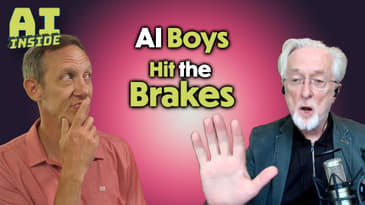


This week, Jason Howell and Jeff Jarvis cover the biggest AI safety week in memory. Anthropic CEO Dario Amodei published a sweeping essay calling for an industry slowdown, Sam Altman backed him and shelved OpenAI's IPO, and Mark Zuckerberg says everyone should tend to their own gardens. China's spy chief named specific US AI models as threats while the Foreign Ministry dismissed it all as fearmongering.
Also in this episode: Apple launches iOS 27 with a waitlisted Siri AI and hidden code for third-party model swapping, Agility Robotics unveils Digit 5, Jeff Jarvis's essay on regulatory capture, and AI upends the math world.
CHAPTERS:
• 0:00 - Start
• 0:00:40 - We Must Pace the Frontier
• 0:25:48 - China Rejects AI ‘Fearmongering’ After Amodei Urges Slowdown - Bloomberg
• 0:35:05 - Apple Watch’s new feature listens to your chats and recaps them
• 0:51:32 - Meta to Launch Camera-Free Smart Glasses Amid Mounting Privacy Concerns
• 0:55:06 - Agility Robotics Unveils Humanoid Designed to Work Safely Alongside Humans - Bloomberg
• 0:57:45 - Math Can’t Go On Like This
• 1:06:50 - OpenAI buys smartphone camera maker Glass Imaging for $300 million, report says | TechCrunch
• 1:08:10 - Introducing Gemini 3.8 Live and 3.8 Live Extended Thinking
• 1:09:25 - Google Home MCP lets Antigravity, Claude, OpenClaw, & more control your smart home
• 1:11:11 - Anthropic merges Claude chat and Cowork in one interface
Hosts: Jason Howell and Jeff Jarvis
Download and subscribe to AI Inside in audio and video: aiinside.show
Support the podcast on Patreon for special perks: patreon.com/aiinsideshow
You'll get ad-free episodes, the NEW AI Inside Daily podcast, a members-only Discord, and you can get an AI Inside T-Shirt by becoming an Executive Producer!
Jason
00:00
Coming up next, Jeff Jarvis and I dig into what seems to be a pretty big inflection point for AI safety at least, Anthropics Dario Amade. uh called publicly for a global slowdown, you know, it's all about that pace. Uh a lot of other AI leaders either agreeing with or pushing back, which is the case uh with uh Mark Zuckerberg and a few others.
00:25
China accusing everyone of fear mongering while at the same time their own spy chief says AI threatens uh the party in which we're in. Uh Apple's new watch set to challenge wiretapping laws, or so it seems, I wouldn't be surprised anyways. Smart glasses without cameras, does that make them any better?
00:44
And robots, and a whole lot more coming up next on this episode of the AI Inside Podcast. Hello everybody and welcome to another episode of AI Inside the Show, where we take a look at the AI that is layered throughout the world of technology in dizzying fashion this week because my Goodness, there's too many stories all related. Making sense of it all was a challenge for me, let me let me just be honest right at the top.
01:20
But We will get through it and I have a feeling you're gonna get a lot of sense made for you because my co-host Jeff Jarvis is here and You wrote about this stuff. I I loved your piece, by the way, which we'll talk about. Yeah, I thought it was great.
Jeff
01:36
Jason, I'm actually coming to you from the bunker. We're all gonna be destroyed. We just don't know when. AI is taking over the world.
Jason
01:43
That's it. It's over. It's over.
01:47
Oh, why am I smiling if it's over? But you know what? Yeah.
Jeff
01:51
Geez, jeez, jeez. Stupidity is just contagious.
Jason
01:57
Yeah.
Jeff
01:58
It's all over and it's driving me. The media coverage is driving me completely bananas. The the policymakers are driving me even more bananas And the bottom line for me is that AI is being run by the wrong people. It's a neat and wonderful technology, and they're ruining it for everybody.
Jason
02:18
Is it uh hmm, let me think about that. Um I d I don't disagree. Uh but they are they do happen to be the people who have built these tools that are being widely adopted. And so of course they believe they're the ones to uh to lead the the charge.
Jeff
02:34
Right, which is which I I will confess that that I've fallen into that trope trap in the past, right? I mean I wrote a book about Google because Google figured it out. We should follow what Google does and all that.
02:45
And I still think there are lessons to be had there. I'm not denying that, but what made Mark Zuckerberg the guy to run our social Graph for all society. No. No. Okay, fair point.
02:55
Right? Absolutely. with transformers that created the possibility of where we go now, but it was a hell of a lot of brilliant mathematicians and computer scientists before that who s laid the groundwork.
03:11
And you're right, these are the companies that had the chutzpah to go out to get the money to resource the resources to be able to build what they built, but that doesn't mean that they're that they should be the ones in charge of everything then Yeah, and it's it's frustrating because even with even Zuckerberg uh you know, who who as I as I write in my piece, there were certain people who were freeze-dried sophomores when he left after his second year in Harvard, and they sound like it's still. Um He tried in the right ways. These guys at OpenAI and Anthropic and certainly at SpaceX are, I think, harming themselves, harming their industry, harming the technology, harming all of us.
03:58
And it's frustrating as hell. And the real problem in my mind, I didn't mean to get right into my piece, sorry. Um, is is that uh they're being followed too much in media.
04:11
So we have this Doomer uh back up a little bit. Um Reed Hoffman is a very good piece, which we'll get to in a few minutes. today in which he contrasts the accelerationist of the doomers.
04:21
And I think for it's a good good description when when you want to get to it. The problem that I'm having is you know I've said it on the show a million times, and we've had guests on, um Emile Torres on the show have talked about this. Yeah.
04:33
It's the cult is not getting covered. And the cultish beliefs are what are driving so much of this discussion. And it's happening in the background such that we don't see it.
04:43
So this weekend, the New York Times, Michelle Goldberg, New York Times, which I criticize often Michelle Goldberg had, I think, a really good column saying that the real story that's going on behind here, um She said that the coverage is incomplete because it doesn't account for tech leaders' messianic dreams. And this goes right into Testcrail. And you've heard me on this show talk about TestcrayL.
05:07
Uh it's the acronym that was created by Timnik Gebrux, the researcher and Emile Torres, stands for transhumanism, extroperanism, signalitarianism, cosmism, rationalism, effective altruism, long-termism, but never mind all that It's a bunch of philosoph faux philosophies that guide many of these people. This is what comes from the Dumerism is that oh my god we are so powerful we could destroy Earth and we owe an obligation to the far, far for f f future of of humanity. Not us today.
05:36
F never mind us today. We're kind of nothing And we wanna live forever, by the way, and we wanna stick chips in our heads, and we wanna populate bars and all this stuff. And all of this is at one level a gigantic distraction from the real issues of AI, and there are real issues of AI, environmental, educational, labor, economic um societal, but it distracts from all that because it's all this future shock crap and it also then SKUs, the most important discussion we have, which is AI safety.
06:09
So when when the Doomers say AI safety, they mean extinction When sane people say AI safety, they mean environment, education, uh, jobs, economy, uh society. Right? So what's happening is that too much of the discussion in media is about this.
06:26
There was one story this morning that drove me nuts. So, you know, Bernie Sanders and Steve Bannon got together at the same event. Well, it was all brought together by the Future of Humanity Institute, I think that was the right name, and that's all money from these doomer cultists, craziest test rails.
06:41
And the stories don't say that. They don't acknowledge that at all. They just say, oh, it's a not-for-profit and held this event.
06:47
Well, that event is held by the people who are pushing these faux philosophies, and out of that comes A distraction from real issues, and B, then um dire predictions of what's going to happen from AI, which aren't going to be the case. And then C out of that's going to come really bad policy. So people like Ted Lew think if I kill create a kill switch, I've solved everything.
07:11
It's simplistic idiocy. If you're Bernie Sanders, you say stop all development. Well that doesn't help us, and it does indeed help China.
07:18
And so there's just this raft of stupidity, and it's driving me completely crazy. And there's very little good coverage. Michelle Goldberg's column I think is very good.
07:28
Um uh Cal Newport, who's a Georgetown computer scientist, has written two columns in the Times that I think are very good, also trying to expose the nuttiness behind this stuff. I have sent the piece I wrote to um A couple of MSNBC anchors trying to get anybody to listen to say there's another story here, there's a better story here, and they're not doing it. Uh and if you go through the coverage, I just went through a couple of days with the coverage in the Times and the Washington Post and uh even The Guardian And it just keeps on repeating these simple things that there's this AI Doomsday.
08:03
Now everybody's talking about Doomsday. We've got to do something to revert doomsday. It's the wrong discussion, people.
08:08
It's the wrong story. And you're not getting the underlying story.
Jason
08:12
Sorry for that rant. I'm here for it.
Jeff
08:17
I didn't mean to start right off with that, but I That's okay.
Jason
08:19
That's okay. Hey, I gave you the open door for it. It's it's all good. And by the way, I'm not saying I'm uh just one more thing.
Jeff
08:25
Sorry, I'm not saying that we don't regulate. It's already regulated. We already have government regulations.
08:31
I am saying that we need to do change some things. We need radical transparency in AI. OpenAI is still not opened up about what its uh agents did.
08:40
By the way, they weren't agents, they were a bunch of subroutines. No, no, no. It was a bunch of computer subroutines that went off and got a sign of task, brought the test back. Not a big deal.
08:49
We don't even know what the prompt was that led to this. We don't know what guardrails were or were not put on. We need much more transparency.
08:56
Second, these companies are creating a cartel by saying, well, we're gonna all slow down together. They're pulling the ladder up into the blimp behind them and they're saying that we're leading. and we're going to try to prevent everybody else from coming in behind us and we're going to hold on to our position.
09:11
It's regulatory capture. It's a real problem. And third, I think we need to support um Competitive efforts.
09:22
Open weight, universities, other countries. These guys can't be in charge of this whole thing. They are proving to be terrible stewards of this technology.
09:31
The technology is amazing. The technology can do great things. We'll talk later about the knowledge you can bring to society.
09:37
And and they're screwing it up. So we need to support universities, we need to support startups. Uh we need to support the study of what's happening in all this by other disciplines.
09:46
Now I'm done, sorry.
Jason
09:48
When when you earlier you were talking about safety being a you know real safety being applying to things other than what people are talking about and and really clearly reacting to um at a large scale. Um I did notice that you didn't necessarily mention safety of like systems, right? Like Like yes, there's environmental and there's all those things. But there is also but but I think the thing that a lot of people do react to is that systems are insecure and safety of systems can lead to Tragedy or it can lead to really bad scenarios.
Jeff
10:26
Why is that not part of the though I think there could be a bit of a silver lining there. Um what these AI systems right now are doing is finding vulnerability after vulnerability. That sounds scary and that and especially if that's tied to your why is your water system tied to the internet, but if it is uh you you're vulnerable, uh power systems, uh health systems, and so on and so forth.
10:49
On the other hand, these systems are being used to find and plug those holes. And and one has to imagine that software written in the future will be at least up to that standard of the plugged hole variety. And and if the AI is is implemented uh appropriately to the right parties, doesn't it at some level make us more secure?
11:12
Never perfectly secure. Because it'll always be another A that's farther ahead. There's no such thing as perfect guardrails.
11:20
Uh it would be a fool's uh uh comfort to think we could land there. But I I think Jason, and I don't know cybersecurity at all, but I think there's an opportunity, I was listening to to TWIT from this Sunday. And Leo Laporte was quoting Steve, saying maybe we get to the point where the number of uh bug reports goes down to nil, to virtually nil.
11:45
Mm-hmm. So maybe we become more secure. We don't know enough yet.
11:48
But you're right. That is one of the issues. That is one of the security issues we've got to pay attention to uh now.
Jason
11:53
How do you feel because this is the this is the week where pacing became a uh a terminology that everybody was throwing around. How do you feel about the idea of of pacing? I mean I think I know how you feel about it, but
Jeff
12:09
Well I I I think what is pacing?
Jason
12:12
I mean it's it's an artificial kind of like slowing of development, right? It's not a a stopping of progression. It is a slowing down, but in or in order.
12:23
And Anthropic, you know, they they had their their blog post where uh Dario um dove into this and says, you know, we need uh independent third party evaluators to be part of the mix which they are committing to, uh apparently, getting them in and and being very independent. as far as we know from what they're doing on the inside. Um frontier companies to agree on safety standards, to agree on limits on how fast they're pushing these capabilities forward, i. e. pacing um the release and then of course this this other step which is um uh a AI uh frontier AI companies inside of democracies coordinating with authoritarian regimes like China on banning the really bad things that people I think are, you know, people part of this conversation are very afraid of, which is like bioweapon technology.
13:16
Um you know The really bad things that that um could potentially lead to a planet exploding or whatever the the worst possible outcome is.
Jeff
13:28
But so a few things on the pacing. Number one, I think it's performative on behalf of Abadeh and then Altman and then Musk. Yeah.
13:38
It's part of regulatory capture. It's part of saying we're gonna slow down. The weird thing about all of this kerfuffling right now is that it it creates strange bedfellows.
13:46
So I'm finding myself agreeing with David Sachs, who's Trump's AI advisor. Who says you don't need government permission to slow down. That's up to you.
13:56
So you want to slow down, slow down. Who's stopping you? Yeah.
13:59
Right? Um Fair point. Now I get the point that it's that they they feel competition with each other.
14:05
And so what really they're talking about is antitrust relief. So that they can all believe that they can look over their shoulders and say, they're not speeding up, they're not speeding up, okay, I'm okay. Another way to look at slowing down is to say we acknowledge we're going too fast in an unsafe and careless way.
14:25
So should you be more careful? Yes. Do you need to announce that?
14:30
Do you need to get the world to give you permission to do that? No. Just say we don't know what's going on Uh Cal Newport had a um uh again he's a he's a computer scientist, he's a mathematician. Uh I don't understand 100% what he says, I don't agree with 100% what he says, but he's very good podcasts.
14:48
And and he had one explaining the Hugging Face OpenAI incident, which he said, by the way, don't call it agents. It's what it's it's it's looping. It's going back and trying the same thing over and over and over again.
14:58
Because they have the compute power to do that, they do it like crazy
Jason
15:02
Yeah.
Jeff
15:02
And he was arguing towards stopping that. Now that's where I didn't fully understand what his solution is. But if you bring it down to more practical terms of what's going on here.
15:12
Uh look also at what OpenAI did. They put these routines out there for as long as two weeks unsupervised Did they have no plan to stop in and say what's happening with this as it went on? To be able to know to stop something from happening?
15:27
Forget whether you have a kill switch. If you don't know you have to use the kill switch because you're not watching, it's not gonna do you any good So um I think this is BS, this notion of the pacing. Uh it's them trying to say look how good we are, it's them trying to say keep my competitors at bay.
15:42
It's them trying to say um Well, for the first time we're going to care a little bit about quality insurance. So no, do your jobs. Do this right.
15:52
Then the other piece of this, which I say all the time on the show. Is that, and it's just what you said about all the possible threats, bioweapons and all of this, uh, we're gonna have to get our heads around the fact that once again that there are no foolproof guardrails So no matter how much they slow down, no matter how much they put in audits, no matter how much they do other stuff, and they should do all that. They should try to put in guardrails.
16:15
I'm not saying you don't try it, you do it. But we as a society have to recognize that in the wrong hands, either malign or accidentally stupid, bad things can happen And so we've got to understand that as the risk and figure out how to grapple with that. But this idea that just sewing down is going to deal with it or just creating uh better guardrails is going to deal with it, it's not.
16:37
It's more complicated than that
Jason
16:39
Yeah, yeah. Well you're talking about strange bedfellows. Um what your kind of the the point that you're making here really aligns with what Mark Zuckerberg was saying, right?
16:51
Which is like, hey, if if you want to do that, like just do it. Like we don't need to get permission from each other to do these things. Like if we're doing our job right We should be building systems that are responsible here.
17:05
Right. In in these ways. I'm I'm totally summarizing uh how he put it.
Jeff
17:10
But well so but it was also what Jensen Wong was basically saying.
Jason
17:13
Jensen Wong as well, yes, you're right, you're right. Mm-hmm. Yeah.
17:17
Both both basically saying the need for new AI safety regulations is is nigh. Um Is is unnecessary, I suppose. More more favoring a decentralized approach, in other words.
Jeff
17:32
Yeah, and and and um Another pitch here for open open weight, open source. I think that that competition is vital. I think that that models that are done in public with open source ethics is vital.
17:51
I think spreading this to other countries is vital. I need more competition. These guys are just more than I'm I'm angry at them.
17:58
I've been I've been I've I've constantly talked about the AI boys. Yeah. But I think that they're just doing a terrible, terrible job And they're gonna be incredibly wealthy very soon.
18:08
And they know this.
Jason
18:11
They know this very, very well. Uh Microsoft had its own response. It had a humanist AI manifesto, Mustafa Soliman, AI chief. Uh saying people matter more than AI.
Jeff
18:24
I didn't manage to get through it all. It was so boring.
Jason
18:26
Well, I mean it's fifteen thousand words. I'm sorry I don't have the time to flip through the floor. Yeah, right, right.
18:36
Um but yeah, but I mean saying basically like we we have to keep developing. Technology keeps moving, we just have to do it with a little bit more caution, a little bit more care And yeah, there's nothing wrong with that. Okay, so then okay, so then you got the AI boys as you put it in your piece, and as we've talked about many times in the show.
18:54
But then you also have The people who are not leading these companies, who are definitely financially um uh incentivized to continue as with business as usual developing these things, AI researchers inside of these companies. who themselves are stepping away. Um, you know, Jacob Coxon, one of one of them in the last week, a researcher at Anthropic.
19:20
uh very public resignation and just basically said AI is not yet a threat to civilization, but he is actually worried about where it's headed. Um You know, he says it's a crunch time for humanity. I guess my point being that like I can understand why the AI boys or the leaders of these companies might have the incentive to talk about doom and gloom because of all the reasons that we talk about on this show.
19:47
But what about the people who are the researchers who are choosing to not get the payout that they would get if they stuck around because they themselves are concerned about the the direction that things are headed.
Jeff
20:01
So I don't mean to paint them all with the same brush because I can't.
Jason
20:05
Yeah.
Jeff
20:05
But we don't know how many of them are in the Tescriel cult. If you're really in the cult, then you think that these tools are so powerful that they can destroy mankind, humankind. And oh my god, I gotta step away.
20:19
So if that's the motivation, I don't uh I don't find them credible As for for that guy, he's worked, what, three years at a combination of OpenAI and Tropic. Why is the why is he on with with with um Anderson Cooper, why is he on with R. A. Melbourne? What makes him the great spokesperson, the great genius to tell us all what's going on?
20:42
Three years.
Jason
20:43
Because he fits the narrative talking about.
Jeff
20:46
Exactly. And and and so the narrative wants to find these people. They want to find this and so they pop him on there and they give him his his more than fifteen minutes, unfortunately, in fame.
20:57
without the expertise to know what's what. And they don't challenge it. They don't say, okay, well this is what you say.
21:03
We found someone who says something else. Where is both sides when you need it? Right?
21:14
And they never they think they've got a balance, but here they're not balancing at all Here they're not going and doing the further reporting at all. And even when the New York Times did a story about the thing where Bernie Stan Bernie Sanders and um uh Steve Bannon spoke. And they mention the funders, but they don't mention what's behind them.
21:33
So in part, Jason, I think my answer is some number of these people are cultists, but I don't know which ones So that still leaves your question valid. Well, what about others who are leaving who are saying that there are problems here?
Jason
21:48
I mean you can it is possible that people look at this with deep concern and they don't automatically identify with this cultural kind of mentality. They're just concerned. You know what I mean?
Jeff
21:59
Absolutely. Right? But I do discount those who say that their concern is extinction.
22:09
As soon as they say that, as soon as they say 10% chance of destroying mankind. That's just stupid. And by the way, we have this all the time.
22:18
I'm not saying that we couldn't destroy ourselves. We can't. We are in the environment. Every day we're destroying ourselves in the environment and we're not paying attention to it.
22:24
We're not doing anything about it. It's just slower. Right?
22:26
Or are tools dangerous? Yes. This week of all weeks, we should well understand that even a passenger jet plane can be used as a weapon.
22:35
Anything can be used as a weapon. Anything can be dangerous. That's true.
22:38
That doesn't mean you don't try to build systems against it and and and have forewarning of it and worry about it. All that is true. But um A lot of these people who are leaving or making their stance are doing it for purposes of, I think, being moral entrepreneurs, getting attention.
22:56
It goes back to the whole Cambridge Analytica thing. Turned out to be that there was it was this whole, my God, it's this horrible thing. It got Trump elected.
23:03
It could do all this power. It was always BS. Cambridge Analytica Analytica had no power and no ability and really didn't do anything.
23:09
People were properly pissed that they ended up with data under false circumstances. Right. But they were they had to be painted into into the position of being a greater villain than they were Because the drama is greater, because that's the narrative.
23:27
C can I switch to read opin for a minute?
Jason
23:29
Yes, yes, please, because you you mentioned this before um right before showtime And I did not get a chance to read this.
Jeff
23:36
So I read it quickly. He's not a doomer by any stretch of the imagination, nor is he an accelerationist. He's a reasonable person who thinks that there need to be reasonable constraints and uh ability to watch over technology.
24:02
But what he said that's written interesting to me is is a is another angle on this, because he's he's going after the He says we have a limited amount of time to deal with the backlash to AI that's going on out there. It's it's it's rampant right now. It's becoming an election issue on both sides.
24:16
Uh a lot of bad stuff could be happened. And he had another Angle on this, which I thought was really interesting, which was AI companies have to prove value to people in their everyday lives What people are hearing about AI right now is either that it's gonna take all their jobs, it's gonna destroy humankind, it's going to um kill us all with weapons, it's going to take over the economy. It's all these vast things that are outside of their lives.
24:43
It's going to put in data centers into your communities, which you don't like because they're noisy and they might affect your electric bill and your water and so on and so forth So what Reed says, which is I think very sensible and it follows on what South Korea is doing that we talked about last week, he said every citizen should end up with three agents to help them. Uh one for let me see if I can find it real quick here. Uh no, not health.
25:08
One for health, one for their kind of their personal assistant, and one other one. I can't remember what it was. Oh, here it is.
25:14
A medical assistant, a legal assistant, and a personal tutor. And that imagine three agents available free to every American. Governments can work hand in hand with labs to ensure these tools are built safely and equitably.
25:26
People should be able to get a deep understanding, help able to get help understanding a diagnosis, navigating a dispute with the landlord or mastering algebra, regardless of income or zip code. Now this is pretty simple simple and straightforward. But I think it makes a bigger point that AI is this amorphous thing that people don't really understand.
25:45
It doesn't have value in their everyday lives. Or actually it does. It helps them with search today.
25:51
It helps them with maps today. It helps them in ways that they don't see. So make that more visible.
25:56
Um And then give them some choices, give them some power over how data centers are built and what you expect back from the companies for doing that. What should they contribute to the to the community for doing this? What standards should there be?
26:09
There are ways to manage and regulate this that will make sense. But right now the discussion is at a point where it's AI is gonna destroy everything! Run for the bunker, grab grandma.
26:22
And and what's gonna happen along the way is we're gonna lose opportunities with this technology.
Jason
26:28
And that bothers me too. Yeah. Well, and and like we've mentioned and is kind of the follow-on to this.
26:36
Um Even even if the big companies here in let's say in the US, the major frontier model AI companies do decide to slow things down to pump the brakes and everything. Um c you know, China, other countries will not. And the and the development of open models will not.
26:59
And um you know, the China's reaction to this you know, f i I guess it all it all kind of relates back to China, right? Like and and I think what I realized through this is It's sort of about safety. Like it might be somewhat about safety for some people versus others, but really at the end of the day, it is about control and it is about power.
27:20
And who has who is in the the driver's seat when it comes to deciding what happens going forward. the near near future of how life is lived in um modernized countries. And so who gets to decide how what that looks like?
27:45
And the US really wants to be in control of it. China would love to be in control of it as well. And so at the end of the day, yeah, maybe it's about safety.
27:53
I mean, I'm I'm sure that's a piece of it, but it's clearly more about who has control.
Jeff
27:58
Yeah. And that's why I got I got angry when, for example, the New York Times uh just said anointed Amade and Altman and Musk as the leaders of AI. That was it.
28:10
They're the leaders. And when um Speaker Johnson talked about having people in Washington, he talked about having the same people in Washington. He's already saying these are the people in charge.
28:18
Well, I also want academics from Stanford and MIT and Cal Poly and Stonybrook there. I also want humanist scholars. from all around in the at that table uh as well.
28:31
Um uh historians and ethicists and anthropologists and and uh people who study communities and the power I want community organizations at that table as well. To say that they're in charge of AI and AI is going to be in charge of society is a technological oligopy that we just can't afford. Mm-hmm.
28:53
Sorry I'm doing soliloquies today. I didn't mean to.
Jason
28:56
I love it. I love it. You're touching all the bases.
29:00
Um And I appreciate it. Yeah, definitely uh folks should go over to Medium and read Jeff's piece on this. I thought it was a fantastic uh fantastic look at this because I mean, you know, we didn't talk about uh open AI and the IPO push.
29:14
I mean there's a lot of like Related but uh but separate kind of threads to this whole discussion and and yeah, it's it's very um very complex.
Jeff
29:24
So there's reports that open AI, by the way, is gonna delay its uh IPO. Anthropic is apparently still going for its IPO as soon as October. Um so that's gonna bring out a lot more coverage as we go.
Jason
29:40
Yeah, indeed. Indeed it will.
Jeff
29:44
So what do you think about China? Where does China fit in all this in your view?
Jason
29:50
I mean I mean I think it goes back to to kind of what I was saying before. Chi you know, China and other countries that are not as hmm well China's a pretty powerful country, but I think these open the open model thing versus the like paid frontier thing. When I look at those, I see the open model effort and and all the development going on there being extremely valuable for certain countries that really don't have a lot of influence and control the way the US does.
30:22
And that sets the stage for why those the the open model uh approach is is important for them, right? You know, they don't want to be left behind. They want the playing field to be leveled And um I think this is the power that that China exerts in this is you do what you want, these open models, they're gonna continue getting more capable.
30:46
we're gonna be the ones driving it and potentially they're the ones that benefit from that because what it ends up doing is impacting the per the perceived value of those paid frontier models, which may always be a little bit ahead in capability, but damn, at a certain point, it kind of doesn't matter when they're all incredibly capable and it's just you know, little bits here and there uh uh uh uh ahead. I don't know. I don't know if that answers your question, but that's roughly where my mind is at as far as China is concerned.
31:15
That's a that's a real keep. Um piece of power that they're leaning into and I think it's smart of them to do that.
Jeff
31:23
Yeah, China's a little bit confusing because on the one hand Yeah, there is a little bit of yes. This is that the US is engaged in fear-mongering. Who made uh uh Dario Amade the boss of this?
31:35
Yeah, to heck with that. Um uh the the US uh is engaging on the other hand there are a spy the spy agency says that hostile forces are using AI for cognitive warfare. So they're playing on both sides.
Jason
31:49
They are playing on both sides.
Jeff
31:50
Let's keep going full speed ahead, but oh yeah, there's danger. There's danger danger to the party in China. Um Yeah.
32:00
On the other hand, you hear uh Sam Altman has done this over time. Let's have an international organization that's just gonna do all this. Peace and love.
32:09
And and I think that that's a a naive But still better uh suggestion for where we go is to try to get international forces together, but I don't see it happening in this kind of atmosphere.
Jason
32:27
That's my question. That's kind of where my mind was at as I was trying to answer that question. I realized they did a pretty poor job. Is yeah, like how how does that get how do you satisfy all the players in the room when they all want the power, you know? And um it it requires concessions on either side that I don't know that they're willing to give.
Jeff
32:51
Yeah, yeah. And and all these other nations are are caught in a bind. You have the the Nordics and and Europeans are doing important development.
32:59
Um China is also trying to bring together the BRICS To create the BRICS uh a a countervailing force here in AI. And I think that's important. Through the years I used to go to Europe a lot and goes to Germany a lot, and the Germans were complained about you guys have Google and we don't. We should have our own Google.
33:19
And I said, well build it. You've got to invest. Yes, please build it.
33:22
Create competition. It's a good thing. The more competition we get, the better.
33:26
But it needs to happen more than just the US and China. Yeah, I was reading um for the next book, I was just reading the papers of David Sarnoff who was the famous head of RCA, NBC, in in the day. And he was envisioning uh a national network for news, NBC.
33:47
So he created that, right? And he said that he's envisioning a worldwide network. Well not just news, national network of radio.
33:53
uh that a worldwide network. And then he he's sending memos to the United Nations after the after World War Two, telling them to start a a worldwide network. And I think that's a reflex.
34:01
It says we can have this this big worldwide hug like a coke commercial. It'll all be on the same side here. And I I think that's as foolish, unfortunately, I would wish that could be the case, but I think it's as naive as as numerisms.
34:15
um we're gonna have to figure out how to how to have competing forces and put those to put that competition to good use.
Jason
34:24
Yeah. Yeah, let's hope let's hope we can. Who knows?
34:30
Who knows? Who knows? Uh let's see here.
34:34
Want to thank those of you who support us on Patreon, patreon. com slash AI inside show. We've got a lot of you supporting us, and we can't thank you enough.
34:44
We actually have a new patron. uh this week, Michael Reichert, and I might even have another name to announce at the end of the show, Hint Hint. Oh my I'm just gonna save that for later.
34:58
But uh Michael Reichert, thank you so much for for supporting the show, for supporting what Jeff and I do here. Patreon. com slash AI Inside Show.
35:07
You can get Uh the daily podcast that I do mostly every day, every once in a while I forget. I feel really bad when I forget, but I've got so many plates spinning that every once in a while I I like It's like 9 p. m. I've had a few times where it's 9 p. m. and I'm like, ah, it's time for bed. Oh my god, I forgot to do the daily.
35:25
So then I throw it out real fast. Uh so apologies when that happens, but um You know, do it doing my best and uh I hope you're enjoying what you get when you get it. And uh yeah, thanks for your support, everybody.
35:37
Yep. Really does mean everything to us. Uh we're gonna take a break.
35:41
When we come back, we'll talk a little bit about Apple. We got some smart glasses, humanoid robots. We're touching on all sorts of themes here coming up.
35:50
Don't go anywhere. All right, so we got Apple with their big event last week. And uh I don't know, did you did you pay attention at all to anything Apple a lot?
36:03
Yeah. We are Android folk here. Yes, we are.
36:06
For for those who don't know. I think I've used an iPhone a total of maybe a month, month and a half in my entire life. What I've swapped with Megan Moroni back in the Twit days for a few weeks at a time.
36:23
So Yeah, so new announcements related to AI. There's a couple of things that that uh stood out for me. So first of all, iOS 27, which we're not looking at right now.
36:34
I pulled up the wrong article, but that's okay. Um Is uh is coming out. It's bringing all the Siri AI improvements that we've been talking about, pulling information from the different apps and the context, you know, stuff like that that we've seen.
36:49
We've seen on Android actually for a little while. Um you're not gonna get it immediately if you have an iPhone. There is a bit of a wait list.
36:55
Uh if you have a compatible device, you might not get access right away, but it is coming. Except if you're in the EU, some of those features are not available in the EU at launch because of privacy concerns uh in the country and not available in China either. Speaking of China, regulatory requirements getting in the way there.
37:14
Um but apparently there are some researchers that were looking or some people that were digging into the code and they were kind of finding evidence um that is pointing to iOS 27 uh frameworks with Siri that allow for the swapping of third party AI models. And you and I know that um the underlying basis of Siri on an AI pro on the AI side of things is Gemini. This kind of sounds like very soon or sometime in the future, folks would be able to um swap in their, you know their Claude or their ChatGPT to work behind the scenes.
37:53
You still interact with Siri. Siri would handle certain parts of that interaction But the real work would be handed off to whatever the the LLM is that you choose. So, you know, and this is clearly this is this is in response to all the the DMA stuff happening in the EU.
38:11
So
Jeff
38:12
So I'm a little confused about this. Okay. On the one hand, I get being able to swap in models under a harness that you create that has your ongoing data and so on and so forth.
38:23
Yeah. On the other hand And that's at a at a nerd level. At a retail brand level, civilian level, I'm a little confused because Ciri is a brand, and Apple's going to want to say that Siri has capabilities.
38:41
Yeah. And if you swap out Gemini and swap in Claude, how can Ciri How can Apple assure you that it's still Siri, that it still has whatever quality control Apple says it has, uh whatever features Apple says it has. Is are the underlying models that interchangeable?
39:04
Um I I I that's what I'm I'm I just don't understand well enough how that would work.
Jason
39:09
Yeah. Yeah, and how do you yeah, it is kind of interesting because it's being offered through the Siri voice. Siri has had a pretty rocky reputation, to say the least And so I think I think a lot of users that know about this, a lot of people probably aren't aware, but a lot of users that know about this change are looking the Siri to be improved, to be better.
39:34
But if you if you have the ability to change the underlying kind of way it does it what it does that removes a little bit of the um I don't know, the the dialed in impact or the effectiveness of it potentially. It makes it less um Less cohesive, less uh d you know, uh you don't know what you're gonna get if you use one LLM versus another underneath, but it's still presented as Siri. Does that oh it didn't do it at all Does that reputation rub off on Siri again or the underlying model?
Jeff
40:06
Or or if you put in um Grok and it does obnoxious, horrible, uh odious things. Yeah.
Jason
40:13
Do you have a lot of people? I wonder if Apple would be like, yeah, sure, Groc, yeah, let's go. Yeah.
40:19
Yeah, it is interesting. Um not sure. That's a good question.
40:25
Um And but the flu and this is not something that's happening immediately either. This is code. Code spotted.
40:32
Plumbing is there, essentially. might, you know, it might slash probably will happen at some point because like I said, the Digital Markets Act in the EU um is going to probably if they don't already require the Savaple um to do that. Whether that will extend outside of the EU, that's another question.
40:53
I don't know. Yeah. Um, but I think, honestly, I think the the real story that I'm more curious about here from the Apple event has to do with the Apple Watch.
Jeff
41:04
Yeah.
Jason
41:06
Because, and it's not that story, um, it has the new Apple Watch, so the Series 12, the Ultra 4, they have two new conversation monitoring tools. that are that are gonna be rolling out there. Siri recap, which summarizes your conversations from throughout the day.
41:23
So Has some sort of context of the conversations that you've had throughout the day. And then live rewind, which is you double press on the digital on the crown and you get a transcript of the previous 15 seconds. So it's kind of like It's kind of like a uh what was it?
41:41
A TiVo buffer for for your life. If you remember the old TiVo boxes. And uh when you were watching TiVo it would buffer a cer you know it would buffer your live TV so you could rewind.
41:53
Before this was like a normal thing. You know, TiVo was one of the first things to do it. And you don't know that you want that moment that just passed until it passes.
42:01
And then you're like, oh well I want to be able to go back in time and capture it And this watch kind of does that. It's only 15 seconds, but it allows you to to recognize a moment and be like, oh, that was important. Boop boop.
42:14
And it saves it, which means it's always to some degree. Capturing what's happening in your life. Apple did say it's not audio recording.
42:26
It's just capturing context. of of what's happening and you can kind of capture that context essentially and and save it. Transcripts disappear after 30 seconds after the display dims unless you save them.
42:40
So they're very very short term as designed right now.
Jeff
42:46
So this is fascinating. I agree with you. I think it's absolutely fascinating in in in a lot of ways.
42:51
One is the legal question. Big question. New York, for example, I think is a two-party state.
42:59
So if you're going to record someone, you have to have their permission. Uh now I think Apple would argue this isn't really recording. Uh because we're not recording, it's going away, and actually all we're doing is summarizing so we can help you.
43:12
And there's all these, you know, the the B and all these other things that are out there trying to do just that. So Apple's not the only one that's going to uh nudge the law on this. Um but I'm also fascinated um a little bit of a of a detour here apart for this and I'm gonna uh use this as an excuse to plug my book, Hot Type, on sale now.
43:32
And if you'd like a autographed copy, go to jeffdarvis. com. You can get a link to the place in Montclair where you can do that.
Jason
43:37
Alright, sorry for the plug. There you go.
Jeff
43:40
Uh there's my favorite character in the book is this guy named James O. Clefane. I might have mentioned him on the show before. He was the best stenographer in Lincoln's cabinet in Washington.
43:49
And he's the one who inspired the inventor of the line of type to create the mechanisms to set type a line at a time and thus vastly speed up the production of content across all media. Well his interest, and I couldn't figure out what his real interest was, but his interest was in recording events. He was a stenographer.
44:08
And the only way to record events was with a pen and paper and his ear, right? And he always wanted to do that better. So he effecta he was the m uh was the first major uh road test uh person with the typewriter, the Remington typewriter.
44:26
He bit up beat up a whole bunch of of versions of it to get it to be better, to perfect it. He invested in what became Columbia Records. He invested in a competitor to uh to Edison's photograph.
44:40
And so the arc of everything he cared about was recording Posterity for posterity. Recording an event. Now you add into that the camera as a mechanism to record.
44:53
And then you add into that film uh talkies, right? And there's this desire to record things, but that always generally occurred at a Scale level. You're a music company, you're a f you're Hollywood, you're a newspaper, you're something like that Uh obviously the camera changed that.
45:15
The the the brownie came in and um that was at a retail level and then the tape recorder came in at its retail level. But now It comes to the phone in an entirely new way. They could say, well, well uh what did she just say?
45:32
Um And I think that it's just part of a an ongoing since the days of the scribes effort to be able to record things because our memory fails Mr. Aristotle didn't like the idea of writing because it it we would lose our memory. And we have lost our memory. I Google everything now if I can't remember something.
45:51
Give me the word that it's about this Yeah. So I think it's a fascinating function. I think Apple's onto something that people want.
45:58
I also think it could cause marital discord. You didn't say that. Yes, I did.
46:05
Here's the proof. It's kind of obnoxious. Yeah.
46:09
And it would get used on me a lot. Uh um so so it's it's an interesting thing to see whether this uh I think a lot of people thought that just voice and our and our series and all of this in our homes we'd be talking to machines. We're still not.
46:23
That didn't take off. So whether this takes off or not, I cannot predict. But I think it's a fascinating next step in our constant desire to record our reality.
Jason
46:33
Yeah, well, and this and right now, as you know, the last couple of years have have progressed with AI tools. Like I know my personal evolution has been that I have really discovered on a deeper level the value of transcribe transcriptions. How how having a transcript for a meeting that I did is like I could do so much more uh from that than when I only take notes, I'm guaranteed to miss something if I'm taking notes.
47:07
I'm also guaranteed more guaranteed to actually comprehend and understand on a deeper level the things that were from that meeting when I take notes because I interact with it on a deeper level. But having both is great. You know, that's kind of like the supercharge because then when I work with my tools, my AI tools or whatever, I can load in that transcript for anything I miss and be like, these are the things I thought was were important What else did I miss?
47:33
And you know, it I think more people are are recognizing how valuable having transcripts for things are when we work and other avenues. Um, and features like this kind of tie into that where it's like, oh, okay, now I know what I'd do with that. You know, now I know how how that would be really beneficial to me.
47:53
to have access to those things. Because how many times have I done something or heard something and wondered like, oh man, I wish I I wish I had captured that. What was that again?
48:03
I I let it disappear, you know? So I don't know.
Jeff
48:07
Yeah.
Jason
48:13
Yeah.
Jeff
48:14
What do they just say? Yeah. Um on the other hand, so I went to the Google book event, uh which is under Thank you for that. Thank you for getting me in in JC.
Jason
48:23
Oh yes The Google Book event that everybody knew was an event that everybody went to, but you can't talk about the Google Book event until Monday. Other than letting people know you were there.
Jeff
48:34
So I I sat there able to take notes on my on my tablet. But I also got my phone out and I recorded the whole event. I'm never gonna pull out that transcript.
Jason
48:43
No.
Jeff
48:44
I don't even need to pull out that transcript. Now if I were writing a story about it immediately, yes, I can see the value, but There'll be plenty of coverage. There'll be lots of facts.
48:51
They'll send me the the the all the kits and everything. There really was no need to record it, but it was a security blanket Totally. Totally.
48:59
Right? I've got it. I went to uh the status, uh Oliver Darcy's status, which is a really, really great uh new site cover a two-year-old site covering media in New York, uh had their first in-person event a week ago, two weeks ago.
49:15
Um and I went and um I recorded every single session I'm probably not going to go back and do that.
Jason
49:24
Maybe. Yeah, you never know. I mean, it doesn't take up a lot of space to record, does it anymore?
49:31
At the very least you have the transcript in text form or or maybe the very least is that gets synthesized down to like a You know, a source of truth document. These are the ten most important things that gets filed away. And if you ever need to tap into it, great.
49:46
You got it in your knowledge bank, but you might not ever need it.
Jeff
49:49
So Apple could really be on this of it here. We we'll see.
Jason
49:53
Mm-hmm Ohza Namp Nightmare in our livestream. Thank you so much, brother. Good to see you says uh thank you for the super chat says with any of these features, my only concern is can I turn it off?
50:06
Beyond that, if you're failing to communicate responsibly to others how you use these things, you'll have deeper issues. Well yeah, especially if you live in a two-party state You better be letting people know. Yeah.
Jeff
50:17
And Blyn Bowden says ask whether fifteen seconds is long enough to get any context. I think that's a really good point.
Jason
50:26
Yeah, no, that's true. You don't get the full context with 15 seconds. I think um I think if Apple thought it could get away with more, it probably would.
50:35
But you know, uh but 15 seconds is like is Kind of proves the point, right? Like it's short enough to be like, okay, well, you're not recording entire hour-long uh sit-down lunches with people surreptitiously. 15 seconds is short enough to be like, okay, well, what can you really get?
50:52
But long enough that maybe you get a thing, you know? What I needed was the title of that thing, or what I needed was, you know what I mean? It's a very short blip and it's not meant for much more.
51:02
It's kind of like that ring that uh that uh the index ring that I can't just c I'm not even wearing it right now because I can't get myself in in the habit of using it And I'm frustr I'm frustrated that I didn't get it fit for the right finger because maybe I'd use it more. But um, you know, that's also a short blip. sort of thing.
51:22
It's not really designed to be a let's record an hour's worth of audio. It's meant for short little oh Remind me to blah blah blah or oh this is important. Okay, I'm done.
51:33
Right, right. And that's what I think this is meant to be. Do they open it up further down the line?
51:39
Do they broaden it? Because people are like, I'd love this if it was for a minute. Maybe.
51:44
I we'll see, I guess.
Jeff
51:45
Well, I wonder whether it ties into the reports, not confirmed, of a camera in the earbuds that won't record. But that gives context to other activities.
Jason
51:57
Yeah. Yeah. I think it does.
52:00
Yeah, it's g it's uh very, very similar. Yeah, I mean that hasn't been confirmed, but they did find a video of it inside of the Apple code showing that the product. So it's Not officially confirmed, but it's pretty darn official.
52:15
Unless I came from the city. Yeah, come from the horse's mouth. Um meta uh speaking of kind of, you know capturing uh all all types of data out in the real world.
52:28
They're smart glasses. Uh apparently the information has uh has sources that say that Meta is working on and possibly launching as soon as next week at their developer conference a version of the glasses without a camera embedded in the frames. uh codenamed Luna.
52:47
So you could do all the things. You could chat with your meta AI or Muse, I guess it will work with this. Sounds like it'll be similar in all the all the ways, except it just won't have a camera embedded in the frame.
53:00
And uh, you know, a lot a lot of pushback right now on camera glasses continues to be pushback. So
Jeff
53:11
Now do all all of the all of the meta glasses up to this point have had a camera?
Jason
53:18
At this point have camera, yes. Yes.
Jeff
53:21
Okay. They do.
Jason
53:22
I mean to my knowledge, yes.
Jeff
53:23
There's the L. You've tested uh virtually all of these glasses from various manufacturers.
Jason
53:28
I mean, I've tested some of them. Not not all of them. God, I have I have some here that I haven't even cracked open because I just don't have the time for it.
53:37
Um Meta's uh These are the the Houstons, the sorry, the Oakley Houstons, they have the cameras. The uh the Wayfarers, the Ray Band Wayfarers, those have cameras. I do not believe that Meta has any without cameras, so this would be a first.
53:53
I do have that I'm working on. These are Halliday. I don't know if you remember Holiday brand from like a CES last year or something.
54:02
These are the Holiday G2. And I've been testing these a little bit. These do not have a camera.
54:08
They do have a uh by um they have a lens in each eye. And it's kind of like a monochrome display and everything. But these are more audio driven with a display, so they don't have a camera.
54:21
I will say that like I'm I mean other than the fact that these frames don't really fit my face very well They do they do actually look good on some people's faces but I don't feel like they look amazing on my face Um the rounded frames don't really usually work for me. Um, but I'm far less um personally aware wearing glasses that don't have cameras than wearing glasses that do when I'm out of the house. You know what I mean?
54:51
The the barrier for me is a lot lower. And especially now because Boy, I don't want to be wearing camera glasses and have someone point at it and say pervert glasses, which is what some people are calling them, you know, to to shame them out of existence. Which is a bummer because like the camera is like Yeah.
55:10
It's such a power f it's such a uh uh uh rocket fuel for this technology. See the discussion earlier about AI.
Jeff
55:18
It's bad implementations ruin it for everyone.
Jason
55:21
Yeah. Yeah So I think Meta's doing a lot of backpedaling as far as that's concerned right now and trying to continue the progress that they're having, but also responding to the moment. Uh these are the holiday G2s that I was talking about.
55:35
These are like 600 bucks, so they're a little pricey. But um They look good on her. Yeah, I mean they look good on, you know, of course they find models and and shoot them sideways.
55:47
But yeah, they work on some faces better than others, but they are very interesting. Um what else do we got? We got robots, agility.
55:57
has a humanoid robot that they say is gonna start working alongside humans in places. Um the digit five uh announced uh yesterday actually and yeah just just really capable um apparently uh digit the digit robot uh four um you know took like a couple hours to charge this one takes nine minutes um it can lift fifty pounds uh 40% more than the digit four. So it's a true kind of level up, but the what they're saying is that this is the first humanoid robot.
56:33
Um assessed on a customer production line against OSHA industrial safety standards. So it's really designed to be, and I can't show you, of course, because Bloomberg uh covers it up. Uh but that it's designed to work alongside humans and um and be yeah.
56:55
Imagine a future where you're working inside your warehouse and these humanoid robots are walking around and that's normal. And I don't think that we're very far from that. It really seems like that's becoming very imminent and maybe a slept on story right now as as uh Tom Merritt mentioned uh yesterday on Daily Tech News Show and I agree with him.
Jeff
57:12
Yep. If you could be around us more. When I go to Jersey City, this is not unknown in California, and you see the little food delivery robots. And nobody's paying attention to them. They're just part of life now.
Jason
57:25
Oh I mean yes, exactly that. Well you know, I went to uh I think I mentioned uh uh a trip with my daughter for a a swim recruiting trip to a university um in Arizona And they had that. They had food delivery robots all over campus buzzing around.
57:43
The first time we saw them, we were like Oh my god, that's so crazy. Like I've heard of these things, but I've never really seen and by the end of the trip it was just normal. They're just you know, jets and noises.
57:56
Zooming along, taking that That student a hammer. You knew the talent you had for Jetson noises, Jason. That was very good.
58:03
Thank you. Thank you. I've uh it's yes.
58:06
Uh when I was a kid, I was definitely into Jetson noises and transformer noises. I could Make them very well. But hidden talent.
58:15
Finally my talents are being recognized But yeah, it was it was really cool and interesting to see them uh buzzing around and just like that's that's just normal poly part of college life now I guess. Yep. So All right, tell me about mathematics.
58:34
We've talked about it on the show before. You found this fascinating. I I agree, but I'm curious to hear why it captured your imagination.
Jeff
58:41
So there's a brief column in uh The Atlantic by Kai I've forgotten the last name, Williams. Williams. Um Lamenting you all probably followed the story that uh OpenAI Was open AI, right?
58:56
Uh solved a eighty-seven year old math conjecture. Yeah. Was it AWDA or was it clawed?
Jason
59:03
Oh sorry, no it was Claude Fable, the Jacobian conjecture. No, you're right.
Jeff
59:08
Uh OpenAI announced that it has cracked the Navier Stokes problem. one of seven millennium prizes, so that was the bigger prize. And there was an NYU professor who was using uh AI to go after this and they beat him to it by devoting, you know, God knows how much uh millions of do dollars worth of compute.
59:31
to do this. And so he's pissed. Uh I listened to another podcast this morning where someone pointed out that they all should be crediting the people who created the original program that both the AI companies and the professor used.
59:46
The point the point is they were using compute power to go after this mathematical problem, which we used to just go after with human brains. So this column kind of laments that, laments what this does to mathematics, and the mathematicians are being pretty whiny about this. And At the one level, I get it because there is a skill that begets other skills and other knowledge, the process you go through, the logical process you go through to get to a solution.
01:00:15
bears fruit along the way. So I understand that. I get that.
01:00:19
On the other hand, it occurs to me that they're being whiny little professors, uh and uh that what's wrong with more knowledge? What's wrong with more solutions? We should have more.
01:00:31
I think it's generally a good thing. And then that got me to think about this. Is it not good that AI solves more problems that we have been unable to solve, whether they're mathematical or puzzles of other sorts?
01:00:49
than we had before. Isn't that good for society? That's the first level.
01:00:53
Should we should we be saying, yeah, we need AI, we need it because it can do these things and without it we're just dumber, less informed? But then the second part of it is who owns that knowledge then? The output of AI cannot be copyrighted under current doctrine in U. S. Copyright Office.
01:01:15
But even so, knowledge itself could never be owned or copyrighted. It's only the treatment of it that can be. So in that sense, it makes me start to think that the product of AI in these ways Is public domain.
01:01:30
And if we start to believe this, this is an analog to what Reed Hoffman was talking about. If every resident of the United States had three free agents to use uh for law and health and tutoring. What if we as a society also said, oh my God, we have a bounty?
01:01:49
of new knowledge that is not going to sit behind copyright trademark patent. But if it comes from AI, we all own it. I'm not saying that's what current doctrine is, and there'd be a lot of fighting about that.
01:02:03
But what would we be saying as a society if we in general saw vast publicly held benefits of the technology. That's the kind of discussion that I think we should be having here. So that's what This little math column, this little whiny math column, I'm sorry, I'm not meaning the tone isn't really whiny by Kai Williams.
01:02:24
He's really quite a big thing. There's quoty people who are whiny. A lot of opinions today.
01:02:30
Yeah, I do, I do. But it made me think that there's just a different way to look at the existence of AI. in disciplines.
01:02:40
And that that the mathematicians, I think, should be celebrating faster advances in their discipline. It should lead to harder problems and different frontiers.
Jason
01:02:50
What is the purpose of the discipline? Is it for humans to solve the problems or is it for the problems to be solved? Right?
01:03:01
Professor? I don't know. What do you think?
01:03:03
Well no, the I I think that's that's kind of the question that we're setting up here. Exactly. Is is if you're a mathematician You want to know that like your life's work is is worth something and that your your knowledge is valued and valuable And the proof of that is I applied it to this thing that could never be solved and it was solved because of me.
01:03:25
I did that. So is the purpose that you did that or is the purpose that the problem that was once never solved is now solved and that's the goal. And I think at the end of the day, probably for all of us non-mathematicians The purpose would be solve the mathematics the mathematical equation that has never been solved, you know, and do I care how it's solved?
01:03:46
I I don't But I'm also not in the position of having spent my life's work doing this thing and now suddenly you know it's as it's as easy as a a A swarm of agents or whatever.
Jeff
01:03:59
I would think at some point, because i if you if you get past the showing off and that I did this alone, if you got to the point of saying, how much can I push this machine? What new frontiers can I find? Now the the practical applicability of these things is not always clear.
01:04:15
What are these puzzles is about fluid mechanics and how all that might be used, you don't know But that's the point, you don't know. I learned when I when I covered the history of the creation of Postscript in my book, Hot Type on Sale Now. Adobe used Bezier curves to describe the shapes of every letter and of every image.
01:04:43
so that it could then be reproduced in uh in PostScript and thus PDFs and be consistent on screen and on paper. Bezier curves were used by a French auto manufacturer to describe the shape of auto parts. So you don't know as a math, it's a it's it's it's it's math being used for something that disrupted 500 years of textual production.
01:05:09
I have to think that the more that we have this knowledge, the better off we're gonna be. Because you don't know, you just can't know What uses can be put to. But right now we're in this, we're going back to the beginning of the show.
01:05:19
We're in a moral panic. But AI is bad. AI is bad.
01:05:22
AI is bad. We could be cutting off knowledge. That could be used in ways we cannot yet imagine.
01:05:28
And if we were believed as a society that we had a proprietary call on that knowledge, Wouldn't we want more of this? That's the train that the AI people are missing because they're talking just all selfishly, they're talking about these, you know, extinction and AGI and ASI and all that BS. And I think in the in the in the story of math, there's an acceder and headache for mathematicians, but there's a potential for a lot more knowledge for society.
01:05:59
And that's the discussion we should be having. So another soliloquy for the day, and I apologize, but I just I was uh I was I was doing my walk this morning, I was thinking about this piece, and I found the extension of what it's about interesting
Jason
01:06:12
Yeah, yeah. No, I I found that interesting too, and I think we're we're on the same page. Uh Bradley Dealey in YouTube says the problem is that the paper that these systems released is awful.
01:06:23
And some parts unreadable. The acknowledgments in the paper were non existent. The explanation of how it solved it, what insights are not there.
Jeff
01:06:30
So Exactly. So we lost something along the way. And so Bradley, the g to rephrase Jason's excellent question.
01:06:38
Is the solution worth less than the process that we would have gotten otherwise? Or can you force uh AI to explain itself. I don't know.
01:06:50
Right, right, yeah. Which I imagine so, but I don't know.
Jason
01:06:53
I don't know. It could it could be that it just
Jeff
01:06:56
It ended up at it. It's like the Yeah.
Jason
01:07:02
Just trust me. Yeah, that your AI is saying, trust me. I did it right.
01:07:06
Just trust me. You don't need to check my work. It's all good.
01:07:10
I'm perfect in so many ways. I'm perfect in this too. Trust me.
01:07:14
It's cool. Six fingers. It's okay.
01:07:17
All right. We're gonna take a break and then uh We have a a few things, a couple of these that I realized during this show, actually the last handful of minutes. I'm like, oh, that happened.
01:07:29
So I threw those in there. We got a couple of surprise. to throw in.
01:07:34
Um so don't go anywhere. We're coming back here in a moment. Uh OpenAI buying a glass.
01:07:41
Well it's Glass Imaging is the name of the startup. It's a camera startup, $300 million, more than $300 million apparently. Uh it's a company that was founded in 2019.
01:07:53
Former Apple engineers And the technology basically uses AI to optimize image quality when you hit the shutter on a on a camera, so it's not a post-processing filter. It's using kind of AI to improve the image quality in real time. And could have something to do with their upcoming hardware device, which boy, I continue to be really skeptical of what open AI is gonna come back with on a hardware side.
01:08:22
But I could be proven completely wrong. And they're building up the the anticipation a little too much. I just have like Yeah.
01:08:30
I I guess I've maybe I've got no imagination, but I'm like, what can you do that hasn't possibly been done already? I'm not quite sure that differentiation. I'm not I'm not convinced that there's going to be enough differentiation where we see it and we go Oh, now that's interesting.
01:08:46
Maybe there will be pieces of it, but I will remain a little skeptical, but I will be curious as well. We'll see. Uh let's see here.
01:08:57
Google announced Gemini 3. 8 Live, Gemini 3. 8 Live Extended Thinking, which is basically just improving their voice model, essentially.
01:09:08
Reason and speak simultaneously, uh natural cues that it offers, like let me check that, I guess. Anyways, it's gonna you're gonna find this in Gmail Live, you're gonna find it in Docs Live, Keep Live, Gemini Live, all the lives. They just, you know, uh like I think we talked about it last week or the week before they broaden out their their live capability to a lot more products so that you can talk to all the things, have a conversation with your Gmail inbox in other words.
01:09:35
And this is gonna kind of tie right into that. Guess what What do you have it? No, I apparently can't because I'm workspace.
01:09:44
I don't know why I thought the the guess what was that you had it, but
Jeff
01:09:48
Yeah, you never have. I wasted two hours trying to figure out how to turn it on in in in workspace, and maybe there's a way to turn it on. If everybody out there knows how to help me turn it on, please tell me, but I've stopped trying.
Jason
01:10:00
I I seriously thought you were gonna come back and say, oh, I actually have this one, but um I don't know why I thought that. That's never the end of that story. That's never the answer to that question when you ask it.
01:10:11
Um Uh speaking of Google, this broke right as we started the show. Um basically Google published an MPC sorry, an N MCP server for Google Home developers and so it exposes um a tool, search documents, searches Google Home documentation. ties into Google Home stuff.
01:10:34
So it's a documentation tool for now. It's not device control, but the infrastructure's there. So maybe eventually this will be an MCP for your home automation.
01:10:46
Um Which I'm kind of surprised that doesn't already exist, but oh no. It's let's see here. Any other agent that supports calling MCP tools to interact with all the devices and event history in your Google Home. Oh, okay, so then it does give device control.
01:11:03
NES cameras, doorbells, nest thermostats, matter light bulbs. Okay. So cross-camera analysis.
01:11:10
You could analyze your home history.
Jeff
01:11:21
And it is interesting how interchangeability is becoming the structure of this industry a lot faster than other things.
Jason
01:11:30
And thank God for that. Yes. So many other technology.
01:11:35
I mean we've been in this long enough to see these things happen and they're so splintered and fragmented and like you bought this thing but it doesn't talk to that thing and there's always the promise that they will and it takes years so I'm really happy that this stuff is happening so So early on in the development of it, of the technology. Very happy about that. And then this I just saw.
01:11:59
I haven't even picked it apart other than the the the headline, which is that uh Tech TechCrunch says Enthropic just merged Claude chat and cowork in one interface. So I guess that takes a little bit of the confusion out of it. You know, you might have asked yourself, why would I just do a simple cloud chat versus a cowork chat?
01:12:19
um making everything a bit more unified. I think they're also doing something uh let's see here dedicated features for making presentations and documents Which I mean you could do before. I'm not sure how this changes things.
01:12:36
I'm gonna, I mean, I am a cloud user, um pretty hardcore, so and I make a lot of documents out of with it as well. So I'll be curious to see what oh I see. It's kind of embedded into the interface So you can determine immediately like now turn this into a slide design.
01:12:53
I don't know how that's different than just requesting it in chat the way I have done before, but maybe it's uh more effective that way. I'm not sure But okay, well I think we've done it. We've done it.
01:13:09
Somehow we've done it Each and every week we do it. And each and every week I get to do this with you, Jeff. And I just so um appreciate being able to talk with you about this.
01:13:20
Same here. I learn every week. Yes, indeed.
01:13:22
Hot type at jeffjarvis. com. You can go there, you can find your copy, you can link to Montclair Book Center and yay!
01:13:29
Yay, it works. It works the s
Jeff
01:13:31
So I have a picture up on my socials. I was there last week. I was signed 15 or 20 copies of the book.
01:13:37
They have a pile of them. I want to thank Ryan and Luke from Rutler Book Center. So you can you can buy an autographed copy You can support uh an independent bookstore and you can make me happy.
Jason
01:13:48
And so yeah.
Jeff
01:13:50
Uh the first uh first two little little piles they had sold out and then then that's when Jason went there and it didn't work, that's why. But now we hope it's solved so that uh you can get a copy. I mean the link works now.
Jason
01:14:02
It goes to a page with things. So that's a good that's a good thing. Or anywhere else you'd like to order it.
Jeff
01:14:08
But uh That's right. Moncler Books Center is very nice to do this for me.
Jason
01:14:12
Excellent. Jeff Jarvis. com to get the link out.
01:14:15
to all the different places that you can buy hot type and Gutenberg Parenthesis and Magazine and the Web We Weave and not what would Google do. Not that one At least not here. You can probably find it probably on Amazon or something.
01:14:30
Somewhere. Um boy, coming up hot, hot and fast. Uh I leave for Hawaii tomorrow with my daughter.
01:14:38
And then next week I am in uh in Hawaii for primarily I'm we're going for the Qualcomm event, so I'll be there for the Qualcomm event. Um, but we're going a little early to to have some family time, which we desperately need right now. And then I'm gonna get back, and then on September twenty-ninth Is an AI Fundamentals for Business Professionals online workshop that I'm holding with my friend Brian West.
01:15:03
It's called Amplify You. If you go to ampyou. ai, that's ampu.
01:15:10
ai, that'll take you to the Luna event page where you can click in And you can get a ticket. And we have some people who have signed up already. We'd love to get it we'd love to get a, you know, a number of more people, but we're gonna be talking about Um different ways to think about prompting.
01:15:27
Not that just the basics and the and the general stuff of uh you know of a prompt structure and things like that, but we're really diving into Fundamentals on how you shape your mindset on when you're talking or or chatting with these chatbots. And how you how you do that through different mindsets actually improves in many ways what you get on the other side. And so I think it's a little different way of thinking about how you approach this stuff.
01:15:55
And so hopefully it's useful to beginners as well as people who've been doing this a long time. And uh, you know, we're we're learning how to do these workshop things. And so this you you'd be part of the development of of something that I'm finding a lot of joy in right now.
01:16:08
So I uh I hope to see some of you there. Ampu. ai.
Jeff
01:16:14
Before it gets sold out.
Jason
01:16:16
Catch your spot, get a hot, get now, little ways away from being sold out, but hey, anything is possible. I would love that Uh AIInside. show for everything you need about this show, including a link to the store to get some uh pretty fantastic merchandise if you like the show and you want to wear it.
01:16:32
There you go. And then finally, Patreon. com slash AI Inside Show if you want to support us on a deeper level.
01:16:39
You certainly can. And hey We've got some news to share here. Executive producers, Doctor Dew, Jeffrey Maricini, Radio Asheville 103.
01:16:46
7. Dante St. James Bono Derrick, Jason Knifer, Jason Brady, Anthony Downs, Mark Starcher, Karsten Samochsky, and our newest executive producer. What's this?
01:17:03
Museel? Evan, thank you so much.
Jeff
01:17:05
Evan, let us know the proper pronunciation because we thank you. We'd love that. We want to make sure we got it absolutely right. Thank you, thank you, thank you for supporting the show.
Jason
01:17:12
Indeed. DM me on Patreon so that uh with a little pronunciation chart for your last name. I'd appreciate that.
01:17:18
Or you know hit hit us up in email. Contact at ainside. show is how you do that.
01:17:23
Um but yay. And I love it. If if I have to spend ten minutes reading names every single week I'm telling you, I would do it in a heartbeat.
01:17:36
I would love to do that. So, anyways, thank you, Evan. It's good to have you with us.
01:17:40
We really appreciate you. And uh and all of you for watching and listening. Um we do this show only because you support us and we can't thank you enough.
01:17:49
Um just a real quick reminder. I am gone next week, so we will not have a live show. However I will be at an event that is very tied to artificial intelligence.
01:18:00
So it is my goal to set up maybe a couple of interviews with a few people that I find from Qualcomm or at the event related to artificial intelligence. So it'll be a little different. It's not gonna be newsy.
01:18:10
as much. Maybe I'll do a little newsy thing at the top. If you want news, you can get the daily podcast through the Patreon, by the way.
01:18:17
So I'll be doing that five days a week, uh, no matter what. And uh yeah, that's next week. So I will miss you next week, Jeff
Jeff
01:18:23
And same back. I'm going to California. I'm doing a uh uh moderating a panel for an event handshake uh on uh Tuesday and flying back Wednesday, so uh it worked out that I couldn't be there anyway
Jason
01:18:34
Yeah, so it all worked out. Sometimes the world works in mysterious ways. Thank you, Jeff.
01:18:40
Have fun on your event. Have fun under the palm trees, Jason. Oh, and I should also mention, uh, yes, I will, uh, thank you to Daniel Croft behind the scenes uh vi uh video support.
01:18:50
And we have a new editor, Amos, who uh who I've been working with on Daily Tech News Show, is gonna be editing the video on a bit of a fond farewell. Farewell to Victor Bognot, who was the editor. He got a jobby job, and I'm really, really happy for him.
01:19:04
Congrats, Victor. Yes, so congrats, Victor. Welcome, Amos, and we'll see y'all next time.
01:19:10
Another episode of AI Inside. Peace out!